✵The article records the herb Gadfly—its English name, Latin name, Pinyin name, properties and flavors, and its insect sources as defined in classical herbal works. The official sources are two insect species: (1) Tabanus bivittatus Matsumura and (2) Tabanus chrysurus Loew. Two additional species are also used: (3) Tabanus mandarinus Schiner and (4) Atylotus bivittatus Takahasi. The article provides a detailed introduction to the morphological features, life habits, growth characteristics, and ecological environments of these four species; the macroscopic characteristics of the herb Gadfly; its pharmacological actions; medicinal efficacy; and administration guidelines.
Tabanus (Gadfly)
Pinyin Name: Ménɡ Chónɡ
English Name: Gadfly
Latin Name:Tabanus Properties and Flavor: Cool; bitter; toxic
Brief Introduction: Tabanus is the dried female insect of Tabanus bivittatus Matsumura. It is used to break blood stasis and reduce swellings, primarily for severe blood stasis syndromes such as amenorrhea and gynecological masses. It is commonly known as Tabanus, Gadfly, or Ménɡ Chónɡ.
Insect Source: Official herbal classics define Tabanus (Gadfly) as the dried female insect of (1) Tabanus bivittatus Matsumura and (2) Tabanus chrysurus Loew. Other authoritative herbal classics include two supplementary species: (3) Tabanus mandarinus Schiner and (4) Atylotus bivittatus Takahasi. All four belong to the family Tabanidae (order Diptera), with the first three in the genus Tabanus and the fourth in the genus Atylotus. The following describes these four species:
(1) Tabanus bivittatus Matsumura.
Description: The insect is commonly known as Fù Dài Méng or Niú Méng Chóng. The female gadfly has a body length of 13–17 mm and is yellowish-green. Compound eyes are large, hairless, and bear a narrow black band in the middle. The forehead is yellowish or slightly grayish; the vertex is covered with short hairs. Antennae are yellow; the third segment is hypertrophied, with blunt dorsal protrusions at the base. The base of the labium and the cheeks are yellowish-gray. The second segment of the maxillary palp is pale yellow, covered with white hairs and interspersed with short black hairs. The mesothorax consists of a scutum and lateral plates; the reticulate structure is grayish-yellow, bearing yellow short hairs and mixed black and yellowish-gray long hairs. Wings are transparent and unspotted, with a yellow haltere. There are three pairs of legs: the middle and posterior femora are gray on the basal one-third; the tarsi of the forelegs and the apical portion of the fore tibiae are black; the apices of the middle and posterior tarsi are dark brown. The abdomen is dark yellowish-gray; the first to third (or first to fourth) ventral segments bear large yellow spots on both sides of the sternites, with a dark yellow longitudinal stripe centrally located—its width is approximately one-quarter to one-third of the abdominal width. The abdomen is densely covered with yellow or yellowish-gray short hairs, occasionally interspersed with black short hairs. The ventral surface is grayish, with yellow coloration on both sides of the first and second (or first to third) sternites. Male gadflies resemble females in shape but are smaller, and their compound eyes are covered with fine grayish hairs.
Female gadflies feed on the blood of cattle, horses, donkeys, and other livestock; males do not suck blood but feed only on plant sap.
Ecological Environment: This insect typically inhabits grasslands and woodlands. It prefers sunny conditions and is diurnal. It is distributed mainly in rural areas and is primarily found in China.
Life Habits: Female insects feed on the blood of animals such as cattle and horses, whereas males feed on plant sap instead of blood. These insects commonly inhabit grasslands and woodlands, prefer sunlight, and are active during the day.
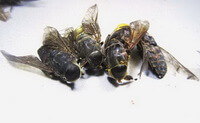
Characteristics of the Herb: The dried insect body is oblong, measuring 1.5–2 cm in length and 5–10 mm in width. The head is dark brown, and the compound eyes are mostly absent. The thorax is dark brown; the dorsum is crustaceous and glossy, and the wings extend beyond the abdomen. The thorax is prominent and dark brown, bearing three pairs of legs—often broken. The abdomen is brownish-yellow and comprises six segments. The herb has a loose, crisp texture and breaks easily. It emits an unpleasant odor and tastes bitter and salty.
Pharmacological Actions: (1) anticoagulant effect and activation of the fibrinolytic system; (2) stimulation of isolated rabbit uterine tissue in vitro; (3) inhibition of endotoxin-induced hepatic hemorrhagic necrosis.
Medicinal Efficacy: Promotes blood circulation to remove stasis, breaks up stagnant blood, and restores menstrual flow. It is indicated for abdominal masses, accumulations, blood retention in the lower abdomen, amenorrhea due to blood stasis, postpartum lochiometra, “dry-blood” tuberculosis (a TCM syndrome), traumatic blood stasis, wounds and injuries, carbuncles and swellings, and pharyngitis (“throat obstruction”).
Administration of Tabanus (Ménɡ Chónɡ):
Reference:
Administration Guide of Tabanus (Ménɡ Chónɡ)
TCM Books:
(1) Internally: water decoction, 0.5–1 qian (≈1.5–3 grams); or finely powdered herb, 1–2 fen (≈0.3–0.6 grams) per dose; also prepared as pills or powders. (2) Internally: water decoction, 1.5–3 grams; finely powdered herb, 0.3–0.6 grams; or prepared as pills or powders. External use: apply an appropriate amount of finely powdered herb as a paste or mix and smear onto affected areas.
Contraindications, Precautions, and Adverse Reactions: Tabanus is contraindicated during pregnancy, menstruation, syndromes without blood stasis, and Qi- and Blood-deficiency patterns. Its use during pregnancy may induce abortion.
(2) Tabanus chrysurus Loew.
Description: The insect is commonly known as Lù Méng.
(3) Tabanus mandarinus Schiner.
Description: The insect is commonly known as Huá Méng. It is slightly larger, measuring approximately 1–3 cm in length; it is stout and hairy. Its head is broad, eyes are large, the piercing mouthparts are short, and the antennae consist of only three segments. Larvae inhabit bogs and are carnivorous. The female feeds on the blood of humans and livestock. Humans (Homo sapiens) are readily bitten by this species.
The female is 16–18 mm long and grayish-black. The forehead is yellowish-gray; the basal scutellum is nearly ovoid and yellowish-brown. The base of the first antennal segment is reddish-brown and bears sharp dorsal protrusions. Wings are transparent, with brown veins. The mesonotal scutum is gray, bearing five distinct longitudinal bands of blackish-gray (charcoal-gray). The abdomen is rounded and obtuse, with a conspicuous white spot. Males resemble females in general morphology but are slightly larger and possess a conical abdomen.
Characteristics of the Herb: The dried insect body is oblong, 1.3–1.7 cm long and 5–10 mm wide. The head is dark brown; most compound eyes are absent. The thorax is dark brown; the dorsum is shell-like and glossy. Wings extend beyond the abdomen. The ventral portion of the thorax is prominent and grayish, bearing five distinct blackish-gray longitudinal bands. It has three pairs of legs—often broken. The abdomen is brownish-yellow, with conspicuous white spots and six segments. The herb has a loose, crisp texture. It emits a foul odor and tastes bitter and salty.
(4) Atylotus bivittateinus Takahasi.
Description: The insect is commonly known as Suāng Bān Huáng Méng. The female is 13–17 mm long and yellowish-green. Eyes are large, with a narrow black transverse band across the middle. The forehead is yellow or grayish. Antennae are orange-yellow, with conspicuous blunt dorsal protrusions on the third segment. Wings are transparent, with yellow veins. The abdomen is dark yellowish-gray, bearing numerous golden hairs and a few black hairs. Large yellow spots occur bilaterally on the tergites; the abdominal sides are grayish. Males resemble females in shape but are smaller.
Life Habits: Adults are primarily diurnal and prefer strong sunlight. Females feed on the blood of livestock.
Characteristics of the Herb: The dried insect is yellowish-green, with large eyes and a thin horizontal black band across the center; wings are transparent with yellow veins; the abdomen is dark grayish-yellow, bearing numerous golden hairs and a few black hairs.

 ✵The article records the herb Gadfly—its English name, Latin name, Pinyin name, properties and flavors, and its insect sources as defined in classical herbal works. The official sources are two insect species: (1) Tabanus bivittatus Matsumura and (2) Tabanus chrysurus Loew. Two additional species are also used: (3) Tabanus mandarinus Schiner and (4) Atylotus bivittatus Takahasi. The article provides a detailed introduction to the morphological features, life habits, growth characteristics, and ecological environments of these four species; the macroscopic characteristics of the herb Gadfly; its pharmacological actions; medicinal efficacy; and administration guidelines.
 Pinyin Name: Ménɡ Chónɡ
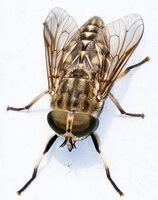 Description: The insect is commonly known as Fù Dài Méng or Niú Méng Chóng. The female gadfly has a body length of 13–17 mm and is yellowish-green. Compound eyes are large, hairless, and bear a narrow black band in the middle. The forehead is yellowish or slightly grayish; the vertex is covered with short hairs. Antennae are yellow; the third segment is hypertrophied, with blunt dorsal protrusions at the base. The base of the labium and the cheeks are yellowish-gray. The second segment of the maxillary palp is pale yellow, covered with white hairs and interspersed with short black hairs. The mesothorax consists of a scutum and lateral plates; the reticulate structure is grayish-yellow, bearing yellow short hairs and mixed black and yellowish-gray long hairs. Wings are transparent and unspotted, with a yellow haltere. There are three pairs of legs: the middle and posterior femora are gray on the basal one-third; the tarsi of the forelegs and the apical portion of the fore tibiae are black; the apices of the middle and posterior tarsi are dark brown. The abdomen is dark yellowish-gray; the first to third (or first to fourth) ventral segments bear large yellow spots on both sides of the sternites, with a dark yellow longitudinal stripe centrally located—its width is approximately one-quarter to one-third of the abdominal width. The abdomen is densely covered with yellow or yellowish-gray short hairs, occasionally interspersed with black short hairs. The ventral surface is grayish, with yellow coloration on both sides of the first and second (or first to third) sternites. Male gadflies resemble females in shape but are smaller, and their compound eyes are covered with fine grayish hairs.
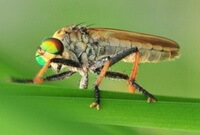 Female gadflies feed on the blood of cattle, horses, donkeys, and other livestock; males do not suck blood but feed only on plant sap.
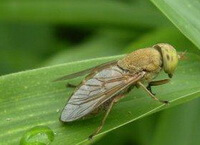 Ecological Environment: This insect typically inhabits grasslands and woodlands. It prefers sunny conditions and is diurnal. It is distributed mainly in rural areas and is primarily found in China.
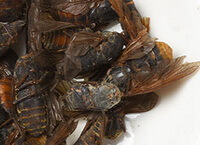 Characteristics of the Herb: The dried insect body is oblong, measuring 1.5–2 cm in length and 5–10 mm in width. The head is dark brown, and the compound eyes are mostly absent. The thorax is dark brown; the dorsum is crustaceous and glossy, and the wings extend beyond the abdomen. The thorax is prominent and dark brown, bearing three pairs of legs—often broken. The abdomen is brownish-yellow and comprises six segments. The herb has a loose, crisp texture and breaks easily. It emits an unpleasant odor and tastes bitter and salty.
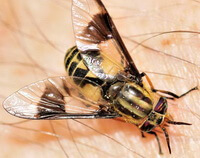 Description: The insect is commonly known as Lù Méng.
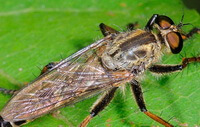 Description: The insect is commonly known as Huá Méng. It is slightly larger, measuring approximately 1–3 cm in length; it is stout and hairy. Its head is broad, eyes are large, the piercing mouthparts are short, and the antennae consist of only three segments. Larvae inhabit bogs and are carnivorous. The female feeds on the blood of humans and livestock. Humans (Homo sapiens) are readily bitten by this species.
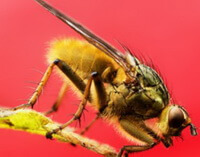 The female is 16–18 mm long and grayish-black. The forehead is yellowish-gray; the basal scutellum is nearly ovoid and yellowish-brown. The base of the first antennal segment is reddish-brown and bears sharp dorsal protrusions. Wings are transparent, with brown veins. The mesonotal scutum is gray, bearing five distinct longitudinal bands of blackish-gray (charcoal-gray). The abdomen is rounded and obtuse, with a conspicuous white spot. Males resemble females in general morphology but are slightly larger and possess a conical abdomen.
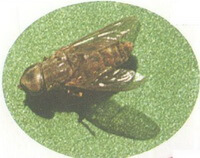 Description: The insect is commonly known as Suāng Bān Huáng Méng. The female is 13–17 mm long and yellowish-green. Eyes are large, with a narrow black transverse band across the middle. The forehead is yellow or grayish. Antennae are orange-yellow, with conspicuous blunt dorsal protrusions on the third segment. Wings are transparent, with yellow veins. The abdomen is dark yellowish-gray, bearing numerous golden hairs and a few black hairs. Large yellow spots occur bilaterally on the tergites; the abdominal sides are grayish. Males resemble females in shape but are smaller.
