✵The article records the herb Common Burreed Tuber—its English name, Latin name, Pinyin name, properties and flavors, and its botanical sources as defined in classical herbal works. The official source is one plant species: (1) Sparganium stoloniferum Buch.-Ham. Two additional species are also used: (2) Sparganium stenophyllum Maxim. and (3) Sparganium simplex Huds. The article provides a detailed introduction to the botanical features, growth characteristics, and ecological environments of these three species, as well as the macroscopic and microscopic characteristics of the herb Common Burreed Tuber, its pharmacological actions, medicinal efficacy, and administration guidelines.
Rhizoma Sparganii (Common Burreed Tuber)
Pinyin Name: Sān Léng
English Name: Common Burreed Tuber
Latin Name:Rhizoma Sparganii Properties and Flavor: Neutral; pungent and bitter
Brief Introduction:Rhizoma Sparganii is the peeled and dried tuber of Sparganium stoloniferum Buch.-Ham. It is used to break blood stasis and dissipate masses, primarily for treating dysmenorrhea, amenorrhea, and abdominal masses. It is commonly known as Rhizoma Sparganii, Common Burreed Tuber, or Sān Léng.
Botanical Source: Official herbal classics define Rhizoma Sparganii (Common Burreed Tuber) as the peeled and dried tuber of (1) Sparganium stoloniferum Buch.-Ham. Other authoritative herbal classics include two additional acceptable species: (2) Sparganium stenophyllum Maxim. and (3) Sparganium simplex Huds. All three belong to the genus Sparganium L., family Sparganiaceae, order Typhales. The following describes the official source and the two supplementary species:
(1) Sparganium stoloniferum Buch.-Ham.
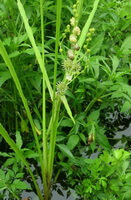
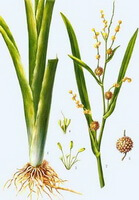
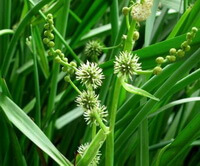
Botanical Description:Sparganium stoloniferum Buch.-Ham. is commonly known as Hēi Sān Léng. It is a perennial herb reaching 50–100 cm in height. Rhizomes are amphitropous; thick, short stem tubers develop beneath the rhizome. The stem is erect, cylindrical, and smooth. Leaves are caespitose (tufted), arranged in two rows; leaf blades are linear, 60–95 cm long and approximately 2 cm wide, with an acuminate apex and an amplexicaul (stem-clasping) base, bearing a single longitudinal ridge on the abaxial surface.
Scapes (flower stalks) arise from leaf clusters; they are simple but occasionally branched. Flowers are unisexual and monoecious, aggregated into capitula (flower heads) subtended by phyllaries (leafy bracts). Male inflorescences occur above the female ones, measuring ~10 mm in diameter and usually numbering 2–10; female inflorescences are ≥12 mm in diameter and typically number 1–3. Each male flower has 3–4 oblanceolate tepals (perianth lobes) and 3 stamens; each female flower has 1 (rarely 2) pistil(s), with a fusiform (spindle-shaped) ovary, a long style, and a narrow-lanceolate stigma.
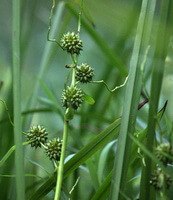
The syncarp (collective fruit) is ~2 cm in diameter; individual drupes are obovate-conical, 6–10 mm long and 4–5 mm in diameter, with a pointed apex and persistent perianth. Flowering occurs from June to July; fruiting from July to August.
Ecological Environment: This species grows in ponds, marshes, ditches, and other wetland habitats.
Growth Characteristics:Sparganium stoloniferum prefers a warm, moist climate. Soil requirements are not strict.
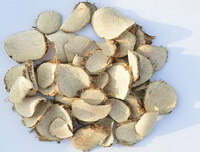
Characters of the Herb: The tuber is conical or obovate, slightly flattened, rounded at the apex and tapering to a point at the base, with slight curvature at the lower end; length ranges from 2–6 cm (sometimes up to 10 cm), and diameter from 2–4 cm. The surface is yellowish-white or sallow (grayish-yellow), bearing shaving marks and stem scars at the apex. Fibrous root scars are punctate and arranged in a transverse, circular pattern; bilateral fibrous root scars are thicker. The herb is heavy, with a dense, firm, and hard texture—difficult to break and sinking in water. The fracture surface is sallow (grayish-yellow) or light brown, relatively flat, with numerous scattered dots and transversely striated bands. It has a faint odor, a slightly bitter and astringent taste, and mild pungency.
Pharmacological Actions: (1) Effects on the small intestine and uterus; (2) Effects on the blood, etc.
Medicinal Efficacy: Breaks blood stasis, regulates Qi circulation, resolves Qi stagnation or food retention, and relieves pain. It is indicated for abdominal masses, abdominal lumps, Qi and blood stagnation, epigastric and abdominal pain, chest obstruction and cardiac pain (e.g., chest tightness, heartache), costal distension and pain, dysmenorrhea (abdominal pain during menstruation), amenorrhea—especially due to blood stasis—postpartum abdominal pain caused by blood stasis, distension and pain from indigestion, traumatic injuries, and swollen sores.
Administration of Rhizoma Sparganii (Sān Léng):
Reference:
Administration Guide for Rhizoma Sparganii (Sān Léng)
TCM Books:
(1) Internally: 5–10 grams; (2) Internally: water decoction, 1.5–3 qián (≈4.5–9 grams), or prepared as pills or powder; (3) Internally: water decoction, 5–10 grams, or prepared as pills or powder.
Contraindications, Precautions, and Adverse Reactions: Rhizoma Sparganii is contraindicated during pregnancy. It should also be avoided in cases of amenorrhea due to blood deficiency, Qi deficiency, or general physical debility. It must not be combined with Natrii Sulfas or Natrii Sulfas Exsiccatus.
(2) Sparganium stenophyllum Maxim.
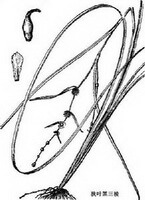
Botanical Description:Sparganium stenophyllum Maxim. (syn. Sparganium stenophyllum Maxim. ex Meinsh.) is commonly known as Xì Yè Hēi Sān Léng or Xiá Yè Hēi Sān Léng. Distinguishing features compared with S. stoloniferum include a smaller, lower-growing habit; shorter rhizomes; and smaller tubers. The stem is erect and slender. Leaf blades are narrowly linear, up to 65 cm long and 2.5–4 mm wide, with a conspicuous midrib. There are 1–2 (rarely 3) sessile, globose female inflorescences, ~8 mm in diameter; female flowers are densely packed; tepals are membranous, obovate or narrowly obovate (1.5–2.5 mm long); the pistil is ~3.5 mm long, with a narrowly elongated ovary that tapers apically into the style; the stigma is narrow-oblong. Male inflorescences usually number ~7, grow at the stem apex or on branches; male flowers are densely arranged, each with 3 membranous, narrowly spatulate or spatulate-linear tepals (1.5–2 mm long) and 3 stamens (filaments long, 2–3 mm).
Ecological Environment: This species grows in swamps.
Characteristics of the Herb: The tuber resembles that of Sparganium stoloniferum but is smaller.
(3) Sparganium simplex Huds.
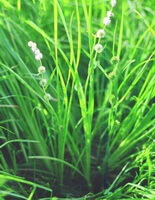
Botanical Description:Sparganium simplex Huds. is commonly known as Xiǎo Hēi Sān Léng or Dān Zhī Hēi Sān Léng. Distinguishing features compared with the preceding two species include an unbranched stem, absence of rhizomes in most individuals, and smaller tubers. Leaf blades are narrowly linear, up to 60 cm long and 5–8 mm wide, with a conspicuous midvein. Female inflorescences number 2–4 (occasionally 6); the lowest 1–2 are pedunculate; all are globose (~8 mm in diameter). Female flowers are dense; tepals are 3–4, narrowly spatulate and irregularly denticulate; the pistil is fusiform (~5 mm long); the style is ~2 mm long; the stigma is subulate. Male inflorescences number 5–7; male flowers are densely arranged; tepals are membranous and nearly linear (~3 mm long); individual male flowers reach up to 5 mm in length. The syncarp (collective fruit) is ~1.5 cm in diameter; individual fruits are fusiform, attenuate at the apex, and bear persistent tepals.
Ecological Environment: This species grows in ponds, marshes, and ditches.
Characteristics of the Herb: The tuber resembles that of Sparganium stoloniferum but is smaller.

 ✵The article records the herb Common Burreed Tuber—its English name, Latin name, Pinyin name, properties and flavors, and its botanical sources as defined in classical herbal works. The official source is one plant species: (1) Sparganium stoloniferum Buch.-Ham. Two additional species are also used: (2) Sparganium stenophyllum Maxim. and (3) Sparganium simplex Huds. The article provides a detailed introduction to the botanical features, growth characteristics, and ecological environments of these three species, as well as the macroscopic and microscopic characteristics of the herb Common Burreed Tuber, its pharmacological actions, medicinal efficacy, and administration guidelines.
 Pinyin Name: Sān Léng
 Botanical Description: Sparganium stoloniferum Buch.-Ham. is commonly known as Hēi Sān Léng. It is a perennial herb reaching 50–100 cm in height. Rhizomes are amphitropous; thick, short stem tubers develop beneath the rhizome. The stem is erect, cylindrical, and smooth. Leaves are caespitose (tufted), arranged in two rows; leaf blades are linear, 60–95 cm long and approximately 2 cm wide, with an acuminate apex and an amplexicaul (stem-clasping) base, bearing a single longitudinal ridge on the abaxial surface.
 The syncarp (collective fruit) is ~2 cm in diameter; individual drupes are obovate-conical, 6–10 mm long and 4–5 mm in diameter, with a pointed apex and persistent perianth. Flowering occurs from June to July; fruiting from July to August.
 Growth Characteristics: Sparganium stoloniferum prefers a warm, moist climate. Soil requirements are not strict.
 Pharmacological Actions: (1) Effects on the small intestine and uterus; (2) Effects on the blood, etc.
 Botanical Description: Sparganium stenophyllum Maxim. (syn. Sparganium stenophyllum Maxim. ex Meinsh.) is commonly known as Xì Yè Hēi Sān Léng or Xiá Yè Hēi Sān Léng. Distinguishing features compared with S. stoloniferum include a smaller, lower-growing habit; shorter rhizomes; and smaller tubers. The stem is erect and slender. Leaf blades are narrowly linear, up to 65 cm long and 2.5–4 mm wide, with a conspicuous midrib. There are 1–2 (rarely 3) sessile, globose female inflorescences, ~8 mm in diameter; female flowers are densely packed; tepals are membranous, obovate or narrowly obovate (1.5–2.5 mm long); the pistil is ~3.5 mm long, with a narrowly elongated ovary that tapers apically into the style; the stigma is narrow-oblong. Male inflorescences usually number ~7, grow at the stem apex or on branches; male flowers are densely arranged, each with 3 membranous, narrowly spatulate or spatulate-linear tepals (1.5–2 mm long) and 3 stamens (filaments long, 2–3 mm).
 Botanical Description: Sparganium simplex Huds. is commonly known as Xiǎo Hēi Sān Léng or Dān Zhī Hēi Sān Léng. Distinguishing features compared with the preceding two species include an unbranched stem, absence of rhizomes in most individuals, and smaller tubers. Leaf blades are narrowly linear, up to 60 cm long and 5–8 mm wide, with a conspicuous midvein. Female inflorescences number 2–4 (occasionally 6); the lowest 1–2 are pedunculate; all are globose (~8 mm in diameter). Female flowers are dense; tepals are 3–4, narrowly spatulate and irregularly denticulate; the pistil is fusiform (~5 mm long); the style is ~2 mm long; the stigma is subulate. Male inflorescences number 5–7; male flowers are densely arranged; tepals are membranous and nearly linear (~3 mm long); individual male flowers reach up to 5 mm in length. The syncarp (collective fruit) is ~1.5 cm in diameter; individual fruits are fusiform, attenuate at the apex, and bear persistent tepals.
