Introduction of Zào Jiǎo Cì: Chinese Honeylocust Spine
✵This article documents the herb Chinese Honeylocust Spine, including its English name, Latin name, Pinyin name, properties and flavor, botanical source—namely, (1) Gleditsia sinensis Lam.—and provides a detailed description of the plant’s morphology, growth characteristics, ecological environment, herbal features, pharmacological actions, medicinal efficacy, and administration guidelines.
Spina Gleditsiae (Chinese Honeylocust Spine)
Pinyin Name: Zào Jiǎo Cì
English Name: Chinese Honeylocust Spine
Latin Name:Spina Gleditsiae Properties and Flavor: Warm; pungent
Brief Introduction:Spina Gleditsiae is the dried spine of Gleditsia sinensis Lam. It is used (1) to reduce swelling and promote abscess rupture in acute suppurative inflammation, and (2) as an antipruritic for skin disorders. It is commonly known as Spina Gleditsiae, Chinese Honeylocust Spine, or Zào Jiǎo Cì.
Botanical Source: Classical herbal works define Spina Gleditsiae (Chinese Honeylocust Spine) as the dried spines of (1) Gleditsia sinensis Lam., a species belonging to the genus Gleditsia L., family Fabaceae (Leguminosae, or the legume/pea family), order Rosales. This widely used species is described below:
(1) Gleditsia sinensis Lam.
Botanical Description:Gleditsia sinensis Lam. is commonly known as Zào Jiāo. It is a deciduous tree or small tree, reaching up to 15 meters in height. Branches are gray to dark brown. Spines are stout, cylindrical, often branched, and conical or cylindrical in shape, up to 16 cm long. Branchlets are glabrous. Leaves are imparipinnate (not paripinnate), 10–18 cm long—or up to 26 cm long—with 3–7 pairs of leaflets (6–14 leaflets total). Leaflets are chartaceous (papery), ovate-oblong to ovate-lanceolate, 3–8 cm long and 1.5–3.5 cm wide; apices are blunt or acuminate; bases are rounded or cuneate—sometimes slightly oblique (obliquely rounded or obliquely cuneate); margins are finely serrulate; surfaces are glabrous. The upper surface is sparsely pubescent; the midvein on the lower surface is slightly pubescent; reticulate veins are prominent and convex on both surfaces. Petioles are 1–2 mm—or up to 5 mm—long and pubescent.
Flowers are polygamous and arranged in axillary racemes; corolla colors range from yellow to white. Inflorescences are axillary or terminal, 5–14 cm long, and pubescent. The calyx is campanulate (bell-shaped) with four lanceolate lobes. There are four white petals; six to eight stamens; and a linear, pilose ovary aligned along the suture. Male flowers: 9–10 mm in diameter; pedicels are 2–8 mm (up to 10 mm); receptacle is 2.5–3 mm long, dark brown, and externally pilose; four triangular-lanceolate sepals, 3 mm long, pubescent on both surfaces; four oblong petals, 4–5 mm long, puberulent; eight stamens; pistillode is 2.5 mm long. Hermaphroditic flowers: 10–12 mm in diameter; pedicels are 2–5 mm long; calyx and petals resemble those of male flowers, except sepals and petals measure 5–6 mm; eight stamens; ovary is sutured, with pilose base (in some specimens from Hubei, the entire ovary may be pilose); stigma is shallowly bilobed; numerous ovules.
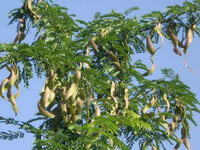
Fruits are linear, non-torsional pods, 12–30 cm long and 2–4 cm wide—straight or slightly twisted. The mesocarp is moderately thick and swollen on both sides. Some pods are shorter and more or less cylindrical, 12–30 cm long and 2–4 cm wide, curved into a crescent shape—commonly termed “pig-tooth soap”—and are typically seedless. Fruit stalks (stipes) measure 1–3.5 cm in length. Fruit valves are coriaceous, brown or reddish-brown, often bearing a whitish or pinkish bloom. Seeds are numerous, oblong to elliptic, 11–13 mm long and 8–9 mm wide, brown and glossy. Flowering occurs from March to May; fruiting extends from May to October—or occasionally to December.
Ecological Environment: The plant is shade-tolerant (photophobic) and prefers partial shade. It grows on hillsides, in valley forests, along roadsides, on plains, and at elevations up to 2,500 meters above sea level. It is frequently found in courtyards or near human dwellings.
Growth Characteristics:Gleditsia sinensis Lam. thrives in warm, sunny habitats. Soil requirements are not strict.
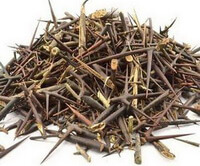
Characteristics of the Herb: The whole thorn is composed of the main spine and 1–2 branches; the main spine is long conical or oblate, measuring 3–15 cm (sometimes up to 18 cm) in length and 0.3–1 cm in diameter, with a base thickness of 8–12 mm and a sharply pointed tip. Branch spines are spirally arranged, forming an angle of 60–80 degrees with the main spine and extending outward circumferentially; their tips are sharp and they are generally 1–7 cm long. Smaller spines often occur on secondary branches, and the inner side of the base of branch spines commonly exhibits a small mound-like bulge. The herb is purple-brown or brown, with a smooth or finely wrinkled surface. It is lightweight, firm, and hard in texture, not easily broken. Commercial specimens are cut into oblique thin slices, usually lanceolate in shape, 2–6 cm long, 3–7 mm wide, and 1–3 mm thick. They typically possess a tapering thorn tip; the xylem of the cross-section is yellow-white, while the central pith is loose and soft, appearing light reddish or reddish-brown. The texture is crisp and breaks easily; it has a faint odor or is nearly odorless, and a mild or tasteless flavor.
Pharmacological Actions: (1) Anticancer effect; (2) Bacteriostatic activity: The aqueous decoction inhibits Staphylococcus aureus and Moraxella catarrhalis.
Medicinal Efficacy: Reduces swelling and drains toxins; dispels wind; draws out toxins; eliminates pathogenic factors; promotes abscess formation and pus discharge; kills parasites. It is indicated for early-stage ulcers or abscesses that fail to rupture, swollen carbuncles, warts, ulcers, scrofula (lymph node tuberculosis), non-healing sores, stubborn dermatitis, tinea infections, postpartum hypogalactia, and retained placenta. Externally, it is used for scabies and leprosy.
Administration of Spina Gleditsiae (Zào Jiǎo Cì):
Reference:
Administration Guide for Spina Gleditsiae (Zào Jiǎo Cì)
TCM Books:
(1) Internally: 3–9 grams; topical: appropriate amount—steam with vinegar and apply the liquid to the affected area. (2) Internally: decocted in water, 1–3 qian (≈3–9grams), or prepared as pills or powder; topical: decoct with vinegar and apply the liquid, or grind the herb into powder and sprinkle or mix for topical application. (3) Internally: decocted in water, 3–9 grams, or prepared as pills or powder; topical: appropriate amount—decoct with vinegar and apply the liquid, grind into powder and sprinkle, or mix and apply as a paste.
Contraindications, Precautions, and Adverse Reactions: Spina Gleditsiae should be avoided during pregnancy.
References:
1.Introduction of Zào Jiǎo Cì: Chinese Honeylocust Spine

 ✵This article documents the herb Chinese Honeylocust Spine, including its English name, Latin name, Pinyin name, properties and flavor, botanical source—namely, (1) Gleditsia sinensis Lam.—and provides a detailed description of the plant’s morphology, growth characteristics, ecological environment, herbal features, pharmacological actions, medicinal efficacy, and administration guidelines.
 Pinyin Name: Zào Jiǎo Cì
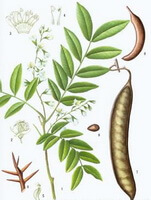 Botanical Description: Gleditsia sinensis Lam. is commonly known as Zào Jiāo. It is a deciduous tree or small tree, reaching up to 15 meters in height. Branches are gray to dark brown. Spines are stout, cylindrical, often branched, and conical or cylindrical in shape, up to 16 cm long. Branchlets are glabrous. Leaves are imparipinnate (not paripinnate), 10–18 cm long—or up to 26 cm long—with 3–7 pairs of leaflets (6–14 leaflets total). Leaflets are chartaceous (papery), ovate-oblong to ovate-lanceolate, 3–8 cm long and 1.5–3.5 cm wide; apices are blunt or acuminate; bases are rounded or cuneate—sometimes slightly oblique (obliquely rounded or obliquely cuneate); margins are finely serrulate; surfaces are glabrous. The upper surface is sparsely pubescent; the midvein on the lower surface is slightly pubescent; reticulate veins are prominent and convex on both surfaces. Petioles are 1–2 mm—or up to 5 mm—long and pubescent.
 Flowers are polygamous and arranged in axillary racemes; corolla colors range from yellow to white. Inflorescences are axillary or terminal, 5–14 cm long, and pubescent. The calyx is campanulate (bell-shaped) with four lanceolate lobes. There are four white petals; six to eight stamens; and a linear, pilose ovary aligned along the suture. Male flowers: 9–10 mm in diameter; pedicels are 2–8 mm (up to 10 mm); receptacle is 2.5–3 mm long, dark brown, and externally pilose; four triangular-lanceolate sepals, 3 mm long, pubescent on both surfaces; four oblong petals, 4–5 mm long, puberulent; eight stamens; pistillode is 2.5 mm long. Hermaphroditic flowers: 10–12 mm in diameter; pedicels are 2–5 mm long; calyx and petals resemble those of male flowers, except sepals and petals measure 5–6 mm; eight stamens; ovary is sutured, with pilose base (in some specimens from Hubei, the entire ovary may be pilose); stigma is shallowly bilobed; numerous ovules.
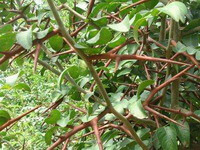 Ecological Environment: The plant is shade-tolerant (photophobic) and prefers partial shade. It grows on hillsides, in valley forests, along roadsides, on plains, and at elevations up to 2,500 meters above sea level. It is frequently found in courtyards or near human dwellings.
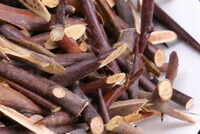 Characteristics of the Herb: The whole thorn is composed of the main spine and 1–2 branches; the main spine is long conical or oblate, measuring 3–15 cm (sometimes up to 18 cm) in length and 0.3–1 cm in diameter, with a base thickness of 8–12 mm and a sharply pointed tip. Branch spines are spirally arranged, forming an angle of 60–80 degrees with the main spine and extending outward circumferentially; their tips are sharp and they are generally 1–7 cm long. Smaller spines often occur on secondary branches, and the inner side of the base of branch spines commonly exhibits a small mound-like bulge. The herb is purple-brown or brown, with a smooth or finely wrinkled surface. It is lightweight, firm, and hard in texture, not easily broken. Commercial specimens are cut into oblique thin slices, usually lanceolate in shape, 2–6 cm long, 3–7 mm wide, and 1–3 mm thick. They typically possess a tapering thorn tip; the xylem of the cross-section is yellow-white, while the central pith is loose and soft, appearing light reddish or reddish-brown. The texture is crisp and breaks easily; it has a faint odor or is nearly odorless, and a mild or tasteless flavor.
