✵The article records the herb Crocus sativus (commonly known as saffron), including its English name, Latin name, Pinyin name, properties and flavor, botanical source—namely, the dried stigmas of a single plant species, (1) Crocus sativus L.—and provides a detailed introduction to the botanical features, growth characteristics, and ecological environment of this species, as well as the morphological features of the herb Crocus sativus, its pharmacological actions, medicinal efficacy, and administration guidelines.
Stigma Croci (Crocus sativus, Saffron)
Pinyin Name: Xī Hóng Huā or Fān Hóng Huā
English Name: Crocus sativus, Saffron
Latin Name:Stigma Croci Properties and Flavor: Neutral in nature; sweet
Brief Introduction:Stigma Croci is the dried stigma of Crocus sativus L., used similarly to Flos Carthami. It is commonly known as Stigma Croci, Crocus sativus, Saffron, Xī Hóng Huā, or Fān Hóng Huā.
Botanical Source: Traditional herbal classics define Stigma Croci (Crocus sativus, Saffron) as the dried stigmas of Crocus sativus L., a perennial herb belonging to the genus Crocus, family Iridaceae (iris family), order Asparagales (formerly classified under Liliflorae, now obsolete). This widely used species is described below:
(1) Crocus sativus L.
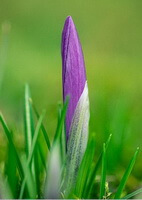
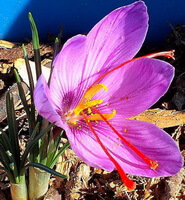
Botanical Description:Crocus sativus L. is commonly known as Fān Hóng Huā, Xī Hóng Huā, or Zàng Hóng Huā. It is a perennial herb with an oblate corm approximately 3 cm in diameter, enveloped by a yellowish-brown membranous tunic. Basal leaves number 9–15, are linear, sage-green (celadon), 15–20 cm long and 2–3 mm wide, with reflexed margins; the leaf tuft base is sheathed by 4–5 membranous, scale-like leaves.
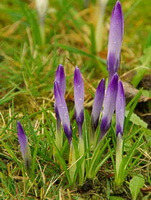
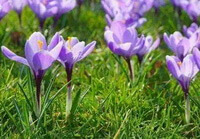
Flower stalks (scapes) are very short and do not emerge above ground; each plant bears 1–2 flowers, pale blue, reddish-violet, or white, fragrant, 2.5–3 cm in diameter. The perianth consists of 6 tepals arranged in two whorls; inner and outer tepals are obovate with obtuse apices, 4–5 cm long. There are 3 upright stamens, 2.5 cm long, with yellow anthers that are pointed and slightly curved. The style is salmon-colored (orange-red), ~4 cm long, trifurcated in the upper part; the branches are curved and pendulous; the stigmas are slightly flattened, wedge-shaped at the apex, shallowly serrated, and longer than the stamens. The ovary is narrowly fusiform.
The capsule fruit is elliptic, ~3 cm long and ~1.5 cm wide, bearing three blunt ridges. Seeds are numerous and globose. Flowering occurs from October to November.
Ecological Environment:Crocus sativus is native to the Mediterranean region. It was introduced into China during the Ming dynasty (1368–1644) and first documented as a medicinal herb in the Compendium of Materia Medica (1552–1578). It appeared in an English medical works as early as the 10th century but disappeared from Western Europe until reintroduced by the Crusaders. Today, major production areas include the Apennine Mountains and Sicily (Italy), France, China, Iran.
Growth Characteristics:Crocus sativus prefers a warm, moist climate; it is heat-sensitive but cold-tolerant.
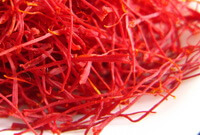
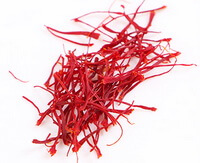
Characteristics of the Herb: The complete stigma is linear, broad and enlarged at the apex, tapering to a tail-like base; the apical margin is irregularly serrated, and the lower end bears a residual yellow style. It measures approximately 2.5 cm in length and 1.5 mm in diameter. Color is violet-red or reddish dark brown, with a slightly glossy surface. The herb is lightweight; its texture is soft, pliable, and crisp when dried—easily fractured. When placed in water, the stigma swells; orange-yellow pigment exudes linearly from the apex and gradually diffuses, dyeing the water yellow without sedimentation; the stigma assumes a trumpet-like shape with short radial fissures. It has a distinctive odor and tastes slightly pungent and bitter.
Pharmacological Actions: (1) Anticoagulant effect; (2) Uterotonic effect; (3) Hypotensive and respiratory stimulant effects; (4) Therapeutic effect in experimental glomerulonephritis; (5) Antitumor activity, among others.
Medicinal efficacy: Promotes blood circulation and resolves blood stasis; cools the blood and detoxifies; disperses stagnation and alleviates stasis-related pain; calms the mind and relieves constraint. Indications include amenorrhea, abdominal masses, dysmenorrhea (pain during menstruation), irregular menstruation, postpartum blood stasis obstruction, prolonged lochiorrhea, mass-associated abdominal pain, febrile toxic maculae, epidemic maculae, measles, depression with chest tightness and oppression, palpitations or anxiety due to fright, delirium secondary to fright, and traumatic injury.
Administration of Stigma Croci (Xī Hónɡ Huā):
Reference:
Administration Guide of Stigma Croci (Xī Hónɡ Huā)
TCM Books:
(1) Internally: 1–3 grams, as a water decoction or steeped in boiling water and consumed; (2) Internally: water decoction, 1–3 grams, infusion in hot water, or maceration in wine followed by gentle heating.
Contraindications, Precautions, and Adverse Reactions: Stigma Croci should be used with caution during pregnancy.

 ✵The article records the herb Crocus sativus (commonly known as saffron), including its English name, Latin name, Pinyin name, properties and flavor, botanical source—namely, the dried stigmas of a single plant species, (1) Crocus sativus L.—and provides a detailed introduction to the botanical features, growth characteristics, and ecological environment of this species, as well as the morphological features of the herb Crocus sativus, its pharmacological actions, medicinal efficacy, and administration guidelines.
 Pinyin Name: Xī Hóng Huā or Fān Hóng Huā
 Botanical Description: Crocus sativus L. is commonly known as Fān Hóng Huā, Xī Hóng Huā, or Zàng Hóng Huā. It is a perennial herb with an oblate corm approximately 3 cm in diameter, enveloped by a yellowish-brown membranous tunic. Basal leaves number 9–15, are linear, sage-green (celadon), 15–20 cm long and 2–3 mm wide, with reflexed margins; the leaf tuft base is sheathed by 4–5 membranous, scale-like leaves.
 Flower stalks (scapes) are very short and do not emerge above ground; each plant bears 1–2 flowers, pale blue, reddish-violet, or white, fragrant, 2.5–3 cm in diameter. The perianth consists of 6 tepals arranged in two whorls; inner and outer tepals are obovate with obtuse apices, 4–5 cm long. There are 3 upright stamens, 2.5 cm long, with yellow anthers that are pointed and slightly curved. The style is salmon-colored (orange-red), ~4 cm long, trifurcated in the upper part; the branches are curved and pendulous; the stigmas are slightly flattened, wedge-shaped at the apex, shallowly serrated, and longer than the stamens. The ovary is narrowly fusiform.
 Ecological Environment: Crocus sativus is native to the Mediterranean region. It was introduced into China during the Ming dynasty (1368–1644) and first documented as a medicinal herb in the Compendium of Materia Medica (1552–1578). It appeared in an English medical works as early as the 10th century but disappeared from Western Europe until reintroduced by the Crusaders. Today, major production areas include the Apennine Mountains and Sicily (Italy), France, China, Iran.
 Growth Characteristics: Crocus sativus prefers a warm, moist climate; it is heat-sensitive but cold-tolerant.
 Pharmacological Actions: (1) Anticoagulant effect; (2) Uterotonic effect; (3) Hypotensive and respiratory stimulant effects; (4) Therapeutic effect in experimental glomerulonephritis; (5) Antitumor activity, among others.
