✵The article provides records of the herb Safflower, including its English name, Latin name, Pinyin name, properties and flavor, botanical source—namely one plant species, (1) Carthamus tinctorius L.—and a detailed introduction to the botanical features, growth characteristics, and ecological environment of this species, as well as the morphological characteristics of the herb Safflower, its pharmacological actions, medicinal efficacy, and administration guidelines.
Flos Carthami (Safflower)
Pinyin Name: Hóng Huā
English Name: Safflower
Latin Name:Flos Carthami Properties and Flavor: Warm; pungent
Brief Introduction:Flos Carthami is the dried flower of Carthamus tinctorius L., used to invigorate blood circulation, resolve blood stasis, and alleviate pain in the treatment of amenorrhea, chest pain, abdominal masses, and traumatic injuries. It is commonly known as Flos Carthami, Safflower, Hóng Huā, or Cǎo Hóng Huā.
Botanical Source: Common herbal classics and other authoritative materia medica works define Flos Carthami (Safflower) as the dried flower of (1) Carthamus tinctorius L. It is a member of the genus Carthamus, family Asteraceae (Compositae, daisy family), order Asterales. This widely used species is described below:
(1) Carthamus tinctorius L.
Botanical Description:Carthamus tinctorius L. is commonly known as Hóng Huā, Hóng Huā Cǎo (“red-flower grass”), or Hóng Huā Cài (“red-flower vegetable”). It is a thistle-like plant in the Asteraceae family (Compositae, daisy family), characterized by a strong, erect main stem, variable branching, and a deep taproot system. The taproot can penetrate to depths of 8–10 feet (2.4–3.05 m), provided subsoil temperature and moisture conditions are favorable. Consequently, safflower exhibits greater drought tolerance than small-grain cereals.
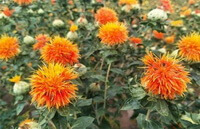
Carthamus tinctorius L. is a winter annual or facultative biennial herb, growing up to 50–100 cm tall. The stem is erect, branched in the upper part, white or whitish (pale), smooth, and glabrous. Leaves are alternate and sessile; cauline leaves in the middle and lower parts are lanceolate, ovate-lanceolate, or oblong-ovate, 7–15 cm long and 2.5–6 cm wide; margins are coarsely serrated, biserrate (double-serrate), serrulate, or occasionally entire—rarely pinnately lobed; apical teeth bear aciculae (stiff, needle-like tips) 1–1.5 mm long. Upper leaves are progressively smaller and lanceolate, with serrated margins and longer aciculae—up to 3 mm—on the tooth apices. All leaves are firm, coriaceous, glabrous on both surfaces, lack glandular dots, and are glossy.
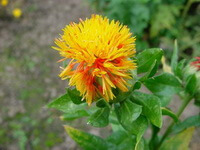
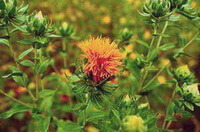
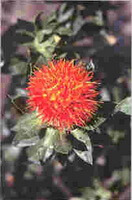
Numerous capitula (flower heads) are arranged in corymbs at the apices of branches and stems, each surrounded by an involucre composed of phyllaries (involucral bracts). Each branch typically bears 1–5 capitula, and each capitulum contains 15–20 achenes. Bracts are elliptic or ovate-lanceolate; their length—including the apical acicula—is 2.5–3 cm; aciculae may be present or absent along the margins. The general involucre is ovoid (egg-shaped), ~2.5 cm in diameter. Phyllaries are arranged in four series: the outermost series is harp-shaped, with the middle or lower portion constricted; upper portions are green and lack marginal aciculae—or bear pectinate (comb-like) aciculae—while the region below the constriction is yellowish-white; the middle and inner series are rigid, oblanceolate-elliptic to narrowly oblanceolate, up to 2.2 cm long, with acuminate apices. All phyllaries are glabrous and lack glandular dots. Florets are red or orange-red (narcissus-red), all hermaphroditic; the corolla is ~2.8 cm long, with a tube ~2 cm long and lobes extending nearly to the base of the limb.
Achenes are obovate, 5.5 mm long and 5 mm wide, cream-white, 4-ribbed, and lack a pappus. Its flowering and fruiting periods extend from May to August.
Ecological Environment:Carthamus tinctorius L. is widely cultivated in China.
Traditionally, the crop was grown for its flowers—used as natural colorants and flavorings in foods and for producing dyes, especially before the advent of cheaper synthetic aniline dyes—and in traditional herbal medicine.
Growth Characteristics: Carthamus tinctorius prefers a warm, dry climate and exhibits tolerance to cold, drought, salinity, alkalinity, and aridity.
Safflower has flowers that may be red, orange, yellow, or white. Flower color is typically yellow or orange, although some cultivars produce red or white flowers. The dried flowers were historically used to extract carthamin—a red textile dye of commercial importance—before being largely replaced by synthetic aniline dyes, except in localized regions of southwestern Asia.
The seed oil is the chief modern use of the plant. Seed oil content ranges from 30% to 45%. Safflower oil does not yellow with age, making it valuable in varnish and paint formulations. However, most of the oil is consumed as soft margarine, salad oil, and cooking oil. It is highly valued for dietary purposes due to its high proportion of polyunsaturated fatty acids. The meal (oilcake residue) is used as a protein supplement for livestock. Safflower is cultivated primarily in western China and has been introduced as an oil crop in the United States, Australia, Canada, and other countries.
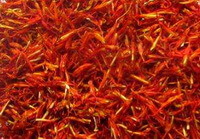
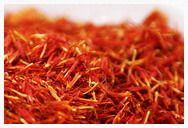
Characteristics of the Herb: The herb consists of discoid florets lacking an ovary, 1–2 cm long. The surface is reddish-yellow (“Titian”) or red. The corolla tube is slender and elongated; the apex is 5-lobed, with narrow, strap-shaped lobes 5–8 mm long. There are five stamens; the anthers are fused into a cylindrical tube and are yellowish-white. The stigma is long and cylindrical, slightly bifurcated at the apex. The texture is soft. The herb has a faint fragrance and tastes slightly bitter.
Pharmacological Actions: (1) Uterotonic effect; (2) Mild cardiotonic effect, increasing coronary and myocardial nutritional blood flow; (3) Inhibition of platelet aggregation; (4) Enhancement of fibrinolytic enzyme activity.
Medicinal Efficacy: Promotes blood circulation, regulates menstruation, resolves blood stasis, and alleviates pain. It is indicated for amenorrhea, dysmenorrhea (painful menstruation), dystocia, retained placenta or stillbirth, apoplexy, urinary bladder dysfunction, cardiodynia, hemiplegia following apoplexy, lochiostasis, postpartum lochiostasis, abdominal masses, fixed abdominal lumps, pain due to blood stasis, carbuncles and swellings, traumatic injuries, arthralgia, painful swellings and ulcers, and macular eruptions.
Administration of Flos Carthami (Hóng Huā):
Reference:
Administration Guide of Flos Carthami (Hóng Huā)
TCM Books:
(1) Internally: 3–9 grams; Internally: water decoction, 1–2 qián (≈ 3–6 grams); alternatively, prepared as a powder or wine infusion, or fresh herb juice extracted. External use: ground herb applied topically as a poultice or dusting powder. (2) Internally: water decoction, 3–10 grams—lower doses (e.g., 3–6 g) are preferred to nourish blood and harmonize circulation; higher doses (e.g., 6–9 g) are used to activate blood and resolve stasis.
Contraindications, Precautions, and Adverse Reactions: Flos Carthami is contraindicated during pregnancy and should be used with caution in women with excessive menstrual bleeding or bleeding disorders.

 ✵The article provides records of the herb Safflower, including its English name, Latin name, Pinyin name, properties and flavor, botanical source—namely one plant species, (1) Carthamus tinctorius L.—and a detailed introduction to the botanical features, growth characteristics, and ecological environment of this species, as well as the morphological characteristics of the herb Safflower, its pharmacological actions, medicinal efficacy, and administration guidelines.
 Pinyin Name: Hóng Huā
 Botanical Description: Carthamus tinctorius L. is commonly known as Hóng Huā, Hóng Huā Cǎo (“red-flower grass”), or Hóng Huā Cài (“red-flower vegetable”). It is a thistle-like plant in the Asteraceae family (Compositae, daisy family), characterized by a strong, erect main stem, variable branching, and a deep taproot system. The taproot can penetrate to depths of 8–10 feet (2.4–3.05 m), provided subsoil temperature and moisture conditions are favorable. Consequently, safflower exhibits greater drought tolerance than small-grain cereals.
 Carthamus tinctorius L. is a winter annual or facultative biennial herb, growing up to 50–100 cm tall. The stem is erect, branched in the upper part, white or whitish (pale), smooth, and glabrous. Leaves are alternate and sessile; cauline leaves in the middle and lower parts are lanceolate, ovate-lanceolate, or oblong-ovate, 7–15 cm long and 2.5–6 cm wide; margins are coarsely serrated, biserrate (double-serrate), serrulate, or occasionally entire—rarely pinnately lobed; apical teeth bear aciculae (stiff, needle-like tips) 1–1.5 mm long. Upper leaves are progressively smaller and lanceolate, with serrated margins and longer aciculae—up to 3 mm—on the tooth apices. All leaves are firm, coriaceous, glabrous on both surfaces, lack glandular dots, and are glossy.
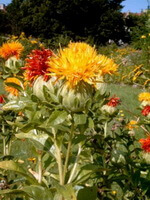 Numerous capitula (flower heads) are arranged in corymbs at the apices of branches and stems, each surrounded by an involucre composed of phyllaries (involucral bracts). Each branch typically bears 1–5 capitula, and each capitulum contains 15–20 achenes. Bracts are elliptic or ovate-lanceolate; their length—including the apical acicula—is 2.5–3 cm; aciculae may be present or absent along the margins. The general involucre is ovoid (egg-shaped), ~2.5 cm in diameter. Phyllaries are arranged in four series: the outermost series is harp-shaped, with the middle or lower portion constricted; upper portions are green and lack marginal aciculae—or bear pectinate (comb-like) aciculae—while the region below the constriction is yellowish-white; the middle and inner series are rigid, oblanceolate-elliptic to narrowly oblanceolate, up to 2.2 cm long, with acuminate apices. All phyllaries are glabrous and lack glandular dots. Florets are red or orange-red (narcissus-red), all hermaphroditic; the corolla is ~2.8 cm long, with a tube ~2 cm long and lobes extending nearly to the base of the limb.
 Achenes are obovate, 5.5 mm long and 5 mm wide, cream-white, 4-ribbed, and lack a pappus. Its flowering and fruiting periods extend from May to August.
 Growth Characteristics: Carthamus tinctorius prefers a warm, dry climate and exhibits tolerance to cold, drought, salinity, alkalinity, and aridity.
 The seed oil is the chief modern use of the plant. Seed oil content ranges from 30% to 45%. Safflower oil does not yellow with age, making it valuable in varnish and paint formulations. However, most of the oil is consumed as soft margarine, salad oil, and cooking oil. It is highly valued for dietary purposes due to its high proportion of polyunsaturated fatty acids. The meal (oilcake residue) is used as a protein supplement for livestock. Safflower is cultivated primarily in western China and has been introduced as an oil crop in the United States, Australia, Canada, and other countries.
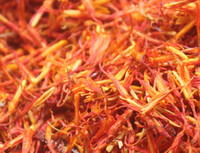 Characteristics of the Herb: The herb consists of discoid florets lacking an ovary, 1–2 cm long. The surface is reddish-yellow (“Titian”) or red. The corolla tube is slender and elongated; the apex is 5-lobed, with narrow, strap-shaped lobes 5–8 mm long. There are five stamens; the anthers are fused into a cylindrical tube and are yellowish-white. The stigma is long and cylindrical, slightly bifurcated at the apex. The texture is soft. The herb has a faint fragrance and tastes slightly bitter.
