Introduction of Niu Xi: Twoteethed Achyranthes Root
✵The article records the herb Twoteethed Achyranthes Root, including its English name, Latin name, Pinyin name, properties and flavor, and botanical source—the dried root of a single plant species, (1) Achyranthes bidentata Blume—along with a detailed description of the botanical features, growth characteristics, and ecological environment of this species; the macroscopic and microscopic characteristics of the herb; its pharmacological actions; medicinal efficacy; and administration guidelines.
Pinyin Name: Niú Xī
English Name: Twoteethed Achyranthes Root
Latin Name:Radix Achyranthis Bidentatae Properties and Flavor: Neutral in nature; bitter and sour
Brief Introduction:Radix Achyranthis Bidentatae is the dried root of Achyranthes bidentata Blume. It is used: (1) to nourish the liver and kidneys and strengthen the tendons and bones—indicated for soreness and weakness of the lower back and knees, and asthenia of the lower limbs; (2) to invigorate blood circulation and dispel stasis—indicated for amenorrhea, dysmenorrhea, irregular menstruation, and traumatic injuries; and (3) to direct rebellious qi or fire downward—indicated for headache and dizziness due to hyperactivity of Liver Yang, epistaxis and hemoptysis due to flaming-up of Fire. It is commonly known as Radix Achyranthis Bidentatae, Twoteethed Achyranthes Root, or Niú Xī.
Botanical Source: Classical herbal works—including authoritative works—define Niu Xi (Ox-Knee Root) as the dried root of Achyranthes bidentata Blume, a perennial herb belonging to the genus Achyranthes, family Amaranthaceae (amaranth family), order Caryophyllales (replacing the obsolete Centrospermae). This widely used species is described below:
(1) Achyranthes bidentata Blume
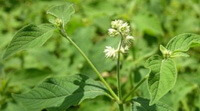
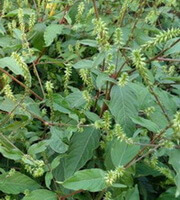
Botanical Description:Achyranthes bidentata Blume—also known as Niú Xī, Yě Niú Xī, Shān Xiàn Cài, Huái Niú Xī, or Duì Jié Cǎo—is a perennial herb reaching 70–120 cm in height. The root is cylindrical, 5–10 mm in diameter, and khaki (stone-yellow) in color. Stems are angular or quadrangular, green or purplish, covered with appressed or spreading white pubescence, becoming glabrescent; branches are opposite, and nodes are swollen. Leaves are simple and opposite; petioles measure 5–30 mm; leaf blades are membranous, elliptic or elliptic-lanceolate, 5–12 cm long and 2–6 cm wide, with an acuminate apex, broadly cuneate base, and entire margin; both surfaces are pubescent.
Inflorescences are terminal and axillary spikes, 3–5 cm long, reflexed after flowering; peduncles are 1–2 cm long and pubescent; flowers are numerous and densely arranged, ~5 mm long. Bracts are broadly ovate, 2–3 mm long, with a long-acuminate apex. Bracteoles are spinose, 2.5–3 mm long, with a curved apex and one oval, membranous lobule (~1 mm long) on each side of the base. Tepals are lanceolate, 3–5 mm long, lustrous, with an acute apex and a single prominent midrib. Stamens measure 2–2.5 mm; the staminode apex is flat and rounded, shallowly incised-serrulate.
Utricles are oblong, 2–2.5 mm long, tawny (yellow-brown), and smooth. Seeds are oblong, ~1 mm long, and tawny. Flowering occurs from July to September; fruiting, from September to October.
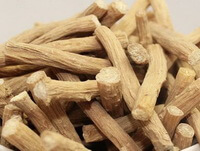
Root Characteristics: Roots are elongated and cylindrical, sometimes slightly curved; the upper end is somewhat thicker, tapering toward the thinner lower end (diameter 4–10 mm). The surface is grayish-yellow or light brown, slightly twisted, with fine longitudinal wrinkles, prominent lenticels, and sparse fine rootlet scars. Texture is hard and brittle—easily fractured—but becomes soft when damp. Fracture surface is flat, yellowish-brown, slightly keratinous and oily. The central vascular bundle is large and yellowish-white; surrounding it are numerous punctate vascular bundles arranged in 2–4 concentric rings. Odor is faintly sweet; taste is slightly bitter. High-quality herb material is long, with fine, smooth skin and a yellowish-white cross-section.
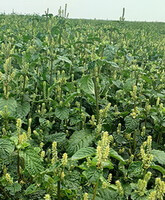
Ecological Environment:Achyranthes bidentata grows in forests on hillsides, forest margins, grassy slopes, mountain foothills, and near dwellings, at elevations of 200–1,750 m above sea level.
Growth Characteristics:Achyranthes bidentata is a deep-rooted perennial preferring warm, moderately moist (not arid) climates and exhibiting low cold tolerance.
Characteristics of the Herb: The roots are slender and cylindrical; some are slightly curved, with the upper end slightly thicker and the lower end thinner. Length is 15–50 cm or 15–70 cm, and diameter is 0.4–1 cm. The surface is sallow (grayish-yellow) or pale brown, bearing slightly twisted vertical wrinkles, small elongated lenticels, and sparse radicel marks (i.e., marks of lateral roots). The herb is hard and crisp, easy to break, but softens upon exposure to dampness. The fracture surface is flat, yellowish-brown or light brown, slightly keratoid and oily; the xylem (wood portion) of the central vascular bundle is prominent and yellowish-white, surrounded by numerous yellowish-white punctate vascular bundles arranged intermittently in 2–4 whorls. The herb has a faint odor and tastes slightly sweet and astringent (or slightly bitter and astringent).
Pharmacological Actions: (1) promotion of protein synthesis; (2) anti-inflammatory and analgesic effects; (3) short-term antihypertensive effect; (4) anti-fertility effect; (5) uterotonic or uterorelaxant effect, etc.
Medicinal Efficacy: Invigorates blood circulation and dispels blood stasis to regulate menstruation; tonifies the liver and kidney; strengthens tendons, bones, and muscles; promotes diuresis and alleviates stranguria; directs blood and fire downward. It is indicated for amenorrhea, dysmenorrhea (menstrual abdominal pain), postpartum abdominal pain due to blood stasis, abdominal masses, retained placenta, edema, headache, dizziness, toothache, aphthous ulcers, sore throat, pharyngitis, hematemesis, epistaxis (nasal bleeding), hematuria, carbuncles and malignant sores, and traumatic injuries. The prepared (processed) herb primarily tonifies the liver and kidney and strengthens tendons, bones, and muscles, and is indicated for low back and knee pain, limb spasm, and Wei Bi (a TCM syndrome characterized by muscular weakness and numbness).
Administration of Radix Achyranthis Bidentatae (Niú Xī):
Reference:
Administration Guide for Radix Achyranthis Bidentatae (Niú Xī)
TCM Books:
(1) Internally: 5–12 grams; (2) Internally: water decoction, 3–5 qian (≈9–15 grams); infusion in wine; preparation as ointment, pills, or powder. External use: crush fresh herb and apply as a poultice; (3) Internally: water decoction, 5–15 grams; infusion in wine; or preparation as pills or powder. External use: appropriate amount—crush herb and apply as a poultice; extract juice and instill into nostrils; or prepare finely ground powder and apply into gingival crevices.
Contraindications, Precautions, and Adverse Reactions: Radix Achyranthis Bidentatae should be used with caution or avoided during pregnancy and in cases of suspected early pregnancy following recent amenorrhea. It should not be combined with Lampyridae (Glowworm), Turtle shell (Carapax Testudinis), Sambucus chinensis, or Rhizoma Cynanchi Stauntonii.
References:
1.Introduction of Niu Xi: Twoteethed Achyranthes Root

 ✵The article records the herb Twoteethed Achyranthes Root, including its English name, Latin name, Pinyin name, properties and flavor, and botanical source—the dried root of a single plant species, (1) Achyranthes bidentata Blume—along with a detailed description of the botanical features, growth characteristics, and ecological environment of this species; the macroscopic and microscopic characteristics of the herb; its pharmacological actions; medicinal efficacy; and administration guidelines.
 Pinyin Name: Niú Xī
 Botanical Description: Achyranthes bidentata Blume—also known as Niú Xī, Yě Niú Xī, Shān Xiàn Cài, Huái Niú Xī, or Duì Jié Cǎo—is a perennial herb reaching 70–120 cm in height. The root is cylindrical, 5–10 mm in diameter, and khaki (stone-yellow) in color. Stems are angular or quadrangular, green or purplish, covered with appressed or spreading white pubescence, becoming glabrescent; branches are opposite, and nodes are swollen. Leaves are simple and opposite; petioles measure 5–30 mm; leaf blades are membranous, elliptic or elliptic-lanceolate, 5–12 cm long and 2–6 cm wide, with an acuminate apex, broadly cuneate base, and entire margin; both surfaces are pubescent.
 Root Characteristics: Roots are elongated and cylindrical, sometimes slightly curved; the upper end is somewhat thicker, tapering toward the thinner lower end (diameter 4–10 mm). The surface is grayish-yellow or light brown, slightly twisted, with fine longitudinal wrinkles, prominent lenticels, and sparse fine rootlet scars. Texture is hard and brittle—easily fractured—but becomes soft when damp. Fracture surface is flat, yellowish-brown, slightly keratinous and oily. The central vascular bundle is large and yellowish-white; surrounding it are numerous punctate vascular bundles arranged in 2–4 concentric rings. Odor is faintly sweet; taste is slightly bitter. High-quality herb material is long, with fine, smooth skin and a yellowish-white cross-section.
 Ecological Environment: Achyranthes bidentata grows in forests on hillsides, forest margins, grassy slopes, mountain foothills, and near dwellings, at elevations of 200–1,750 m above sea level.
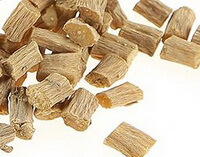 Characteristics of the Herb: The roots are slender and cylindrical; some are slightly curved, with the upper end slightly thicker and the lower end thinner. Length is 15–50 cm or 15–70 cm, and diameter is 0.4–1 cm. The surface is sallow (grayish-yellow) or pale brown, bearing slightly twisted vertical wrinkles, small elongated lenticels, and sparse radicel marks (i.e., marks of lateral roots). The herb is hard and crisp, easy to break, but softens upon exposure to dampness. The fracture surface is flat, yellowish-brown or light brown, slightly keratoid and oily; the xylem (wood portion) of the central vascular bundle is prominent and yellowish-white, surrounded by numerous yellowish-white punctate vascular bundles arranged intermittently in 2–4 whorls. The herb has a faint odor and tastes slightly sweet and astringent (or slightly bitter and astringent).
