Introduction of Shuǐ Hónɡ Huā Zǐ: Prince’s-Feather Fruit
✵This article documents the herb Prince’s-Feather Fruit, including its English name, Latin name, Pinyin name, properties and flavor, botanical sources—namely (1) Polygonum orientale L. and (2) Polygonum lapathifolium L.—and provides a detailed description of the botanical characteristics, growth habits, and ecological environment of these plant species, as well as the morphological features of the herb, its pharmacological actions, medicinal efficacy, and administration guidelines.
Fructus Polygoni Orientalis (Prince’s-Feather Fruit)
Pinyin Name: Shuǐ Hónɡ Huā Zǐ
English Name: Prince’s-Feather Fruit
Latin Name:Fructus Polygoni Orientalis Properties and Flavor: Slightly cold; salty
Brief Introduction:Fructus Polygoni Orientalis is the dried, ripe fruit of Polygonum orientale L., used clinically to invigorate blood and dispel stasis for abdominal pain and to relieve epigastric pain caused by food stagnation. It is commonly known as Fructus Polygoni Orientalis, Prince’s-Feather Fruit, or Shuǐ Hónɡ Huā Zǐ.
Botanical Source: Classical herbal works define Fructus Polygoni Orientalis (Prince’s-Feather Fruit) as the dried, ripe fruit of (1) Polygonum orientale L. Other authoritative herbal classics also accept (2) Polygonum lapathifolium L. as an alternative source. Both belong to the genus Polygonum L., family Polygonaceae (smartweed or buckwheat family), order Caryophyllales. The two commonly used species are described below:
(1) Polygonum orientale L.
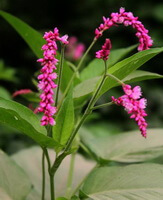
Botanical Description:Polygonum orientale L. is commonly known as Hónɡ Liǎo. It is an annual herb reaching 1–3 meters in height. The stem is erect, hollow, and either unbranched or branched in the upper portion (often profusely branched), densely covered with pilose hairs.
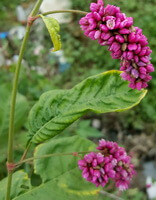
Leaves are alternate; the ochrea (stipular sheath) is tubular—the lower portion is membranous and brown, the upper portion is herbaceous and pilose, often expanding into ring-like wings at the apex. Leaf blades are ovate (egg-shaped) or broadly ovate, 10–20 cm long and 5–12 cm wide; the apex is acuminate, the base is orbicular, rounded, or subcordate; margins are entire; both surfaces are sparsely pubescent, with densely pubescent veins. Petioles are 2–10 cm long and bear spreading, long pilose hairs. Stipules are tubular, membranous, 1–2 cm long, villous, with long cilia, and typically bear herbaceous, green, wing-like extensions along the apex.
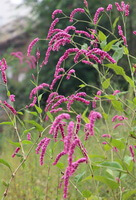
Inflorescences are spicate racemes composed of numerous spikelets, terminal or axillary, 3–7 cm long; flowers are compact and slightly pendulous; several flowers often form paniculate clusters. Bracts are broad-ovate or broadly funnelform, 3–5 mm long, herbaceous and green, pubescent, with a long-margined edge; each bract subtends 3–5 flowers. Pedicels are longer than the bracts. The perianth is deeply 5-lobed, pink or white; tepals are elliptic, 3–4 mm long. There are usually 7 stamens, longer than the perianth; the floral disc is conspicuous; there are 2 styles—connate at the lower and middle portions, longer than the perianth—with capitate stigmas.
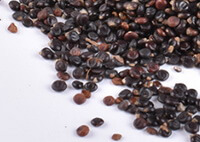
Achenes are orbicular (subcircular), biconcave, and flattened, 3–3.5 mm in diameter, dark brown to black, glossy, and enclosed within the persistent perianth. Flowering occurs from June to September; fruiting from August to October.
Ecological Environment:Polygonum orientale L. grows along ditches, in wetlands, around villages, and along roadsides, at elevations of 30–2,700 m above sea level. It is widely distributed across China and also occurs in Southeast Asia, Europe, and Oceania.
Growth Characteristics:Polygonum orientale L. prefers warm, humid environments with ample sunlight. It exhibits strong adaptability and has no strict soil requirements. It commonly grows in valleys, along roadsides, on field dikes, in grasslands, and in riparian wetlands. The plant displays vigorous vitality and is rarely affected by diseases or insect pests.
Characteristics of the Herb: The achenes are oblate (flat, circular), 2–3.5 mm or 3–4 mm in diameter, and 1–1.5 mm thick. The surface is brownish-black, brown, or reddish-brown; smooth and glossy; slightly biconcave; with a faint longitudinal ridge along the central portion; a prominent stylopodium at the apex; yellowish, spotted carpopodium (fruit stalk) scars at the base; and occasionally residual, ash-gray, membranous perianth. The herb is firm and hard in texture. Beneath the pericarp, an oblate seed is visible, enveloped by a light brown, membranous spermoderm (seed coat); it bears a light brown, protruding micropyle at the apex and a rounded hilum at the base. The endosperm is white and powdery; the embryo is thin, minute, and curved, surrounding the endosperm. The herb has a faint odor and a mild or slightly pungent taste.
Medicinal Efficacy: Invigorates blood and dispels stasis; dissipates masses; promotes qi circulation; resolves food retention; alleviates pain; strengthens the spleen and eliminates dampness via diuresis; clears heat and detoxifies; improves vision. It is indicated for abdominal masses, hypochondriac or abdominal accumulation, gallbladder swelling and pain, dyspepsia and indigestion, ascites, epigastric or abdominal distension and pain, poor appetite, conjunctivitis (pink eye), swellings and sores, scrofula, and other related conditions.
Administration of Fructus Polygoni Orientalis (Shuǐ Hónɡ Huā Zǐ):
Reference:
Administration Guide for Fructus Polygoni Orientalis (Shuǐ Hónɡ Huā Zǐ)
TCM Books:
(1) Internally: 15–30 grams; topical: appropriate amount—prepare as an ointment and apply. (2) Internally: water decoction, 2–3 qian (≈6–9 grams); higher doses up to 1 liǎng (≈30 grams); may also be prepared as powder, ointment, or wine infusion. Topical: prepare as an ointment or mash and apply. (3) Internally: water decoction, 3–10 grams; may also be prepared as powder, ointment, or wine infusion. Topical: appropriate amount—prepare as an ointment or mash and apply.
(2) Polygonum lapathifolium L.
Botanical Description:Polygonum lapathifolium L. is commonly known as Suān Mú Yè Liǎo. It is an annual herb growing up to 20–120 cm tall. The stem is erect, branched, and glabrous, with swollen nodes.
Leaves are alternate; petioles are short and covered with coarse, stiff bristles. The ochrea (stipular sheath) is fistulose (tubular), glabrous, with a truncate apex and numerous veins. Leaf blades are lanceolate, oblong-lanceolate, or broadly lanceolate, 5–15 cm long and 1–3 cm wide; the apex is acuminate or acute—often slightly obtuse; the base is cuneate. The upper surface is green, bearing large, blackish-brown, crescent-shaped spots; the lower surface has glandular dots; coarse, stiff bristles occur along the midvein and leaf margin; margins are entire. Petioles are short and shortly stiffly pubescent. The leaf-sheath is tubular, 1.5–3 cm long, membranous, pale brown, glabrous, veined, with a truncate apex—glabrous, rarely sparsely hairy.
Inflorescences are spicate racemes composed of several spikes, terminal or axillary, 4–6 cm long; flowers are compact and usually arranged in paniculate clusters; the inflorescence axis bears glandular dots or glandular hairs. Bracts are funnelform, with a slanting (oblique) margin and sparse marginal setae (trichomes); each bract subtends several flowers. The perianth is pink, viridescent (pea-green), or white, usually deeply 4- or 5-lobed, with glandular dots; the lobes are elliptic—the two outer lobes are larger, with prominent veins. There are 6 stamens. The 2 styles are free near the base and excurved.
Achenes are oval (egg-shaped) or broadly ovate, flattened, biconcave, and faintly ridged, 2–3 mm long, dark brown, glossy, and enclosed within the persistent perianth. Flowering occurs from June to August; fruiting from July to October.
Ecological Environment:Polygonum lapathifolium grows along field margins, roadsides, water bodies, wastelands, and wetlands—including ditch edges—at elevations of 30–3,900 m above sea level. It is widely distributed across China and also occurs in Europe, other parts of East Asia, and additional regions.
Growth Characteristics:Polygonum lapathifolium is a common weed in dry and paddy fields and their surrounding areas. This species exhibits strong environmental adaptability.
References:
1.Introduction of Shuǐ Hónɡ Huā Zǐ: Prince’s-Feather Fruit

 ✵This article documents the herb Prince’s-Feather Fruit, including its English name, Latin name, Pinyin name, properties and flavor, botanical sources—namely (1) Polygonum orientale L. and (2) Polygonum lapathifolium L.—and provides a detailed description of the botanical characteristics, growth habits, and ecological environment of these plant species, as well as the morphological features of the herb, its pharmacological actions, medicinal efficacy, and administration guidelines.
 Pinyin Name: Shuǐ Hónɡ Huā Zǐ
 Botanical Description: Polygonum orientale L. is commonly known as Hónɡ Liǎo. It is an annual herb reaching 1–3 meters in height. The stem is erect, hollow, and either unbranched or branched in the upper portion (often profusely branched), densely covered with pilose hairs.
 Inflorescences are spicate racemes composed of numerous spikelets, terminal or axillary, 3–7 cm long; flowers are compact and slightly pendulous; several flowers often form paniculate clusters. Bracts are broad-ovate or broadly funnelform, 3–5 mm long, herbaceous and green, pubescent, with a long-margined edge; each bract subtends 3–5 flowers. Pedicels are longer than the bracts. The perianth is deeply 5-lobed, pink or white; tepals are elliptic, 3–4 mm long. There are usually 7 stamens, longer than the perianth; the floral disc is conspicuous; there are 2 styles—connate at the lower and middle portions, longer than the perianth—with capitate stigmas.
 Ecological Environment: Polygonum orientale L. grows along ditches, in wetlands, around villages, and along roadsides, at elevations of 30–2,700 m above sea level. It is widely distributed across China and also occurs in Southeast Asia, Europe, and Oceania.
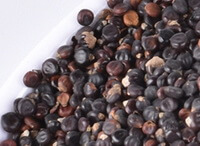 Characteristics of the Herb: The achenes are oblate (flat, circular), 2–3.5 mm or 3–4 mm in diameter, and 1–1.5 mm thick. The surface is brownish-black, brown, or reddish-brown; smooth and glossy; slightly biconcave; with a faint longitudinal ridge along the central portion; a prominent stylopodium at the apex; yellowish, spotted carpopodium (fruit stalk) scars at the base; and occasionally residual, ash-gray, membranous perianth. The herb is firm and hard in texture. Beneath the pericarp, an oblate seed is visible, enveloped by a light brown, membranous spermoderm (seed coat); it bears a light brown, protruding micropyle at the apex and a rounded hilum at the base. The endosperm is white and powdery; the embryo is thin, minute, and curved, surrounding the endosperm. The herb has a faint odor and a mild or slightly pungent taste.
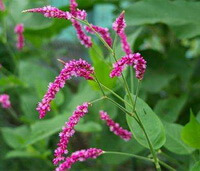 Pharmacological Actions: (1) Antitumor activity; (2) Antibacterial activity; (3) Diuretic activity.
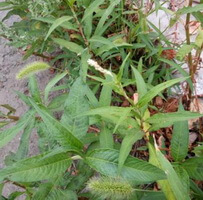 Botanical Description: Polygonum lapathifolium L. is commonly known as Suān Mú Yè Liǎo. It is an annual herb growing up to 20–120 cm tall. The stem is erect, branched, and glabrous, with swollen nodes.
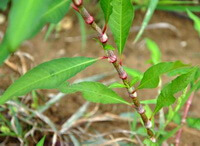 Inflorescences are spicate racemes composed of several spikes, terminal or axillary, 4–6 cm long; flowers are compact and usually arranged in paniculate clusters; the inflorescence axis bears glandular dots or glandular hairs. Bracts are funnelform, with a slanting (oblique) margin and sparse marginal setae (trichomes); each bract subtends several flowers. The perianth is pink, viridescent (pea-green), or white, usually deeply 4- or 5-lobed, with glandular dots; the lobes are elliptic—the two outer lobes are larger, with prominent veins. There are 6 stamens. The 2 styles are free near the base and excurved.
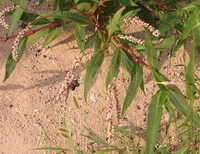 Ecological Environment: Polygonum lapathifolium grows along field margins, roadsides, water bodies, wastelands, and wetlands—including ditch edges—at elevations of 30–3,900 m above sea level. It is widely distributed across China and also occurs in Europe, other parts of East Asia, and additional regions.
