✵The article records the herb Cow-Herb Seed, including its English name, Latin name, Pinyin name, properties and flavor, botanical source—namely, the single plant species (1) Vaccaria segetalis (Neck.) Garcke—and provides a detailed introduction to the botanical features, growth characteristics, and ecological environment of this species; the characteristics of the herb Cow-Herb Seed; its pharmacological actions, medicinal efficacy, and administration guidelines.
Semen Vaccariae (Cow-Herb Seed)
Pinyin Name: Wánɡ Bù Liú Xínɡ
English Name: Cow-Herb Seed
Latin Name:Semen Vaccariae Property and Flavor: Neutral in nature, bitter.
Brief Introduction:Semen Vaccariae is the dried ripe seed of Vaccaria segetalis (Neck.) Garcke. It is used as an emmenagogue and galactagogue for treating amenorrhea and insufficient lactation, and also employed in the treatment of urinary calculi. The herb is commonly known as Semen Vaccariae, Cow-Herb Seed, or Wánɡ Bù Liú Xínɡ.
Botanical Source: Herbal classical works define Semen Vaccariae (Cow-Herb Seed) as the dried ripe seed of (1) Vaccaria segetalis (Neck.) Garcke. It is a plant of the genus Vaccaria, family Caryophyllaceae (the carnation or pink family), order Caryophyllales. This commonly used species is described below:
(1) Vaccaria segetalis (Neck.) Garcke
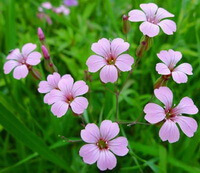
Botanical Description:Vaccaria segetalis (Neck.) Garcke is also known as Saponaria segetalis Neck., Vaccaria pyramidata Medic., and is commonly called Mài Lán Cài. It is an annual or biennial herb, growing up to 30–70 cm tall. The whole plant is smooth and glabrous, glaucous, and celadon (grayish-green). The root system is taprooted. The stem is solitary and erect; the upper part is dichotomously branched. Nodes near the base are thick, stout, and shorter; nodes are slightly enlarged, with a creamy-white (milky-white) surface. Leaves are simple, opposite, and sessile; leaf blades are ovate-elliptic to ovate-lanceolate, 1.5–7.5 cm long and 0.5–3.5 cm wide; the apex is acuminate; the base is rounded or subcordate, slightly connate and amplexicaul (stem-clasping); margins are entire; both surfaces are pale green (pink green); the midvein is prominent on the abaxial surface; the basal portion of the blade is broader; the apex is pointed; and there are three basal, exfoliating veins.
Sparse cymes are terminal; pedicels are thin and elongated, 1–4 cm long, bearing two scaly bracteoles below; bracts are oblanceolate and inserted on the upper-middle portion of the pedicel; calyx is cylindrical or ovoid-conical, 10–15 mm long and 5–9 mm wide, becoming 5-angled and ovoid in fruit, apex is 5-dentate; corolla has five petals, pink or reddish, 14–17 mm long and 2–3 mm wide, narrowly obovate, oblique or explanate, slightly concave, sometimes with inconspicuous lacunae; petal apices bear irregular small teeth; stamens are ten, unequal in length; ovary is superior, unilocular, with two linear styles, slightly exserted.
The capsule is enclosed by a persistent calyx, broadly ovate or suborbicular, 8–10 mm long; at maturity, the apex is 4-dentate; seeds are numerous, spheroidal (globular), ~2 mm in diameter, reddish-brown to fulvous, bearing conspicuous verrucous protrusions. Flowering occurs from April to June; fruiting from May to July.
Ecological Environment: The plant grows on grassy slopes, abandoned land, roadsides, and wheat fields, and is a common weed in wheat fields. It is widely distributed across Asia and Europe.
Growth Characteristics:Vaccaria segetalis prefers a warm and moist climate and is drought-tolerant. It is cold-tolerant but sensitive to high temperatures, preferring cool, humid climates. Soil requirements are not strict.
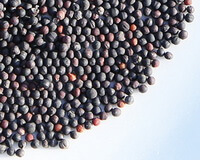
Characteristics of the Herb: The seeds are spheroidal or subspheroidal, 1.5–2 mm in diameter. The surface is black (occasionally reddish-brown), slightly glossy, and densely covered with minute granular protrusions. The hilum is dot-shaped, sunken, and light-colored; one side bears a band-shaped, longitudinal concave groove, within which the granular protrusions are arranged in vertical columns. The texture is hard and difficult to fracture. Upon removal of the spermoderm (seed coat), the white endosperm is visible, and the embryo is curved into a ring shape with two cotyledons. The herb has a slight odor and tastes mild to slightly puckery and bitter.
Medicinal efficacy: Promotes blood circulation and regulates menstruation; acts as a galactagogue and reduces swelling; resolves abscesses; promotes diuresis; and alleviates stranguria. It is indicated for amenorrhea, dysmenorrhea, menstrual abdominal pain, dystocia, postpartum lactation failure, acute mastitis with swelling and pain, carbuncles and boils, stranguria with dysuria and pain, hematuric stranguria (stranguria accompanied by hematuria), and traumatic wounds with bleeding.
Administration of Semen Vaccariae (Wánɡ Bù Liú Xínɡ):
Reference:
Administration Guide for Semen Vaccariae (Wánɡ Bù Liú Xínɡ)
TCM Books:
(1) Internally: 5–10 grams; (2) Internally: water decoction, 1.5–3 qian (≈4.5–9 grams); or prepared as pills or powder. External use: apply finely powdered herb topically; (3) Internally: water decoction, 6–10 grams.
Contraindications, Precautions, and Adverse Reactions: Semen Vaccariae should be used with caution during pregnancy and is contraindicated in cases of blood deficiency, chronic bleeding disorders, menorrhagia, metrorrhagia, or metrostaxis.

 ✵The article records the herb Cow-Herb Seed, including its English name, Latin name, Pinyin name, properties and flavor, botanical source—namely, the single plant species (1) Vaccaria segetalis (Neck.) Garcke—and provides a detailed introduction to the botanical features, growth characteristics, and ecological environment of this species; the characteristics of the herb Cow-Herb Seed; its pharmacological actions, medicinal efficacy, and administration guidelines.
 Pinyin Name: Wánɡ Bù Liú Xínɡ
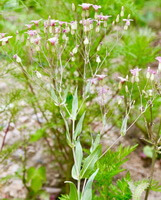 Botanical Description: Vaccaria segetalis (Neck.) Garcke is also known as Saponaria segetalis Neck., Vaccaria pyramidata Medic., and is commonly called Mài Lán Cài. It is an annual or biennial herb, growing up to 30–70 cm tall. The whole plant is smooth and glabrous, glaucous, and celadon (grayish-green). The root system is taprooted. The stem is solitary and erect; the upper part is dichotomously branched. Nodes near the base are thick, stout, and shorter; nodes are slightly enlarged, with a creamy-white (milky-white) surface. Leaves are simple, opposite, and sessile; leaf blades are ovate-elliptic to ovate-lanceolate, 1.5–7.5 cm long and 0.5–3.5 cm wide; the apex is acuminate; the base is rounded or subcordate, slightly connate and amplexicaul (stem-clasping); margins are entire; both surfaces are pale green (pink green); the midvein is prominent on the abaxial surface; the basal portion of the blade is broader; the apex is pointed; and there are three basal, exfoliating veins.
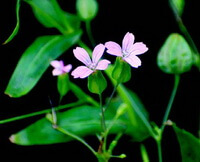 Sparse cymes are terminal; pedicels are thin and elongated, 1–4 cm long, bearing two scaly bracteoles below; bracts are oblanceolate and inserted on the upper-middle portion of the pedicel; calyx is cylindrical or ovoid-conical, 10–15 mm long and 5–9 mm wide, becoming 5-angled and ovoid in fruit, apex is 5-dentate; corolla has five petals, pink or reddish, 14–17 mm long and 2–3 mm wide, narrowly obovate, oblique or explanate, slightly concave, sometimes with inconspicuous lacunae; petal apices bear irregular small teeth; stamens are ten, unequal in length; ovary is superior, unilocular, with two linear styles, slightly exserted.
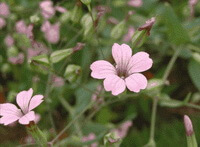 Ecological Environment: The plant grows on grassy slopes, abandoned land, roadsides, and wheat fields, and is a common weed in wheat fields. It is widely distributed across Asia and Europe.
 Characteristics of the Herb: The seeds are spheroidal or subspheroidal, 1.5–2 mm in diameter. The surface is black (occasionally reddish-brown), slightly glossy, and densely covered with minute granular protrusions. The hilum is dot-shaped, sunken, and light-colored; one side bears a band-shaped, longitudinal concave groove, within which the granular protrusions are arranged in vertical columns. The texture is hard and difficult to fracture. Upon removal of the spermoderm (seed coat), the white endosperm is visible, and the embryo is curved into a ring shape with two cotyledons. The herb has a slight odor and tastes mild to slightly puckery and bitter.
