✵The article records the herb Bugleweed (Herba Lycopi), including its English name, Latin name, Pinyin name, properties and flavors, and its botanical sources as defined in classical herbal texts—namely, (1) Lycopus lucidus Turcz. var. hirtus Regel. and (2) Lycopus lucidus Turcz.—with a detailed introduction to the botanical characteristics, growth habits, and ecological environments of these two plant species; the macroscopic features of the herb; its pharmacological actions, medicinal efficacy, and administration guidelines.
Herba Lycopi (Bugleweed Herb)
Pinyin Name: Zé Lán
English Name: Bugleweed Herb
Latin Name:Herba Lycopi Properties and Flavor: Slightly warm; pungent and bitter
Brief Introduction:Herba Lycopi is the dried aerial part of Lycopus lucidus Turcz. var. hirtus Regel. It is used (1) to invigorate blood circulation, resolve blood stasis, and regulate menstruation—indicated for irregular menstruation and postpartum abdominal pain; (2) to reduce swelling and alleviate traumatic injuries, boils, and sores; and (3) to promote diuresis for edema and ascites. Commonly known names include Herba Lycopi, Bugleweed Herb, Hiraute Shiny Bugleweed Herb, and Herb of Hirsute Shiny Bugleweed, as well as Zé Lán.
Botanical Source: Official herbal classics define Herba Lycopi (Bugleweed Herb) as the dried aerial part of Lycopus lucidus Turcz. var. hirtus Regel. Other authoritative herbal classics accept either (1) Lycopus lucidus Turcz. var. hirtus Regel. or (2) Lycopus lucidus Turcz. Both belong to the genus Lycopus L., family Lamiaceae (syn. Labiatae, mint family), order Lamiales (revised from outdated “Tubiflorae”). The two botanical sources recognized in classical texts are introduced below:
(2) Lycopus lucidus Turcz.
Botanical Description: This plant is commonly known as Dì Guā ér Miáo (“sweet potato seedling”) or Dì Sǔn (“earth bamboo shoot”). It is a perennial herb reaching 0.6–1.7 meters in height. The rhizome is cylindrical, amphitropous, and subterranean, bearing nodes with lodicules and dense fibrous roots. Stems are erect, usually unbranched, quadrangular, longitudinally grooved, and green; nodes are typically violet-red, glabrous, or sparsely pilose.
Leaves are decussate, with very short petioles or sessile; cauline leaves on the lower stem are mostly deciduous, whereas those on the upper stem are elliptic, narrowly oblong, or lanceolate, measuring 4–10 cm in length and 1.2–2.5 cm (up to 4 cm) in width. The apex is acuminate; the base is attenuate and cuneate; the margin is irregularly sharply serrated. The upper surface is dark green (sap-green), glabrous, and slightly glossy; the lower surface bears sunken glandular dots, is glabrous, or exhibits sparse white pubescence along the veins.
Verticillasters are multiflorous (or pluriflorous), axillary; bracteoles are ovate-lanceolate, with an apical thorn-like tip, shorter than the calyx or nearly equal in length, and pubescent; the calyx is campanulate (bell-shaped), ~4 mm long, glabrous on both surfaces, 4–6-lobed, with narrowly triangular lobes ending in a spinose apex; the corolla is campanulate and white, 4.5–5 mm long, glabrous externally and bearing yellow, shiny glandular dots; the upper and lower lips are nearly equal in length; the upper lip is emarginate (slightly notched), while the lower lip is 3-lobed—the central lobe is orbicular and larger, the lateral lobes are slightly shorter and smaller; the anterior pair of stamens is fertile and exserted beyond the corolla, with divergent anther locules; the posterior pair consists of staminodes—filaments only, or sometimes entirely absent; occasionally all four stamens are degenerate, leaving only filament remnants and vestigial anther marks; the ovary is oblong, deeply 4-lobed (4-parted), inserted on the floral disc; the style is exserted beyond the corolla, glabrous, and terminates in an unequally 2-lobed, flattened stigma.
The nutlets are flat, obovate-trigonous, slightly narrowed at the base, 1–1.5 mm long and ~1.2 mm wide, brown to dark brown (dust-colored); the margin is thickened, the abaxial surface is flat, and the ventral surface is ribbed and glandular. Flowering occurs from June to September; fruiting extends from August to October (occasionally into November).
Ecological Environment: The plant grows at elevations below 2,100 m, in marshes, hillsides, low-lying land, along water bodies, and other moist habitats.
Growth Characteristics:Lycopus lucidus prefers a warm, humid climate. It thrives during the hot, rainy months of June and July. It is cold-tolerant, waterlogging-resistant.
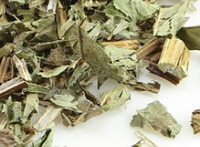
Characteristics of the Herb: Stems are quadrangular, with shallow longitudinal grooves on all four sides, 50–100 cm long and 2–5 mm in diameter; the surface is yellow-green or slightly purplish; nodes are prominent; internodes measure 2–11 cm. The herb is crisp and easily fractured, with a hollow pith. Leaves are opposite, mostly wrinkled, lanceolate or oblong when flattened, with serrated margins; the upper surface is dark green, the lower surface is grayish green (celadon), bearing brown glandular dots. Flowers are clustered in leaf axils, arranged in whorls; the corolla is usually abscises, while bracts and calyx are persist. The herb has a faint odor and a mild taste.
Pharmacological Actions: (1) Improves microcirculatory disturbances in experimental animals; (2) Exerts a cardiac stimulant effect.
Medicinal efficacy: Promotes blood circulation, regulates menstruation, resolves blood stasis, disperses carbuncles, alleviates edema, reduces swelling, and detoxifies. It is indicated for irregular menstruation, amenorrhea, dysmenorrhea, postpartum abdominal pain due to blood stasis, abdominal masses, edema, dropsy, traumatic injuries (including contusions and incised wounds), carbuncles and furuncles, and ascites.
Administration of Herba Lycopi (Zé Lán):
Reference:
Administration Guide of Herba Lycopi (Zé Lán)
TCM Books:
(1) Internally: 6–12 grams; (2) Internally: water decoction, 1.5–3 qián (~4.5–9 grams), or prepared as pills or powder. External use: Crush fresh herb and apply as a poultice; or use decoction for fumigation and wash. (3) Internally: water decoction, 6–12 grams, or prepared as pills or powder. External use: Apply appropriate amount of crushed fresh herb as a poultice; or use decoction for fumigation and wash.
Contraindications, Precautions, and Adverse Reactions: Herba Lycopi should be used with caution in cases without blood stasis.
(1) Lycopus lucidus Turcz. var. hirtus Regel.
Botanical Description: This plant is commonly known as Máo Yè Dì Guā ér Miáo (“hairy-leaf sweet potato seedling”) or Máo Yè Dì Sǔn (“hairy-leaf earth bamboo shoot”). It is a variety of Lycopus lucidus Turcz. A perennial herb, it grows up to 40–100 cm tall. The subterranean rhizome is horizontal, slightly thickened, and white. Stems are erect, quadrangular, with distinct angles, hollow, green on the upper surface, and violet-red (or purplish-green) at the nodes; they are smooth and glabrous except for tufts of hairs at the nodes. Leaves are decussate; laminae are lanceolate, narrowly lanceolate, or broadly lanceolate, 4.5–11 cm long and 8–35 mm wide; the apex is acuminate; the base is cuneate; the margin is coarsely serrate—sometimes with secondary serrations between primary teeth; the texture is subcoriaceous (somewhat leathery), slightly glossy and glabrous on the upper surface, densely glandular on the lower surface, which is otherwise glabrous or sparsely pubescent with white hairs along the veins; petioles are short or subsessile.
Verticillasters are axillary; flowers are small and multiflorous (polyanthous); bracts are lanceolate with pilose margins; the calyx is campanulate (bell-shaped), ~4 mm long, and 5-lobed; lobes are narrowly lanceolate with acuminate apices; the corolla is white and campanulate, slightly exserted beyond the calyx, 4.5–5 mm long, and glandular externally; the upper lip is erect; the lower lip is 3-lobed, with lobes nearly equal in length; there are two fertile stamens; the ovary is oblong (not rectangular), deeply 4-lobed, inserted on the floral disc; the stigma is unequally 2-lobed and exserted.
Nutlets are flat, ~1 mm long, and dark brown. Flowering occurs from July to September; fruiting extends from September to October.
Ecological Environment: The plant grows in swamps, along water bodies, and other moist habitats.
Characteristics of the Herb: Stems, nodes, and leaf surfaces are densely hirsute; other morphological features resemble those of Lycopus lucidus Turcz.

 ✵The article records the herb Bugleweed (Herba Lycopi), including its English name, Latin name, Pinyin name, properties and flavors, and its botanical sources as defined in classical herbal texts—namely, (1) Lycopus lucidus Turcz. var. hirtus Regel. and (2) Lycopus lucidus Turcz.—with a detailed introduction to the botanical characteristics, growth habits, and ecological environments of these two plant species; the macroscopic features of the herb; its pharmacological actions, medicinal efficacy, and administration guidelines.
 Pinyin Name: Zé Lán
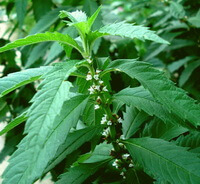 Botanical Description: This plant is commonly known as Dì Guā ér Miáo (“sweet potato seedling”) or Dì Sǔn (“earth bamboo shoot”). It is a perennial herb reaching 0.6–1.7 meters in height. The rhizome is cylindrical, amphitropous, and subterranean, bearing nodes with lodicules and dense fibrous roots. Stems are erect, usually unbranched, quadrangular, longitudinally grooved, and green; nodes are typically violet-red, glabrous, or sparsely pilose.
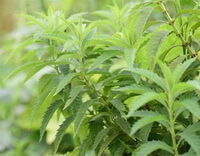 Verticillasters are multiflorous (or pluriflorous), axillary; bracteoles are ovate-lanceolate, with an apical thorn-like tip, shorter than the calyx or nearly equal in length, and pubescent; the calyx is campanulate (bell-shaped), ~4 mm long, glabrous on both surfaces, 4–6-lobed, with narrowly triangular lobes ending in a spinose apex; the corolla is campanulate and white, 4.5–5 mm long, glabrous externally and bearing yellow, shiny glandular dots; the upper and lower lips are nearly equal in length; the upper lip is emarginate (slightly notched), while the lower lip is 3-lobed—the central lobe is orbicular and larger, the lateral lobes are slightly shorter and smaller; the anterior pair of stamens is fertile and exserted beyond the corolla, with divergent anther locules; the posterior pair consists of staminodes—filaments only, or sometimes entirely absent; occasionally all four stamens are degenerate, leaving only filament remnants and vestigial anther marks; the ovary is oblong, deeply 4-lobed (4-parted), inserted on the floral disc; the style is exserted beyond the corolla, glabrous, and terminates in an unequally 2-lobed, flattened stigma.
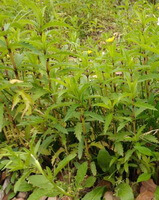 Ecological Environment: The plant grows at elevations below 2,100 m, in marshes, hillsides, low-lying land, along water bodies, and other moist habitats.
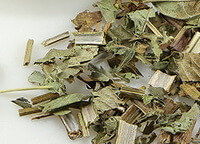 Characteristics of the Herb: Stems are quadrangular, with shallow longitudinal grooves on all four sides, 50–100 cm long and 2–5 mm in diameter; the surface is yellow-green or slightly purplish; nodes are prominent; internodes measure 2–11 cm. The herb is crisp and easily fractured, with a hollow pith. Leaves are opposite, mostly wrinkled, lanceolate or oblong when flattened, with serrated margins; the upper surface is dark green, the lower surface is grayish green (celadon), bearing brown glandular dots. Flowers are clustered in leaf axils, arranged in whorls; the corolla is usually abscises, while bracts and calyx are persist. The herb has a faint odor and a mild taste.
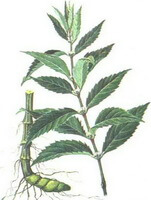 Botanical Description: This plant is commonly known as Máo Yè Dì Guā ér Miáo (“hairy-leaf sweet potato seedling”) or Máo Yè Dì Sǔn (“hairy-leaf earth bamboo shoot”). It is a variety of Lycopus lucidus Turcz. A perennial herb, it grows up to 40–100 cm tall. The subterranean rhizome is horizontal, slightly thickened, and white. Stems are erect, quadrangular, with distinct angles, hollow, green on the upper surface, and violet-red (or purplish-green) at the nodes; they are smooth and glabrous except for tufts of hairs at the nodes. Leaves are decussate; laminae are lanceolate, narrowly lanceolate, or broadly lanceolate, 4.5–11 cm long and 8–35 mm wide; the apex is acuminate; the base is cuneate; the margin is coarsely serrate—sometimes with secondary serrations between primary teeth; the texture is subcoriaceous (somewhat leathery), slightly glossy and glabrous on the upper surface, densely glandular on the lower surface, which is otherwise glabrous or sparsely pubescent with white hairs along the veins; petioles are short or subsessile.
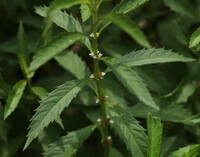 Verticillasters are axillary; flowers are small and multiflorous (polyanthous); bracts are lanceolate with pilose margins; the calyx is campanulate (bell-shaped), ~4 mm long, and 5-lobed; lobes are narrowly lanceolate with acuminate apices; the corolla is white and campanulate, slightly exserted beyond the calyx, 4.5–5 mm long, and glandular externally; the upper lip is erect; the lower lip is 3-lobed, with lobes nearly equal in length; there are two fertile stamens; the ovary is oblong (not rectangular), deeply 4-lobed, inserted on the floral disc; the stigma is unequally 2-lobed and exserted.
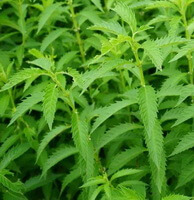 Ecological Environment: The plant grows in swamps, along water bodies, and other moist habitats.
