Introduction of Ji Xue Teng: Suberect Spatholobus Stem
✵This article documents the herb Suberect Spatholobus Stem—including its English name, Latin name, Pinyin name, properties and flavor—and describes its botanical sources as defined in classical herbal works: (1) Spatholobus suberectus Dunn.; and three additional species accepted in regional practice: (2) Mucuna birdwoodiana Tutcher; (3) Millettia dielsiana Harms ex Diels; and (4) Millettia nitida Benth. It provides detailed accounts of the botanical features, growth characteristics, and ecological environments of these four species; macroscopic and microscopic characteristics of the herb; pharmacological actions; medicinal efficacy; and administration guidelines.
Caulis Spatholobi (Suberect Spatholobus Stem)
Pinyin Name: Jī Xuè Ténɡ
English Name: Suberect Spatholobus Stem
Latin Name:Caulis Spatholobi Properties and Flavor: Warm; bitter, slightly sweet.
Brief Introduction:Caulis Spatholobi is the dried lianoid stem of Spatholobus suberectus Dunn. It invigorates and tonifies the blood, regulates menstruation, and unblocks the collateral meridians. It is used to treat menstrual disorders arising from concurrent blood deficiency and blood stasis, peripheral vascular inflammation or thrombosis, numbness of the body and limbs, and leucopenia. It is commonly known as Caulis Spatholobi, Suberect Spatholobus Stem, or Jī Xuè Téng (“Chicken-Blood Vine”).
Botanical Source: Classical herbal works define Caulis Spatholobi (Suberect Spatholobus Stem) as the dried lianoid stem of Spatholobus suberectus Dunn. This species belongs to the genus Spatholobus Hassk, family Leguminosae (Fabaceae, the legume or pea family), order Rosales. Other authoritative classical works also accept, for regional use, the dried lianoid stems of: (1) Spatholobus suberectus Dunn; (2) Mucuna birdwoodiana Tutcher (genus Mucuna Adans); (3) Millettia dielsiana Harms ex Diels (genus Millettia Wight et Arn.); and (4) Millettia nitida Benth (genus Millettia Wight et Arn.). These species all belong to the family Leguminosae (Fabaceae) and order Rosales. Strictly speaking, only Spatholobus suberectus Dunn is recognized as the official botanical source in pharmacopoeial standards. The one officially designated species and the three regionally accepted species are described below:
(1) Spatholobus suberectus Dunn.
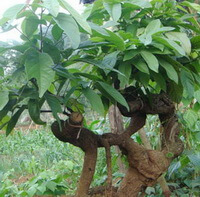
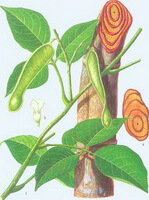
Botanical Description:Spatholobus suberectus Dunn is also known as Butea suberecta (Dunn) Blatter. It is commonly known as Mì Huā Dòu, Xiǎo Dòu Huā, or Sān Yè Jī Xuè Ténɡ. It is a plant of the genus Spatholobus Hassk, family Leguminosae (Fabaceae, the legume or pea family), order Rosales. It is a ligneous climbing liana, shrubby when young, reaching up to tens of meters in length. When an old stem is cut, several concentric or eccentric ring-like bands are visible, and a chicken-blood-like liquid exudes from these rings. The leaves are trifoliolate and alternate; the terminal leaflet is broadly ovate, 12–20 cm long and 7–15 cm wide, with an acute apex and a rounded or nearly cordate base; the upper surface is sparsely hirsute, while the lower surface bears yellowish short beard hairs along the veins; the lateral leaflets have oblique bases, their petiolules are about 6 mm long, and the stipels are acicular (aciform).
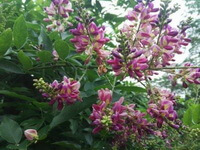
Panicles are axillary or terminal on branchlets, large, many-flowered and dense, up to 50 cm long; the inflorescence axis and pedicels are covered with yellow pubescence; flowers are about 10 mm long; the calyx is succulent and tubulose, 5-toothed, with the upper two teeth connate; both surfaces bear yellow pubescence; the corolla is white and succulent; the vexillum is orbicular with claws; the alae and keel (carina) are each about 7 mm long, with claws and auricles; there are 10 stamens arranged in two groups, and 10 anthers—five of which are larger and five are smaller; the ovary is covered with white hirsutes.
Legumes (pods) are ligulate, 8–10 cm long, and covered with yellow pubescence; each contains one seed, located near the apical end of the pod. Flowering occurs from June to July; fruiting occurs from August to December.
Ecological Environment:Spatholobus suberectus Dunn grows in open forests or valleys within dense forests or shrublands, at altitudes of 800–1,700 meters above sea level.
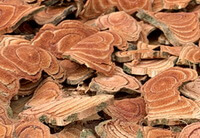
Characteristics of the Herb: The stem is a flattened cylinder (flattened cylindrical), slightly curved, 2–7 cm in diameter. The surface is tawny brown (grayish brown), sometimes bearing ash-gray patches; areas where the cork bark has exfoliated appear reddish brown. Prominent longitudinal grooves and small punctiform lenticels are present. The herb is firm and hard, difficult to break, with an irregularly splintery fracture surface. Slices are elliptic, long rectangular, oblong, or irregularly oblique, 3–10 mm thick. The xylem (wood portion) of the slice is reddish brown or blackish brown, containing numerous irregularly arranged vessel pores; resinous secretions occur in the cortex, appearing reddish brown to blackish brown and alternating with the xylem to form 3–10 eccentric semicircular or circular rings. The pith is small and eccentrically positioned. The herb has a faint odor and a puckering (astringent) taste.
Pharmacological Actions: (1) marked anti-atherosclerotic effect; (2) therapeutic effect on anemia in experimental rabbits; (3) increased femoral arterial blood flow in experimental animals; (4) reduction of vascular resistance, etc.
Medicinal efficacy: Invigorates blood, activates blood circulation, nourishes blood, regulates menstruation, unblocks collaterals, and relaxes tendons. It is indicated for irregular menstruation, dysmenorrhea (abdominal pain during or after menstruation), amenorrhea, blood deficiency with sallow complexion, numbness of hands and feet, hemiparesis or paralysis, rheumatic arthralgia, and soreness or pain in the lumbar region and knees.
Administration of Caulis Spatholobi (Jī Xuè Ténɡ):
Reference:
Administration Guide for Caulis Spatholobi (Jī Xuè Ténɡ)
TCM Books:
(1) Internally: 9–15 grams; (2) Internally: water decoction, 3–5 qian (≈9–15 grams); higher doses up to 1 liang (≈30 grams), or wine maceration; (3) Internally: water decoction, 10–15 grams; higher doses up to 30 g, or wine maceration.
Botanical Description:Mucuna birdwoodiana Tutcher is commonly known as Bái Huā Yóu Má Téng or Hé Qiǎo Huā. It is a plant of the genus Mucuna Adans, family Leguminosae (Fabaceae, the legume or pea family), order Rosales. It is an evergreen, woody vine reaching up to 10 meters in length. The outer cortex of the old stem is tawny brown (grayish brown), with a reddish-brown cross-section bearing 3–4 eccentric or concentric rings. Young stems are longitudinally grooved; lenticels are brown, raised, glabrous, or velvety on the internodes. Leaves are trifoliolate and alternate, with three leaflets (rarely five); leaflets are coriaceous; petiolules are sparsely pilose; stipules (perphylla) are ovate (egg-shaped) and caducous; leaf blades are ovate-elliptic or elliptic, 8–13 cm long and 4–6 cm wide, with a long-acuminate or shortly caudate-acuminate apex and a broad cuneate or orbicular base; the bases of the lateral leaflets are oblique; both surfaces are glabrous or sparsely hairy.
Racemes are axillary or grow on old stems or in leaf axils, 20–38 cm long, bearing 20–30 flowers in fascicles; the calyx is campanulate (bell-shaped), with five teeth, the upper two teeth connate and the lower tooth longer; it is covered with sparse brown, long hirsute hairs; the papilionaceous corolla is light greenish-white, exserted beyond the calyx, with flowers 7.5–8.5 cm long; there are 10 stamens, diadelphous (in two bundles), with dimorphic anthers—five anthers are oblong and five anthers are rounded; the ovary is densely covered with rust-colored pubescence; the style is filiform and recurved.
Legumes (pods) are woody, linear-lanceolate, up to 40 cm long, covered with brown pubescence, bearing sharp, wing-like ridges along the dorsal and ventral sutures, and slightly constricted between seeds. Seeds number 5–10 per pod, reniform, black. Flowering occurs from April to September; fruiting occurs from May to October.
Ecological Environment:Mucuna birdwoodiana Tutcher grows in valley woodlands or shrublands, on sunny mountain slopes, roadsides, and stream banks, often climbing trees and shrubs, at altitudes of 400–500 meters above sea level.
Growth Characteristics:Mucuna birdwoodiana Tutcher prefers a warm and humid climate, is shade-tolerant and drought-resistant, but cold-sensitive.
Characteristics of the Herb: The dried stem is flattened-cylindrical, slightly curved, 1.7–2.5 cm in diameter. The surface is tawny (dust-colored), very coarse; areas where cork bark has exfoliated appear reddish brown. Prominent longitudinal grooves and fine transverse ring-like markings (annular ridges) are present, along with numerous verrucose, protuberant lenticels; nodes show slight protrusions, and branch scars are sometimes visible. The herb is firm and hard, not easily broken, and exhibits a flaky fracture. In cross-section, the phloem contains resinoid secretions appearing as reddish-brown to brownish-black or dark brown (nearly black) rings; externally, the phloem forms concentric semicircular bands alternating with xylem; the xylem is yellowish gray or reddish brown, with vessel pores arranged radially and orderly; phloem and xylem alternate to form several layers of concentric rings; the pith is small and slender. The herb has a mild odor and a slightly astringent and sweet taste. When fresh, bright red juice exudes from the brown annular regions, resembling chicken blood; upon drying, this juice condenses into glossy black, colloidal, silk-like spots.
(3) Millettia dielsiana Harms ex Diels.
Botanical Description:Millettia dielsiana Harms ex Diels is also known as Millettia champutongensis Hu, commonly known as Xiāng Huā Yá Dòu Téng. It is a plant of the genus Millettia Wight et Arn., family Leguminosae (Fabaceae, the legume or pea family), order Rosales. It is a woody vine, 2–5 meters long; branches are covered with brown, short hairs, and branchlets are pilose or glabrescent. Leaves are alternate, imparipinnate compound leaves, 15–30 cm long; petioles are 5–12 cm long; stipules are linear, about 3 mm long; leaflets number five, coriaceous, with short stalks (stipitate); leaf blades are oblong-ovate to lanceolate (occasionally ovate), 4–15 cm long and 2–3 cm wide; the apex is blunt-acuminate; the base is obtuse or circular; the upper surface is glabrous; the lower surface is sparsely pubescent or glabrous; reticulate veins are dense and conspicuous.
Racemes are terminal or axillary, forming panicles, up to 15 cm long, and densely covered with tawny (yellowish-brown) pubescence; bracts are small and ovate (egg-shaped); pedicels are about 5 mm long and covered with pubescence; flowers are densely arranged; the calyx is campanulate (bell-shaped), 5-lobed, and densely covered with rust-colored pubescence; the corolla is white externally, densely covered with rust-colored pubescence, while the interior surface of the petals is dark purple; the corolla is papilionaceous; there are 10 stamens, diadelphous; the ovary is linear, and the style is recurved.
Legumes (pods) are narrowly elliptic, slightly flattened, 7–12 cm long and 14–25 mm wide, subligneous (nearly woody), and densely covered with rust-colored pubescence. Seeds number 1–5 per pod, flat and oblong-elliptic. Flowering occurs from May to August; fruiting occurs from October to November.
Ecological Environment: The plant grows in scrub woodland (holt or mixed deciduous forest) on hillsides or mountain slopes, in shrublands, on shaded rocky slopes, in rock crevices, and along forest margins.
Characteristics of the Herb: The dried stem of Millettia dielsiana Harms is cylindrical, 1.5–2.0 cm in diameter. The surface is tawny (dust-colored) and coarse; the cork bark is scaly; lenticels are elliptic, with longitudinal fissures. The processed herb consists of obliquely cut, oblong-elliptic slices; the cortex occupies approximately one-quarter to one-third of the radius in cross-section; the outer cortex is pale yellow, and the inner secretory substance is blackish brown; the xylem (wood portion) is pale yellow, with vessel pores arranged radially and spirally; the pith is small and centrally located. The herb has a mild odor and a slightly astringent taste.
(4) Millettia nitida Benth.
Botanical Description:Millettia nitida Benth. is also known as Millettia kueichowensis Hu, commonly known as Guāng Yè Yá Dòu Téng. It is a plant of the genus Millettia Wight et Arn., family Leguminosae (Fabaceae, the legume or pea family), order Rosales. It is a woody vine or climbing shrub. Fresh twigs are covered with rust-colored pubescence and gradually become glabrescent. Leaves are alternate, imparipinnate compound leaves, 5–11 cm long, petiolate; leaflets number five, chartaceous (papery); leaf blades are lanceolate or ovate, 5–11 cm long and 2–3.5 cm wide; the apex is blunt or acuminate; the base is rounded or obtuse; the upper surface is glabrous; the lower surface bears white, pilose hairs and is lustrous; reticulate veins are conspicuous.
Racemes are terminal or axillary, stout, 10–20 cm long; the main rachis and lateral branches bear thread-like hairs; the calyx is campanulate (bell-shaped), covered with thread-like hairs, and has five sepals (calyx lobes); the papilionaceous corolla is purple; the vexillum bears two callosity-based appendages at its base; there are 10 stamens, diadelphous; the ovary is linear, and the style is recurved.
Legumes (pods) are striated and oblong, slightly flattened, 5–15 cm long and 1.5–2 cm wide, covered with rust-colored tomentum, subligneous (nearly woody), and prone to splitting. Seeds number 3–5 per pod, brown, flat and circular, approximately 1 cm in diameter. Flowering occurs from May to August; fruiting occurs from October to November.
Ecological Environment:Millettia nitida Benth. grows in shrublands on hillsides or mountain slopes, or among rocks in mountainous regions.
Characteristics of the Herb: Stems and vines are harvested in summer and autumn, cut into slices, and sun-dried. The dried stem closely resembles that of the preceding species.
References:
1.Introduction of Ji Xue Teng: Suberect Spatholobus Stem

 ✵This article documents the herb Suberect Spatholobus Stem—including its English name, Latin name, Pinyin name, properties and flavor—and describes its botanical sources as defined in classical herbal works: (1) Spatholobus suberectus Dunn.; and three additional species accepted in regional practice: (2) Mucuna birdwoodiana Tutcher; (3) Millettia dielsiana Harms ex Diels; and (4) Millettia nitida Benth. It provides detailed accounts of the botanical features, growth characteristics, and ecological environments of these four species; macroscopic and microscopic characteristics of the herb; pharmacological actions; medicinal efficacy; and administration guidelines.
 Pinyin Name: Jī Xuè Ténɡ
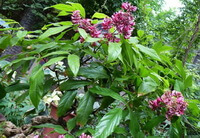 Botanical Description: Spatholobus suberectus Dunn is also known as Butea suberecta (Dunn) Blatter. It is commonly known as Mì Huā Dòu, Xiǎo Dòu Huā, or Sān Yè Jī Xuè Ténɡ. It is a plant of the genus Spatholobus Hassk, family Leguminosae (Fabaceae, the legume or pea family), order Rosales. It is a ligneous climbing liana, shrubby when young, reaching up to tens of meters in length. When an old stem is cut, several concentric or eccentric ring-like bands are visible, and a chicken-blood-like liquid exudes from these rings. The leaves are trifoliolate and alternate; the terminal leaflet is broadly ovate, 12–20 cm long and 7–15 cm wide, with an acute apex and a rounded or nearly cordate base; the upper surface is sparsely hirsute, while the lower surface bears yellowish short beard hairs along the veins; the lateral leaflets have oblique bases, their petiolules are about 6 mm long, and the stipels are acicular (aciform).
 Panicles are axillary or terminal on branchlets, large, many-flowered and dense, up to 50 cm long; the inflorescence axis and pedicels are covered with yellow pubescence; flowers are about 10 mm long; the calyx is succulent and tubulose, 5-toothed, with the upper two teeth connate; both surfaces bear yellow pubescence; the corolla is white and succulent; the vexillum is orbicular with claws; the alae and keel (carina) are each about 7 mm long, with claws and auricles; there are 10 stamens arranged in two groups, and 10 anthers—five of which are larger and five are smaller; the ovary is covered with white hirsutes.
 Ecological Environment: Spatholobus suberectus Dunn grows in open forests or valleys within dense forests or shrublands, at altitudes of 800–1,700 meters above sea level.
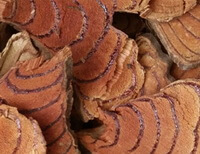 Characteristics of the Herb: The stem is a flattened cylinder (flattened cylindrical), slightly curved, 2–7 cm in diameter. The surface is tawny brown (grayish brown), sometimes bearing ash-gray patches; areas where the cork bark has exfoliated appear reddish brown. Prominent longitudinal grooves and small punctiform lenticels are present. The herb is firm and hard, difficult to break, with an irregularly splintery fracture surface. Slices are elliptic, long rectangular, oblong, or irregularly oblique, 3–10 mm thick. The xylem (wood portion) of the slice is reddish brown or blackish brown, containing numerous irregularly arranged vessel pores; resinous secretions occur in the cortex, appearing reddish brown to blackish brown and alternating with the xylem to form 3–10 eccentric semicircular or circular rings. The pith is small and eccentrically positioned. The herb has a faint odor and a puckering (astringent) taste.
 Pharmacological Actions: (1) marked anti-atherosclerotic effect; (2) therapeutic effect on anemia in experimental rabbits; (3) increased femoral arterial blood flow in experimental animals; (4) reduction of vascular resistance, etc.
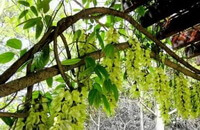 Botanical Description: Mucuna birdwoodiana Tutcher is commonly known as Bái Huā Yóu Má Téng or Hé Qiǎo Huā. It is a plant of the genus Mucuna Adans, family Leguminosae (Fabaceae, the legume or pea family), order Rosales. It is an evergreen, woody vine reaching up to 10 meters in length. The outer cortex of the old stem is tawny brown (grayish brown), with a reddish-brown cross-section bearing 3–4 eccentric or concentric rings. Young stems are longitudinally grooved; lenticels are brown, raised, glabrous, or velvety on the internodes. Leaves are trifoliolate and alternate, with three leaflets (rarely five); leaflets are coriaceous; petiolules are sparsely pilose; stipules (perphylla) are ovate (egg-shaped) and caducous; leaf blades are ovate-elliptic or elliptic, 8–13 cm long and 4–6 cm wide, with a long-acuminate or shortly caudate-acuminate apex and a broad cuneate or orbicular base; the bases of the lateral leaflets are oblique; both surfaces are glabrous or sparsely hairy.
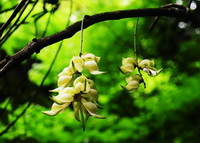 Racemes are axillary or grow on old stems or in leaf axils, 20–38 cm long, bearing 20–30 flowers in fascicles; the calyx is campanulate (bell-shaped), with five teeth, the upper two teeth connate and the lower tooth longer; it is covered with sparse brown, long hirsute hairs; the papilionaceous corolla is light greenish-white, exserted beyond the calyx, with flowers 7.5–8.5 cm long; there are 10 stamens, diadelphous (in two bundles), with dimorphic anthers—five anthers are oblong and five anthers are rounded; the ovary is densely covered with rust-colored pubescence; the style is filiform and recurved.
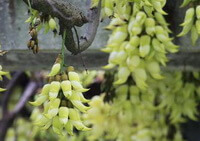 Ecological Environment: Mucuna birdwoodiana Tutcher grows in valley woodlands or shrublands, on sunny mountain slopes, roadsides, and stream banks, often climbing trees and shrubs, at altitudes of 400–500 meters above sea level.
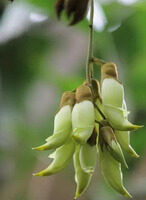 Growth Characteristics: Mucuna birdwoodiana Tutcher prefers a warm and humid climate, is shade-tolerant and drought-resistant, but cold-sensitive.
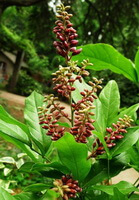 Botanical Description: Millettia dielsiana Harms ex Diels is also known as Millettia champutongensis Hu, commonly known as Xiāng Huā Yá Dòu Téng. It is a plant of the genus Millettia Wight et Arn., family Leguminosae (Fabaceae, the legume or pea family), order Rosales. It is a woody vine, 2–5 meters long; branches are covered with brown, short hairs, and branchlets are pilose or glabrescent. Leaves are alternate, imparipinnate compound leaves, 15–30 cm long; petioles are 5–12 cm long; stipules are linear, about 3 mm long; leaflets number five, coriaceous, with short stalks (stipitate); leaf blades are oblong-ovate to lanceolate (occasionally ovate), 4–15 cm long and 2–3 cm wide; the apex is blunt-acuminate; the base is obtuse or circular; the upper surface is glabrous; the lower surface is sparsely pubescent or glabrous; reticulate veins are dense and conspicuous.
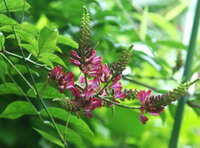 Racemes are terminal or axillary, forming panicles, up to 15 cm long, and densely covered with tawny (yellowish-brown) pubescence; bracts are small and ovate (egg-shaped); pedicels are about 5 mm long and covered with pubescence; flowers are densely arranged; the calyx is campanulate (bell-shaped), 5-lobed, and densely covered with rust-colored pubescence; the corolla is white externally, densely covered with rust-colored pubescence, while the interior surface of the petals is dark purple; the corolla is papilionaceous; there are 10 stamens, diadelphous; the ovary is linear, and the style is recurved.
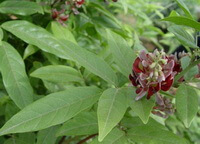 Ecological Environment: The plant grows in scrub woodland (holt or mixed deciduous forest) on hillsides or mountain slopes, in shrublands, on shaded rocky slopes, in rock crevices, and along forest margins.
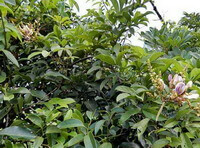 Botanical Description: Millettia nitida Benth. is also known as Millettia kueichowensis Hu, commonly known as Guāng Yè Yá Dòu Téng. It is a plant of the genus Millettia Wight et Arn., family Leguminosae (Fabaceae, the legume or pea family), order Rosales. It is a woody vine or climbing shrub. Fresh twigs are covered with rust-colored pubescence and gradually become glabrescent. Leaves are alternate, imparipinnate compound leaves, 5–11 cm long, petiolate; leaflets number five, chartaceous (papery); leaf blades are lanceolate or ovate, 5–11 cm long and 2–3.5 cm wide; the apex is blunt or acuminate; the base is rounded or obtuse; the upper surface is glabrous; the lower surface bears white, pilose hairs and is lustrous; reticulate veins are conspicuous.
