✵This article documents the herb Dragon’s Blood, including its English name, Latin name, Pinyin name, properties and flavor, botanical source—namely, the single plant species (1) Daemonorops draco Bl.—and provides a detailed description of this species’ botanical characteristics, growth habits, ecological environment, as well as the macroscopic and microscopic features of the resin, its pharmacological actions, medicinal efficacy, and administration guidelines.
Sanguis Draconis (Dragon’s Blood)
Pinyin Name: Xuè Jié
English Name: Dragon’s Blood
Latin Name:Sanguis Draconis Properties and Flavor: Neutral; sweet and salty
Brief Introduction:Sanguis Draconis is a red resin exuded from the fruit of Daemonorops draco Blume. It is used to invigorate blood circulation, dissipate blood stasis, alleviate pain, and promote wound healing—particularly in the treatment of traumatic injuries. Common names include Sanguis Draconis, Dragon’s Blood, and Xuè Jié.
Botanical Source: Classical herbal works define Sanguis Draconis (Dragon’s Blood) as the red resin exuded from the fruit of Daemonorops draco Blume. This species belongs to the genus Daemonorops Bl. (family Arecaceae, order Arecales). The following account describes this widely used species:
Daemonorops draco Blume
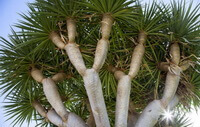
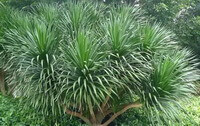
Botanical Description: The plant Daemonorops draco Blume is commonly known as Qí Lín Jié (Qí Lín means kylin—a Chinese unicorn, a mythical mascot in ancient legends; the male is called Qí, the female Lín), also known as Lóng Xuě Téng. It is a perennial evergreen vine that grows up to 10–20 meters long. Stems are covered with leaf sheaths and sharp, pointed spines. Pinnately compound leaves are alternate and grow at branch tips, sometimes subopposite toward the lower part; petioles and rachises bear spiculate thorns; leaflets are alternate, linear-lanceolate, about 20–30 cm long and about 3 cm wide, with an acute apex, a narrowed base, and trinervious (ternate) venation that is parallel.
The inflorescence is a spadix bearing pale yellow, cristate flowers that are unisexual and dioecious; there are 6 perianth segments arranged in two whorls. Male flowers have 6 stamens with long-conical anthers; female flowers have 6 sterile stamens, 1 pistil that is doliform (bottle-shaped), an ovary that is slightly ovoid (egg-shaped) and densely scaly, a short style, and a 3-lobed stigma.
The fruit is drupaceous, ovoid, about 2–3 cm in diameter, russet (reddish-brown), and covered with yellow scales; it contains deep red liquid resin that often exudes from beneath the scales and resembles blood clots when dried. Each fruit contains a single seed.
Ecological Environment: This species is cultivated in China and on islands of Southeast Asia.
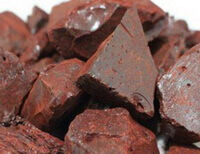
Characteristics of the Herb: The herb occurs as slightly rounded, oblate spheroidal, square, or brick-shaped irregular blocks, varying in size. The surface is russet (reddish-brown), red, or brick-red; the fracture surface is glossy. The texture is hard and brittle (crisp); the broken surface is red or dark red, glossy; and the powdered material is blood-red. The herb has a faint odor and a mild taste. It is insoluble in cold water but softens in hot water.
Pharmacological Actions: (1) Antifungal activity: an aqueous infusion of Sanguis Draconis exhibits varying degrees of inhibition against Trichophyton violaceum, Trichophyton gypseum, and Achorion schoenleinii, among other pathogenic dermatophytes. (2) Hemostatic effect, etc.
Medicinal Efficacy: Promotes blood circulation and alleviates pain; resolves blood stasis and arrests bleeding; promotes granulation (tissue regeneration); and astringes ulcers (promotes wound healing). It is indicated for traumatic injuries (e.g., falls), stasis-induced abdominal or cardiac pain, internal contusions and bruises, dysmenorrhea (menstrual abdominal pain), postpartum abdominal pain due to stasis obstruction, bleeding wounds, non-healing ulcers, scrofula (cervical lymphadenitis/tuberculous lymphadenitis), chronic ecthyma (long-standing ulcerative skin lesions), hemorrhoids, etc.
Administration of Sanguis Draconis (Xuè Jié):
Reference:
Administration Guide for Sanguis Draconis (Xuè Jié)
TCM Books:
(1) Internally: 1–2 grams of finely powdered herb daily, administered as powder or in pill form. External use: apply powdered herb topically, or incorporate into ointment; (2) Internally: 1–3 fen (≈0.3–0.9 grams) of finely powdered herb daily, administered as powder or in pill form. External use: apply powdered herb topically, or incorporate into plaster for topical application. (3) Internally: 1–1.5 grams of finely powdered herb daily, administered as powder or in pill form. External use: apply an appropriate amount of powdered herb topically, or incorporate into plaster for topical application.

 ✵This article documents the herb Dragon’s Blood, including its English name, Latin name, Pinyin name, properties and flavor, botanical source—namely, the single plant species (1) Daemonorops draco Bl.—and provides a detailed description of this species’ botanical characteristics, growth habits, ecological environment, as well as the macroscopic and microscopic features of the resin, its pharmacological actions, medicinal efficacy, and administration guidelines.
 Pinyin Name: Xuè Jié
 Botanical Description: The plant Daemonorops draco Blume is commonly known as Qí Lín Jié (Qí Lín means kylin—a Chinese unicorn, a mythical mascot in ancient legends; the male is called Qí, the female Lín), also known as Lóng Xuě Téng. It is a perennial evergreen vine that grows up to 10–20 meters long. Stems are covered with leaf sheaths and sharp, pointed spines. Pinnately compound leaves are alternate and grow at branch tips, sometimes subopposite toward the lower part; petioles and rachises bear spiculate thorns; leaflets are alternate, linear-lanceolate, about 20–30 cm long and about 3 cm wide, with an acute apex, a narrowed base, and trinervious (ternate) venation that is parallel.
 Ecological Environment: This species is cultivated in China and on islands of Southeast Asia.
