Introduction of Gu Sui Bu: Fortune’s Drynaria Rhizome
✵The article records the herb Fortune’s Drynaria Rhizome, including its English name, Latin name, Pinyin name, properties and flavors, and its officially defined botanical source—the single plant species (1) Drynaria fortunei (Kunze) J. Smith—along with six other acceptable species: (2) Drynaria propinqua (Wall.) J. Smith, (3) Drynaria sinica Diels, (4) Pseudodrynaria coronans (Wall.) Ching, (5) Phymatodes lucida (Roxb.) Ching, (6) Davallia divaricata Blume, and (7) Davallia mariesii Moore ex Bak., followed by a detailed introduction to the botanical features, growth characteristics, and ecological environments of these seven plant species; the macroscopic and microscopic features of the herb Fortune’s Drynaria Rhizome; and its pharmacological actions, medicinal efficacy, and administration guidelines.
Rhizoma Drynariae (Fortune’s Drynaria Rhizome)
Pinyin Name: Gǔ Suì Bǔ
English Name: Fortune’s Drynaria Rhizome
Latin Name:Rhizoma Drynariae Properties and Flavor: Warm in nature, bitter in taste
Brief Introduction:Rhizoma Drynariae is the dried rhizome of Drynaria fortunei (Kunze) J. Smith or Drynaria baronii (Christ) Diels (family Polypodiaceae), used (1) to tonify the kidney for treating lumbago, impaired hearing, and tinnitus; (2) to promote the healing of traumatic injuries and bone fractures; and (3) externally for alopecia areata and vitiligo. The herb is commonly known as Rhizoma Drynariae, Fortune’s Drynaria Rhizome, Gǔ Suì Bǔ, or Shí Yán Jiāng (“Rock Ginger”), Hóu Jiāng (“Monkey Ginger”), and Máo Jiāng (“Hairy Ginger”).
Botanical Source: Official herbal classics define Rhizoma Drynariae (Fortune’s Drynaria Rhizome) as the dried rhizome of (1) Drynaria fortunei (Kunze) J. Smith. Other authoritative herbal classics extend this definition to include the dried rhizomes of (1) Drynaria fortunei (Kunze) J. Smith, (2) Drynaria propinqua (Wall.) J. Smith, (3) Drynaria sinica Diels, (4) Pseudodrynaria coronans (Wall.) Ching, (5) Phymatodes lucida (Roxb.) Ching, (6) Davallia divaricata Blume, and (7) Davallia mariesii Moore ex Bak. These one officially designated species and six additional acceptable species are described below:
(1) Drynaria fortunei (Kunze) J.Smith.
Botanical Description:Drynaria fortunei (Kunze) J. Smith—also known as Polypodium fortunei Kunze—is commonly called Hú Jué, Xī Nán Hú Jué, and Bǎn Yá Jiāng. It is a herbaceous epiphyte of the genus Drynaria (family Polypodiaceae, order Polypodiales), growing up to 20–40 cm tall. Its rhizomes are amphitropous, coarse, and succulent, densely covered with subulate-lanceolate scales and green hairs.
Leaves are dimorphic: trophophylls (vegetative leaves) are daimyo-oak-leaf-shaped, coriaceous, reddish-brown or taupe brown (grayish brown), oval (egg-shaped), sessile, scarious, 5–6.5 cm long (up to 7 cm), and about 3.5 cm wide (or 4–5.5 cm wide); the base is cordate; the abaxial surface is sparsely pubescent; and the margin is coarsely and shallowly lobed. Fertile fronds are tall and large, chartaceous (papery), green, glabrous, oblong-oval, 14–18 cm long (not “wide”), tapering toward the base, undulate, decurrent, and forming short petioles with winged margins; the portion above the middle is deeply pinnately divided. Pinnae occur in 7–13 pairs, slightly obliquely ascending, 7–10 cm long and 2–3 cm wide, with shortly acuminate tips; margins bear inconspicuous, sparse crenations; venation is reticulate and conspicuous on both surfaces.
Sori are circular, grow at the junctions of veinlets; arranged in 2–3 rows along both sides of the midvein; lacking an indusium.
Ecological Environment:Drynaria fortunei (Kunze) J. Smith grows on rocks in forests or on tree trunks at altitudes of 200–1,800 m and is predominantly distributed in China, as well as in parts of Southeast Asia.
Growth Characteristics:Drynaria fortunei (Kunze) J. Smith grows attached to tree trunks, rocks, mountain walls, or walls. It prefers warm, damp, and humid environments.
Characteristics of the Herb: The rhizomes are irregular, stripe-like structures with flat dorsal and ventral surfaces, often lumpy or flaky, mostly curved, and frequently constricted and branched on both sides; they measure 3–20 cm in length and 0.7–1.5 cm in width. The surface of the dried rhizome is densely covered with brown or reddish-brown, small, appressed, membranous, peltate (shield-shaped) scales; the erect scales are lanceolate, with acute apices and fimbriate (penicillate or fringelike) margins bearing cilia, and are especially dense at the bases of petioles and the apical (tender) ends of the rhizomes. Where scales have fallen off, the underlying tissue appears brown, revealing fine longitudinal veins and ridges. Petiole scars are present on the upper (adaxial) surface, while the lower (abaxial) surface bears longitudinal ridges and radicel scars (marks of fine roots). The herb is firm and hard in texture; its fracture surface is reddish-brown, with white, discrete vascular bundles (steles) arranged in elongated, oblate shapes. It has a fragrant odor and tastes slightly sweet and astringent.
Pharmacological Actions: (1) Prevent elevation of blood lipids and reduce hyperlipidemia; (2) Promote healing of bone injuries; (3) Exhibit bacteriostatic activity; (4) Inhibit the in vitro growth of Staphylococcus aureus, among others.
Medicinal Efficacy: Promote wound healing and alleviate pain; tonify the kidney and strengthen bones; invigorate blood circulation; arrest bleeding; externally dispel wind and resolve dampness. It is indicated for traumatic injuries (e.g., falls), tendon and bone fractures, kidney deficiency–induced lumbago, chronic diarrhea due to kidney deficiency, flaccidity of tendons and bones, weakness and soreness of the feet and knees, rheumatic arthralgia, chronic diarrhea, enuresis (nocturnal enuresis), tinnitus, deafness, dentalgia (toothache), tooth mobility (loosening of teeth), and bone fractures; appendicitis is not a recognized indication for Rhizoma Drynariae and has been omitted. Externally, it is used for alopecia areata, vitiligo (leukoderma), and clavus (heloma).
Administration of Rhizoma Drynariae (Gǔ Suì Bǔ):
Reference:
Administration Guide for Rhizoma Drynariae (Gǔ Suì Bǔ)
TCM Books:
(1) Internally: 3–9 grams, typically as a water decoction. (2) Internally: water decoction, 3–5 qián (≈9–15 grams); also prepared as wine infusions, pills, or powders. External use: Apply an appropriate amount—fresh herb crushed and applied topically; (3) Internally:water decoction, 10–20 grams; or formulated into pills or powders. External use: Apply an appropriate amount—fresh herb crushed and applied topically; or dried herb ground into fine powder and applied; or soaked in wine and applied topically by smearing.
Contraindications, Precautions, and Adverse Reactions: Rhizoma Drynariae should not be used concurrently with mutton, sheep’s blood, or the stem and leaves of Brassica campestris L.
(2) Drynaria propinqua (Wall.) J. Smith
Botanical Description:Drynaria propinqua (Wall.) J. Smith—also known as Polypodium propinquum Wall.—is commonly called Guāng Yè Hú Jué and Shí Lián Jiāng Hú Jué. It is a herbaceous epiphyte of the genus Drynaria (family Polypodiaceae, order Polypodiales), growing up to 60 cm tall. Its rhizomes are succulent and amphitropous, covered with opaque, tan (chocolate brown), lanceolate scales.
Leaves are dimorphic and glabrous: trophophylls (vegetative leaves) are broadly ovate, 8–15 cm long and 5–10 cm wide, shallowly to deeply pinnately divided or parted; fertile fronds have petioles 8–20 cm long, inserted at joints on the rhizome; leaf blades are 25–45 cm long, oblong or oblong-ovate, with shortly acuminate apices and bases 20–30 cm wide, pinnately parted nearly to the rachis; pinnae are lanceolate, alternate, smooth on both surfaces, with slightly thickened margins and sparse, shallow incisions; venation is reticulate and conspicuous. Sori lack an indusium.
Ecological Environment: This species grows on tree trunks or rocks in forests at altitudes of 500–2,400 m above sea level. It is predominantly distributed in China and also occurs in several countries of South Asia.
Characteristics of the Herb: The herb resembles the dried rhizome of Drynaria fortunei (Kunze) J. Smith. Rhizomes are oblate (flattened, circular), 0.5–1.2 cm in diameter. Scales are reddish brown, coriaceous, triangular, imbricate, peltate, and inserted near the base, closely appressed to the rhizome surface. The herb is crisp in texture; its fracture surface displays discrete vascular bundles (steles) arranged elliptically. It has a fragrant odor and tastes salty and astringent.
(3) Drynaria sinica Diels
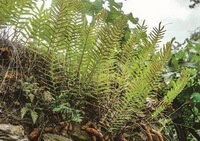
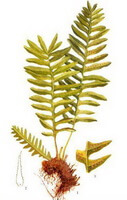
Botanical Description:Drynaria sinica Diels—also known as Drynaria baronii (Christ) Diels or Polypodium baronii Christ—is commonly called Qín Lǐng Hú Jué, Zhōng Huá Hú Jué, or Huá Hú Jué. It is a herbaceous epiphyte of the genus Drynaria (family Polypodiaceae, order Polypodiales), growing up to 20–50 cm tall. Its rhizomes are amphitropous and succulent, approximately 1–2 cm in diameter, and densely covered with reddish-brown, lanceolate scales.
Leaves are dimorphic; the rachis and leaf veins are sparsely pubescent. Trophophylls (vegetative leaves) are sparse and few in number, oblong-lanceolate, and pinnately parted. Fertile fronds have petioles with narrow wings; the base bears nodes and joints. Leaf blades are broadly lanceolate, 20–40 cm long, with the midportion 5–10 cm wide; they are deeply pinnately parted nearly to the rachis. Both surfaces bear white pubescence along the veins and rachis. Pinnae occur in 20–30 pairs, 5–15 mm wide, with obtuse apices and incised-serrate margins. Venation is conspicuous.
Sori are circular, grow at the junctions of veinlets; arranged in a single row along both sides of the midvein; lacking an indusium.
Ecological Environment: This species grows among rocks in valleys or at forest edges, at altitudes of 900–2,800 m above sea level, or on rocky understories of hillsides at 1,380–3,800 m. It is predominantly distributed in China.
Characteristics of the Herb: The rhizomes are irregularly cylindrical, slightly flattened on both dorsal and ventral surfaces, 3–8 cm long and 0.6–1 cm wide. Scales are strip-lanceolate; where scales have fallen off, the exposed surface is taupe (grayish brown) and exhibits fine, longitudinal veins. The fracture surface is brownish ash-gray (grayish-white), with punctate, discrete vascular bundles (steles) arranged elliptically. The herb has a fragrant odor and tastes astringent.
(4) Pseudodrynaria coronans (Wall.) Ching
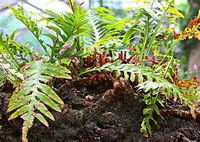
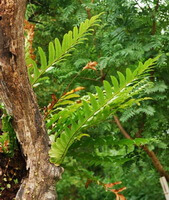
Botanical Description:Pseudodrynaria coronans (Wall.) Ching—also known as Polypodium coronans Wall.—is commonly called Yá Jiāng Jué or Chuān Shí Jiàn. It belongs to the genus Pseudodrynaria (C. Chr.) C. Chr. (family Polypodiaceae, order Polypodiales) and grows up to 80–140 cm tall. Its rhizomes are stout and densely covered with brown, linear scales. Leaves are monomorphic, forming dense, tufted, erect, hollow, rounded clusters. Leaf blades are 80–140 cm long, with acuminate apices; the portion below the middle tapers gradually, while the base broadens and becomes cordate; the portion above the middle is deeply pinnately parted, shallowly lobed, and undulate distally. Both surfaces are smooth and glabrous, with entire margins. Venation is reticulate and distinct on both surfaces, with veinlets in the meshes either simple or bifurcated.
Sori grow at the junctions of veinlets, arranged in a single row between each pair of lateral veins; they are circular or usually elongated along the tertiary veinlets, becoming linear and fragmented at maturity.
Spores are elliptic; the sporoderm bears spinules or tuberculate (lumpy) ridges; no indusium is present.
Ecological Environment: This species grows attached to tree trunks or on rocks in forests at altitudes of 1,000–1,900 m above sea level. It is distributed in China and other regions.
Characteristics of the Herb: The rhizomes are cylindrical, with surfaces densely covered by strip-lanceolate, loose, and soft scales. Where scales have fallen off, the exposed surface is puce (purplish brown), bearing longitudinal grooves, ridges, and fine, variably sized surface patterns. The fracture surface is brown, with dot-like, discrete vascular bundles (steles) arranged orbicularly. The herb has a very faint odor and tastes astringent.
(5) Phymatodes lucida (Roxb.) Ching.
Botanical Description:Phymatodes lucida (Roxb.) Ching is commonly known as Guānɡ Liànɡ Mì Wǎnɡ Jué and also as Phymatodes cuspidata (D. Don) J. Smith, or Guānɡ Liànɡ Liú Jué; it is a plant of the family Polypodiaceae (order Polypodiales). It is an epiphyte that adheres to rocks. The plant is 40–100 cm tall. Rhizomes are decumbent, about 2 cm in diameter, celadon (grayish-green), and sparsely scaly; scales are oval (egg-shaped), peltate and centrally inserted, brown, with irregular margins. Leaves are spaced far apart and round in outline; petioles are 30–50 cm long, culm-colored, stout, and glabrous; the leaf blade is once-pinnate, 30–50 cm long and 20–25 cm wide. Pinnae occur in 8–15 pairs, each 15–20 cm long and 2–3.5 cm wide; the apex is acuminate, the base is stipitate (with a petiole up to 1 cm long), and the margins are entire. Lateral veins are inconspicuous, and veinlets form a reticulate network. Leaves are subcoriaceous, and both surfaces are smooth and glabrous. Sori are arranged in a single row on either side of the midvein of the pinnae, located between the midvein and the margin; the spore surface bears minute granular ornamentation.
Ecological Environment: This species grows on limestone cliffs at forest edges, at altitudes of 250–1,500 m. It is mainly distributed in China.
Characteristics of the Herb: The dried rhizome is cylindrical, about 13 cm long, and often dichotomously branched. The surface is taupe (gray-brown), bearing numerous fibrous root scars or light brown scales. The texture is firm and hard; the fracture surface is slightly flat, ash-gray (grayish-white), with vascular bundles arranged in a ring and numerous small brown spots. The herb has a faint odor and a slightly astringent taste.
(6) Davallia divaricata Bl.
Botanical Description:Davallia divaricata Bl. is also known as Davallia formosana Hayata and commonly called Dà Yè Gǔ Suì Bǔ; it is a plant of the genus Davallia (family Davalliaceae, order Polypodiales). The plant reaches a height of 50–150 cm, or approximately 1 m. The rhizome is stout, long, and amphitropous, 1 cm in diameter, and densely covered with fluffy scales; scales are broadly lanceolate, about 1 cm long, with a long-acuminate apex, ciliate margins, reddish-brown color, and membranous texture.
Leaves are spaced far apart, at intervals of 3–5 cm; petioles are 30–60 cm long and about 4 mm in diameter; both petioles and rachises are bright brown or dark brown, with deep longitudinal grooves on the upper surface; leaf blades are large, triangular or ovate-triangular, up to 60–90 cm in both length and width; the apex is acuminate; the fronds are quadripinnate or pentapinnate; pinnae occur in about 10 pairs, alternate and widely spreading; lower petioles are 2–4 cm long; the basal pair is the largest—long-triangular, 20–30 cm long and 12–18 cm wide—with a long-acuminate apex and deflexed base; primary pinnules occur in about 10 pairs, alternate, with petioles 3–5 mm long on the lower part, widely spreading; the uppermost pinnule on the basal pinna is the largest—triangular, about 7 cm long and 4 cm wide—with an acuminate apex and rounded-cuneate base; bipinnules occur in 7–10 pairs, alternate, short-stipitate, obliquely ascending; the uppermost bipinnule on the basal pinna is slightly larger—ovate-oblong, about 2 cm long and 1 cm wide—with an acute apex and decurrent base; the terminal pinnule is elliptic, with a blunt apex and decurrent base on the lower side, deeply pinnately lobed; lobes are obliquely triangular, obliquely ascending, 1–2 mm wide, often bifurcated into unequal, sharp teeth; middle pinnae are broadly lanceolate, gradually decreasing in size upward and becoming lanceolate. Leaf veins are conspicuous and dichotomous; each tooth tip bears a single veinlet that nearly reaches the leaf margin. Leaves are firm-herbaceous or chartaceous, turning brown upon drying, and glabrous.
Sori are numerous; each lobe bears one sorus, located on the curved portion of the midveinlet or at the point of bifurcation—distant from the leaf margin and from the curved or absent portions of the teeth; the indusium is tubular, about 1 mm long and approximately twice as wide, truncate at the apex, brown with a golden luster, and thickly membranous.
Ecological Environment: This species grows attached to tree trunks or rocks in ravine forests at altitudes of 600–700 m. It is mainly distributed in China.
Characteristics of the Herb: The dried rhizome is twisted-cylindrical or slightly flattened, 4–13 cm long and 7–9 mm in diameter; the surface is brown, with longitudinal furrows and wrinkles, and bears a few yellowish-brown scales. Circular leaf-base scars, each with a central protrusion, occur on the upper side. The texture is firm and hard, rendering it brittle. The fracture surface is slightly flattened and reddish-brown, bearing numerous yellow, punctate vascular bundles arranged in a ring, along with two larger, crescent-shaped vascular bundles centrally located. The herb has a faint odor and a slightly astringent taste.
(7) Davallia mariesii Moore ex Bak.
Botanical Description:Davallia mariesii Moore ex Bak. is commonly known as Hǎi Zhōu Gǔ Suì Bǔ; it is a plant of the genus Davallia (family Davalliaceae, order Polypodiales). The plant is 20 cm tall or grows 15–40 cm high. Rhizomes are long and amphitropous, 4–5 mm in diameter, and densely covered with taupe-brown, fluffy scales; scales are broadly lanceolate or lanceolate, about 8 mm long, with a long-acuminate apex and ciliate margins; the central portion is dark-colored, while the margins are paler.
Leaves are spaced far apart at intervals of 1–5 cm; petioles are 6–20 cm long and 1–1.5 mm in diameter, deep culm-colored or brownish, with shallow longitudinal grooves on the upper surface; the base is scaly, becoming smooth upward; leaf blades are pentagonal, 8–25 cm long and wide, with an acuminate apex and shallowly cordate base; fronds are quadripinnate. Pinnae occur in about 6–12 pairs; the 1–2 lowermost pairs are opposite or subopposite, while those above are alternate, short-stipitate, and widely spreading; the basal pair is the largest—triangular, 5–10 cm long and wide, or slightly longer. Primary pinnules occur in 6–10 pairs, alternate and short-stipitate, obliquely ascending; the pinnule on the lower side of the basal pinna is especially large—2.5–7 cm long and 2–3 cm wide—ovate-oblong, with a blunt or acute apex and asymmetrical base: the upper side is truncate and parallel to the pinna rachis, while the lower side is cuneate; the lamina is pinnately divided nearly to the rachis, with winged segments. Bipinnules occur in 5–8 pairs, sessile and slightly obliquely ascending, closely appressed; the bipinnule on the upper side of the basal pinna is slightly larger—8–15 mm long and 4–8 mm wide—elliptic, with a blunt apex and decurrent base on the lower side; several lower bipinnules bear midveins with broad wings, whereas those above are pinnatilobate. Lobes are elliptic, 1.5–2 mm wide, obliquely ascending, with blunt apices that are either entire or bifurcated into unequal, crenate teeth. Upper pinnules are gradually narrow and become elliptic, with a short-acuminate apex and deflexed base; they are closely appressed; lower pinnules are bipinnatifid, while upper ones are pinnately parted nearly to the rachis, with winged segments. Leaf veins are conspicuous and dichotomous; each blunt tooth bears a single veinlet that nearly reaches the leaf margin. Leaves are firm-herbaceous and turn tan (chocolate brown) to brownish-green when dried.
Sori grow at the tips of veinlets; each lobe bears one sorus. The indusium is tubular, about 1 mm long and approximately 1.5 times as wide, truncate at the apex, not extending to the curved or absent portions of the blunt teeth, with an external tapering angle; it is brown and thickly membranous.
Ecological Environment: This species grows on tree trunks or rocks in montane forests, particularly attached to rocky slopes, at altitudes of 500–700 m. It is mainly distributed in China.
References:
1.Introduction of Gu Sui Bu: Fortune’s Drynaria Rhizome

 ✵The article records the herb Fortune’s Drynaria Rhizome, including its English name, Latin name, Pinyin name, properties and flavors, and its officially defined botanical source—the single plant species (1) Drynaria fortunei (Kunze) J. Smith—along with six other acceptable species: (2) Drynaria propinqua (Wall.) J. Smith, (3) Drynaria sinica Diels, (4) Pseudodrynaria coronans (Wall.) Ching, (5) Phymatodes lucida (Roxb.) Ching, (6) Davallia divaricata Blume, and (7) Davallia mariesii Moore ex Bak., followed by a detailed introduction to the botanical features, growth characteristics, and ecological environments of these seven plant species; the macroscopic and microscopic features of the herb Fortune’s Drynaria Rhizome; and its pharmacological actions, medicinal efficacy, and administration guidelines.
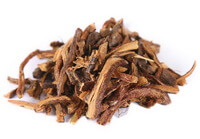 Pinyin Name: Gǔ Suì Bǔ
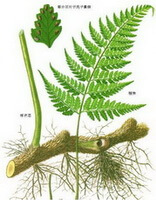 Botanical Description: Drynaria fortunei (Kunze) J. Smith—also known as Polypodium fortunei Kunze—is commonly called Hú Jué, Xī Nán Hú Jué, and Bǎn Yá Jiāng. It is a herbaceous epiphyte of the genus Drynaria (family Polypodiaceae, order Polypodiales), growing up to 20–40 cm tall. Its rhizomes are amphitropous, coarse, and succulent, densely covered with subulate-lanceolate scales and green hairs.
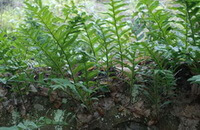 Ecological Environment: Drynaria fortunei (Kunze) J. Smith grows on rocks in forests or on tree trunks at altitudes of 200–1,800 m and is predominantly distributed in China, as well as in parts of Southeast Asia.
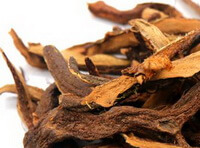 Characteristics of the Herb: The rhizomes are irregular, stripe-like structures with flat dorsal and ventral surfaces, often lumpy or flaky, mostly curved, and frequently constricted and branched on both sides; they measure 3–20 cm in length and 0.7–1.5 cm in width. The surface of the dried rhizome is densely covered with brown or reddish-brown, small, appressed, membranous, peltate (shield-shaped) scales; the erect scales are lanceolate, with acute apices and fimbriate (penicillate or fringelike) margins bearing cilia, and are especially dense at the bases of petioles and the apical (tender) ends of the rhizomes. Where scales have fallen off, the underlying tissue appears brown, revealing fine longitudinal veins and ridges. Petiole scars are present on the upper (adaxial) surface, while the lower (abaxial) surface bears longitudinal ridges and radicel scars (marks of fine roots). The herb is firm and hard in texture; its fracture surface is reddish-brown, with white, discrete vascular bundles (steles) arranged in elongated, oblate shapes. It has a fragrant odor and tastes slightly sweet and astringent.
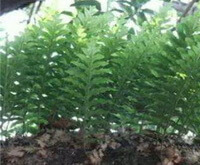 Botanical Description: Drynaria propinqua (Wall.) J. Smith—also known as Polypodium propinquum Wall.—is commonly called Guāng Yè Hú Jué and Shí Lián Jiāng Hú Jué. It is a herbaceous epiphyte of the genus Drynaria (family Polypodiaceae, order Polypodiales), growing up to 60 cm tall. Its rhizomes are succulent and amphitropous, covered with opaque, tan (chocolate brown), lanceolate scales.
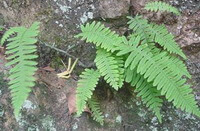 Ecological Environment: This species grows on tree trunks or rocks in forests at altitudes of 500–2,400 m above sea level. It is predominantly distributed in China and also occurs in several countries of South Asia.
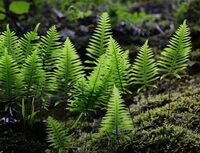 Botanical Description: Drynaria sinica Diels—also known as Drynaria baronii (Christ) Diels or Polypodium baronii Christ—is commonly called Qín Lǐng Hú Jué, Zhōng Huá Hú Jué, or Huá Hú Jué. It is a herbaceous epiphyte of the genus Drynaria (family Polypodiaceae, order Polypodiales), growing up to 20–50 cm tall. Its rhizomes are amphitropous and succulent, approximately 1–2 cm in diameter, and densely covered with reddish-brown, lanceolate scales.
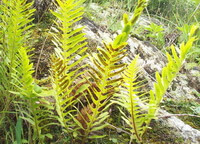 Leaves are dimorphic; the rachis and leaf veins are sparsely pubescent. Trophophylls (vegetative leaves) are sparse and few in number, oblong-lanceolate, and pinnately parted. Fertile fronds have petioles with narrow wings; the base bears nodes and joints. Leaf blades are broadly lanceolate, 20–40 cm long, with the midportion 5–10 cm wide; they are deeply pinnately parted nearly to the rachis. Both surfaces bear white pubescence along the veins and rachis. Pinnae occur in 20–30 pairs, 5–15 mm wide, with obtuse apices and incised-serrate margins. Venation is conspicuous.
 Ecological Environment: This species grows among rocks in valleys or at forest edges, at altitudes of 900–2,800 m above sea level, or on rocky understories of hillsides at 1,380–3,800 m. It is predominantly distributed in China.
 Characteristics of the Herb: The rhizomes are irregularly cylindrical, slightly flattened on both dorsal and ventral surfaces, 3–8 cm long and 0.6–1 cm wide. Scales are strip-lanceolate; where scales have fallen off, the exposed surface is taupe (grayish brown) and exhibits fine, longitudinal veins. The fracture surface is brownish ash-gray (grayish-white), with punctate, discrete vascular bundles (steles) arranged elliptically. The herb has a fragrant odor and tastes astringent.
 Botanical Description: Pseudodrynaria coronans (Wall.) Ching—also known as Polypodium coronans Wall.—is commonly called Yá Jiāng Jué or Chuān Shí Jiàn. It belongs to the genus Pseudodrynaria (C. Chr.) C. Chr. (family Polypodiaceae, order Polypodiales) and grows up to 80–140 cm tall. Its rhizomes are stout and densely covered with brown, linear scales. Leaves are monomorphic, forming dense, tufted, erect, hollow, rounded clusters. Leaf blades are 80–140 cm long, with acuminate apices; the portion below the middle tapers gradually, while the base broadens and becomes cordate; the portion above the middle is deeply pinnately parted, shallowly lobed, and undulate distally. Both surfaces are smooth and glabrous, with entire margins. Venation is reticulate and distinct on both surfaces, with veinlets in the meshes either simple or bifurcated.
 Sori grow at the junctions of veinlets, arranged in a single row between each pair of lateral veins; they are circular or usually elongated along the tertiary veinlets, becoming linear and fragmented at maturity.
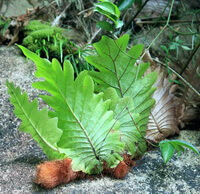 Characteristics of the Herb: The rhizomes are cylindrical, with surfaces densely covered by strip-lanceolate, loose, and soft scales. Where scales have fallen off, the exposed surface is puce (purplish brown), bearing longitudinal grooves, ridges, and fine, variably sized surface patterns. The fracture surface is brown, with dot-like, discrete vascular bundles (steles) arranged orbicularly. The herb has a very faint odor and tastes astringent.
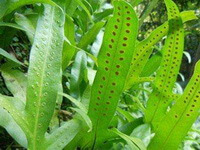 Botanical Description: Phymatodes lucida (Roxb.) Ching is commonly known as Guānɡ Liànɡ Mì Wǎnɡ Jué and also as Phymatodes cuspidata (D. Don) J. Smith, or Guānɡ Liànɡ Liú Jué; it is a plant of the family Polypodiaceae (order Polypodiales). It is an epiphyte that adheres to rocks. The plant is 40–100 cm tall. Rhizomes are decumbent, about 2 cm in diameter, celadon (grayish-green), and sparsely scaly; scales are oval (egg-shaped), peltate and centrally inserted, brown, with irregular margins. Leaves are spaced far apart and round in outline; petioles are 30–50 cm long, culm-colored, stout, and glabrous; the leaf blade is once-pinnate, 30–50 cm long and 20–25 cm wide. Pinnae occur in 8–15 pairs, each 15–20 cm long and 2–3.5 cm wide; the apex is acuminate, the base is stipitate (with a petiole up to 1 cm long), and the margins are entire. Lateral veins are inconspicuous, and veinlets form a reticulate network. Leaves are subcoriaceous, and both surfaces are smooth and glabrous. Sori are arranged in a single row on either side of the midvein of the pinnae, located between the midvein and the margin; the spore surface bears minute granular ornamentation.
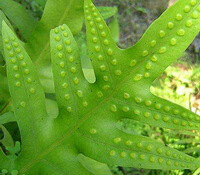 Ecological Environment: This species grows on limestone cliffs at forest edges, at altitudes of 250–1,500 m. It is mainly distributed in China.
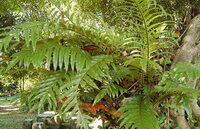 Botanical Description: Davallia divaricata Bl. is also known as Davallia formosana Hayata and commonly called Dà Yè Gǔ Suì Bǔ; it is a plant of the genus Davallia (family Davalliaceae, order Polypodiales). The plant reaches a height of 50–150 cm, or approximately 1 m. The rhizome is stout, long, and amphitropous, 1 cm in diameter, and densely covered with fluffy scales; scales are broadly lanceolate, about 1 cm long, with a long-acuminate apex, ciliate margins, reddish-brown color, and membranous texture.
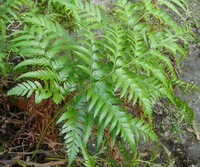 Ecological Environment: This species grows attached to tree trunks or rocks in ravine forests at altitudes of 600–700 m. It is mainly distributed in China.
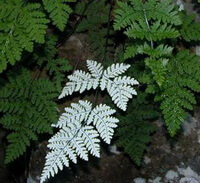 Botanical Description: Davallia mariesii Moore ex Bak. is commonly known as Hǎi Zhōu Gǔ Suì Bǔ; it is a plant of the genus Davallia (family Davalliaceae, order Polypodiales). The plant is 20 cm tall or grows 15–40 cm high. Rhizomes are long and amphitropous, 4–5 mm in diameter, and densely covered with taupe-brown, fluffy scales; scales are broadly lanceolate or lanceolate, about 8 mm long, with a long-acuminate apex and ciliate margins; the central portion is dark-colored, while the margins are paler.
