✵This article documents the herb Leech, including its English name, Latin name, Pinyin name, properties and flavors, and its source—as defined in classical herbal works—comprising three animal species: (1) Whitmania pigra Whitman, (2) Hirudo nipponica Whitman, and (3) Whitmania acranulata Whitman. It provides a detailed description of the morphological features, life habits, and ecological environments of these three species; outlines the characteristics of the herb Leech; and covers its pharmacological actions, medicinal efficacy, and administration guidelines.
Hirudo (Leech)
Pinyin Name: Shuǐ Zhì
English Name: Leech
Latin Name:Hirudo Properties and Flavor: Neutral; salty, bitter, and toxic.
Brief Introduction: Hirudo is the dried whole body of Whitmania pigra Whitman, Whitmania acranulata Whitman, or Hirudo nipponica Whitman. It is used to break blood stasis and reduce swelling, primarily for severe blood stasis syndromes such as hematoma, amenorrhea, gynecological masses, and contusions. Commonly known as Hirudo, Leech, or Shuǐ Zhì.
Source: Classical herbal works and other authoritative materia medica define Hirudo (Leech) as the dried whole body of (1) Whitmania pigra Whitman, (2) Hirudo nipponica Whitman, and (3) Whitmania acranulata Whitman—small animals belonging to the family Hirudinidae, order Rhynchobdellida. These three commonly used species are described below:
(1) Whitmania pigra Whitman
Description: It is commonly known as Ma Huang or Kuan Ti Jin Xian Zhi. The body is slightly fusiform (spindle-shaped) and dorsoventrally flattened. It measures 60–120 mm in length and 13–14 mm in width. The dorsal surface is dark green, bearing five yellowish-white longitudinal streaks composed of alternating black and pale yellow bands. On each side of the ventral surface, there is one flaxen longitudinal stripe; the remaining ventral area is hoary (off-white), mottled, and bears a tawny spot. The body comprises 10 annuli (body rings). The banding pattern is conspicuous. The male and female genital pores are located between the 33rd–34th and 38th–39th annular furrows, respectively. The anterior sucker is small. The palatal teeth are underdeveloped, and the species does not feed on blood.
The body is slightly flattened; at first glance, it resembles a cylinder. Its length is approximately 2–2.5 cm, and its width is about 2–3 mm. The dorsal surface is greenish-black with five yellow longitudinal lines. The ventral surface is flat and grayish-green, lacking mottled spots; the annular segmentation is prominent. Each body segment consists of five annuli, and the width of each annulus is relatively uniform. It possesses 10 eyes arranged in an inverted-U (∩) configuration. Inside the mouth are three semicircular jaws arranged in a Y-shaped pattern; during feeding, it uses these jaws to pierce the host’s skin and draw blood. Blood passes from the pharynx through the esophagus into the entire digestive tract and caecal diverticula (blind sacs). A pair of nephridiopores (excretory openings) opens ventrally on each segment. The male and female genital pores are separated by four annuli, with each pore situated between adjacent annuli. The anterior sucker is readily visible, whereas the posterior sucker is larger, more conspicuous, and exhibits strong adhesive capacity.
Ecological Environment: It inhabits rice paddies, irrigation ditches, shallow stagnant water bodies, and muddy ponds. It is non-hematophagous, highly agile, capable of undulatory swimming and inchworm-like locomotion. In early spring, leeches emerge from dormancy; their spawning period extends from June to October. During winter, they hibernate in moist coastal mud, ceasing feeding and movement—exhibiting remarkable survival capacity.
Life Habits: It dwells in paddy fields and rivers.
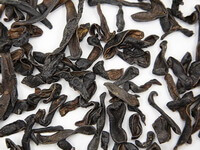
Herb Characteristics: The dried herb is flat-fusiform (spindle-shaped) and segmented, measuring 4–10 cm in length and 0.5–2 cm in width. The dorsal surface is blackish-brown or dark brown, slightly depressed, and marked with black spots arranged in five longitudinal rows; the water-entry points (pores) are clearly visible. The ventral surface is yellowish and flat, with brownish-yellow margins on both sides. The anterior end is slightly pointed; the posterior end is bluntly rounded and bears a large, conspicuous posterior sucker, while the anterior sucker is smaller. The texture is brittle and easily fractured. The herb emits a fishy odor and has a salty taste.
Pharmacological Actions: (1) reduces serum cholesterol levels; (2) inhibits the conversion of fibrinogen to fibrin; (3) suppresses activation of coagulation factors and thrombin-induced platelet aggregation; (4) exerts anticoagulant activity; (5) improves local microcirculation.
Medicinal Efficacy: Breaks blood stasis, promotes menstruation, resolves stasis-induced abdominal masses. It is indicated for abdominal masses, palpable abdominal lumps, blood stasis retention, amenorrhea due to blood stasis, dry-blood consumption (a TCM syndrome resembling consumptive disease), apoplexy with hemiplegia, traumatic injuries, eye pain, nebula (mild corneal opacity), and other stasis-related conditions.
Administration of Hirudo (Shuǐ Zhì):
Reference:
Administration Guide for Hirudo (Shuǐ Zhì)
TCM Books:
(1) Internally: 1–3 grams; (2) Internally:formulated into pills or powders, 0.5–4 qian (≈1.5–12 grams). Externally:put at the diseased region and let it suck, or prepare infusion and dropping; (3) Internally: as a water decoction, 3–9 grams; or as pills/powders, 0.5–1.5 grams per dose (maximum single dose: 3 grams).
Contraindications, Precautions, and Adverse Reactions: Hirudo is contraindicated during pregnancy, in syndromes without blood stasis, during menstruation, and in individuals with hemorrhagic tendencies. It should not be processed with lime (calcium oxide) or salt.
(2) Hirudo nipponica Whitman.
Description: It is commonly known as Shuǐ Zhì. The body is slightly dorsoventrally flattened; at first glance, it resembles a cylinder. Its length ranges from approximately 2–15 cm, and its width from 2 mm to 1.5 cm. The dorsal surface is greenish-black with five yellow longitudinal stripes. The ventral surface is flat and celadon (grayish-green), lacking mottled spots; the annular segmentation is prominent. Each body segment bears five annuli of relatively uniform width. It possesses 10 eyes arranged in an inverted-U (∩) configuration. Inside the mouth are three semicircular jaws arranged in a Y-shaped pattern; during feeding, it uses these jaws to pierce the host’s skin and draw blood. The body is relatively large—60–120 mm in length and 13–14 mm in width. The dorsal surface is dark green, marked with five longitudinal stripes. Blood passes from the pharynx through the esophagus into the entire digestive tract and caecal diverticula (blind sacs). A pair of nephridiopores (excretory openings) opens ventrally on each segment. The male and female genital pores are separated by four annuli, with each pore situated between adjacent annuli. The anterior sucker is readily visible; the posterior sucker is larger, more conspicuous, and exhibits strong adhesive capacity.
Ecological Environment: It inhabits rice paddies, irrigation ditches, shallow stagnant water bodies, and muddy ponds. It is hematophagous—feeding on the blood of humans and animals—and highly agile, capable of undulatory swimming and inchworm-like locomotion. It becomes active in early spring; its spawning period extends from June to October. During winter, it hibernates in moist coastal mud, ceasing feeding and movement—demonstrating remarkable survival capacity.
It is widely distributed across lakes, ponds, and paddy fields throughout most regions of China.
Life Habits: Leeches are ectothermic (cold-blooded) animals, capable of growth and reproduction in both northern and southern China. They primarily inhabit reservoirs, ditches, paddy fields, and lakes—freshwater habitats—especially organically rich ponds or unpolluted rivers.
Herb Characteristics: The dried herb is flat, elongated, and cylindrical—composed of numerous annuli—with frequent twists and curves. It measures 2–5 cm in length and 0.2–0.3 cm in width. The dorsal surface is dark green or dark brown, bearing five yellowish-brown longitudinal stripes that become clearly visible upon immersion in water. The ventral surface is celadon (grayish-green). The anterior end is slightly pointed; the posterior end is bluntly rounded, with suckers present at both ends. The posterior sucker is particularly prominent, lighter in color, and more brittle than typical specimens; its fracture surface is gelatinous. The herb emits a mild fishy odor.
(3) Whit-mania acranulata Whitman.
Description: It is commonly known as Liu Ye Ma Huang or the tawny leech. It belongs to the family Hirudinidae and is also colloquially referred to as “cattle leech.” It exhibits a flattened morphology and brownish-green coloration. The tawny leech is distributed across most regions of China.
Its shape resembles that of a willow leaf. The dorsal surface is brownish-green, marked with five fine greenish-black spots aligned vertically. The ventral surface is pale yellow and markedly flattened, scattered with irregular dark green spots. Other morphological features closely resemble those of Whitmania pigra (the broad-bodied golden-thread leech).
Herb Characteristics: The dried herb is long, narrow, flat, or linear, measuring 8–12 cm in length and 1–5 mm in width. Both ends taper gradually, and the surface is uneven. The dorsal and ventral surfaces are dark brown; the suckers are inconspicuous due to small perforations at both ends introduced during processing. The texture is brittle, and the fracture surface is uneven and dull. The herb emits a soil-like, fishy odor.

 ✵This article documents the herb Leech, including its English name, Latin name, Pinyin name, properties and flavors, and its source—as defined in classical herbal works—comprising three animal species: (1) Whitmania pigra Whitman, (2) Hirudo nipponica Whitman, and (3) Whitmania acranulata Whitman. It provides a detailed description of the morphological features, life habits, and ecological environments of these three species; outlines the characteristics of the herb Leech; and covers its pharmacological actions, medicinal efficacy, and administration guidelines.
 Pinyin Name: Shuǐ Zhì
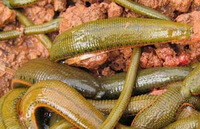 Description: It is commonly known as Ma Huang or Kuan Ti Jin Xian Zhi. The body is slightly fusiform (spindle-shaped) and dorsoventrally flattened. It measures 60–120 mm in length and 13–14 mm in width. The dorsal surface is dark green, bearing five yellowish-white longitudinal streaks composed of alternating black and pale yellow bands. On each side of the ventral surface, there is one flaxen longitudinal stripe; the remaining ventral area is hoary (off-white), mottled, and bears a tawny spot. The body comprises 10 annuli (body rings). The banding pattern is conspicuous. The male and female genital pores are located between the 33rd–34th and 38th–39th annular furrows, respectively. The anterior sucker is small. The palatal teeth are underdeveloped, and the species does not feed on blood.
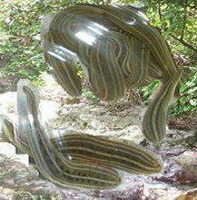 Description: It is commonly known as Shuǐ Zhì. The body is slightly dorsoventrally flattened; at first glance, it resembles a cylinder. Its length ranges from approximately 2–15 cm, and its width from 2 mm to 1.5 cm. The dorsal surface is greenish-black with five yellow longitudinal stripes. The ventral surface is flat and celadon (grayish-green), lacking mottled spots; the annular segmentation is prominent. Each body segment bears five annuli of relatively uniform width. It possesses 10 eyes arranged in an inverted-U (∩) configuration. Inside the mouth are three semicircular jaws arranged in a Y-shaped pattern; during feeding, it uses these jaws to pierce the host’s skin and draw blood. The body is relatively large—60–120 mm in length and 13–14 mm in width. The dorsal surface is dark green, marked with five longitudinal stripes. Blood passes from the pharynx through the esophagus into the entire digestive tract and caecal diverticula (blind sacs). A pair of nephridiopores (excretory openings) opens ventrally on each segment. The male and female genital pores are separated by four annuli, with each pore situated between adjacent annuli. The anterior sucker is readily visible; the posterior sucker is larger, more conspicuous, and exhibits strong adhesive capacity.
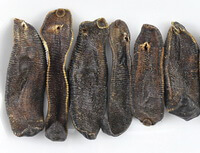 Herb Characteristics: The dried herb is flat, elongated, and cylindrical—composed of numerous annuli—with frequent twists and curves. It measures 2–5 cm in length and 0.2–0.3 cm in width. The dorsal surface is dark green or dark brown, bearing five yellowish-brown longitudinal stripes that become clearly visible upon immersion in water. The ventral surface is celadon (grayish-green). The anterior end is slightly pointed; the posterior end is bluntly rounded, with suckers present at both ends. The posterior sucker is particularly prominent, lighter in color, and more brittle than typical specimens; its fracture surface is gelatinous. The herb emits a mild fishy odor.
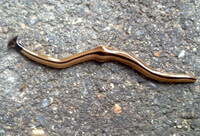 Description: It is commonly known as Liu Ye Ma Huang or the tawny leech. It belongs to the family Hirudinidae and is also colloquially referred to as “cattle leech.” It exhibits a flattened morphology and brownish-green coloration. The tawny leech is distributed across most regions of China.
