✵The article records the mineral herb Pyrite, including its English name, Latin name, Pinyin name, properties and flavors, and its mineral source—namely, native iron disulfide (FeS₂). It provides a detailed description of the mineral’s physical and crystallographic characteristics, macroscopic features of the crude drug, its pharmacological actions, medicinal efficacy, and administration guidelines.
Pyritum (Pyrite)
Pinyin Name: Zì Rán Tónɡ
English Name: Pyrite
Latin Name:Pyritum Properties and Flavors: Neutral in nature; pungent
Brief Introduction:Pyritum is a brassy-yellow mineral composed of iron disulfide (FeS₂), commonly occurring as cubic or octahedral crystals. It is used in Traditional Chinese Medicine to promote fracture healing and alleviate traumatic pain. Commonly known as Pyrite, Pyritum, or Zì Rán Tónɡ.
Mineral Source: Classical herbal works define Pyritum (Pyrite) as native iron disulfide (FeS₂). The following describes this commonly used mineral:
Native Iron Disulfide (FeS₂): Its crystalline structure belongs to the isometric (cubic) system. Crystals occur in various forms—including cubes, octahedra, and pentagonal dodecahedra—and polymorphic aggregates may appear botryoidal (grape-like), granular, stalactitic, or massive. Crystal faces often display striations. The mineral is pale brass-yellow in color; streak is greenish-black to brownish-black. It exhibits a strong metallic luster. Cleavage is indistinct; fracture is uneven to conchoidal. Hardness on the Mohs scale is 6–6.5; brittleness is high. Specific gravity ranges from 4.9 to 5.2.
Distribution: Pyrite is one of the most abundant and widely distributed sulfide minerals in the Earth’s crust. It occurs in diverse geological settings—including igneous, metamorphic, and sedimentary rocks—but is especially common in volcanic-sedimentary and hydrothermal deposits. In exodiagenetic environments, it is frequently found in stratified sedimentary rocks, sedimentary ores, and coal seams, where it typically forms compact, massive, or nodular (concretionary) aggregates.
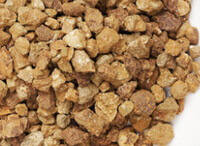
Characters of herbs: The crude herb consists predominantly of cubic or hexahedral fragments, 0.2–2.5 cm in diameter, with distinct ridges and a bright, pale yellow surface. Streak is greenish-black or brownish-red. The surface is smooth, occasionally revealing fine striations. The material is opaque, with a pronounced metallic luster. It is heavy; texture is firm, hard, and brittle; fractures are readily. Fresh fracture surfaces are pale yellow to white and retain a metallic luster. Odorless and tasteless, but emits sulfur dioxide when heated. Weathered pyrite may oxidize to limonite, appearing tawny (yellowish-brown) or dark brown; fractured pieces remain dark brown, though pale yellow unweathered FeS₂ cores may persist within.
Pharmacological Actions: (1) Promotion of fracture healing; (2) Antifungal activity.
Medicinal Efficacy: Invigorates blood circulation, dispels blood stasis, alleviates pain, strengthens tendons, and promotes bone regeneration. Indicated for traumatic injuries (e.g., contusions, tendon/muscle injuries, lacerations), swelling and pain due to blood stasis, abscesses, carbuncles, ulcers, burns (thermal injuries), and post-traumatic indurations.
Administration of Pyritum (Zì Rán Tónɡ):
Reference:
Administration Guide for Pyritum (Zì Rán Tónɡ)
TCM Books:
(1) Internally: 3–9 grams, prepared as pills or powder; if used in decoction, added early in the boiling process. For external use: apply an appropriate amount; (2) Internally: water decoction, 1–3 qián (≈3–9 grams), or prepared as pills or powder. For external use: apply the finely powdered herb mixed with a suitable medium (e.g., vinegar or honey) as a topical paste; (3) Internally: water decoction, 1–3 qián (≈3–9 grams), or prepared as pills or powder. For external use: apply the finely powdered herb mixed with a suitable medium as a topical paste.
Contraindications, Precautions, and Adverse Reactions: Pyritum is contraindicated during pregnancy. Use with caution in patients with bleeding disorders or deficiency-cold syndromes. Should not be administered concurrently with iron supplements or prepared/stored in iron utensils.

 ✵The article records the mineral herb Pyrite, including its English name, Latin name, Pinyin name, properties and flavors, and its mineral source—namely, native iron disulfide (FeS₂). It provides a detailed description of the mineral’s physical and crystallographic characteristics, macroscopic features of the crude drug, its pharmacological actions, medicinal efficacy, and administration guidelines.
 Pinyin Name: Zì Rán Tónɡ
 Characters of herbs: The crude herb consists predominantly of cubic or hexahedral fragments, 0.2–2.5 cm in diameter, with distinct ridges and a bright, pale yellow surface. Streak is greenish-black or brownish-red. The surface is smooth, occasionally revealing fine striations. The material is opaque, with a pronounced metallic luster. It is heavy; texture is firm, hard, and brittle; fractures are readily. Fresh fracture surfaces are pale yellow to white and retain a metallic luster. Odorless and tasteless, but emits sulfur dioxide when heated. Weathered pyrite may oxidize to limonite, appearing tawny (yellowish-brown) or dark brown; fractured pieces remain dark brown, though pale yellow unweathered FeS₂ cores may persist within.
