Introduction of Máo Dōnɡ Qīnɡ: Pubescent Holly Root
✵This article documents the herb Pubescent Holly Root—including its English name, Latin name, Pinyin name, properties and flavor, botanical source (a single plant species: Ilex pubescens Hook. et Arn.), and provides a detailed description of the plant’s botanical features, growth characteristics, ecological environment, macroscopic characteristics of the dried root, pharmacological actions, medicinal efficacy, and administration guidelines.
Radix llicis Pubescentis (Pubescent Holly Root)
Pinyin Name: Máo Dōnɡ Qīnɡ
English Name: Pubescent Holly Root
Latin Name:Radix llicis Pubescentis Properties and Flavor: Cold, bitter, and slightly astringent
Brief Introduction:Radix Ilicis Pubescentis is the dried root of Ilex pubescens Hook. et Arn. It is used (1) to invigorate blood circulation and unblock the meridians and collaterals—indicated for thromboangiitis obliterans and angina pectoris; (2) to clear heat and counteract toxins—indicated for inflammatory conditions such as acute tonsillitis; and (3) as an antitussive and expectorant—indicated for acute bronchitis. It is commonly known as Radix Ilicis Pubescentis, Pubescent Holly Root, Root of Pubescent Holly, or Máo Dōnɡ Qīnɡ.
Botanical Source: Classical herbal works define Radix Ilicis Pubescentis (Pubescent Holly Root) as the dried root of Ilex pubescens Hook. et Arn., a plant of the genus Ilex L., family Aquifoliaceae (holly family), order Sapindales. The following description pertains to this commonly used species:
(1) Ilex pubescens Hook. et Arn.
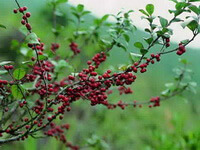
Botanical Description:Ilex pubescens Hook. et Arn. is also known as Ilex trichoclada Hayata, commonly called Máo Dōnɡ Qīnɡ. It is an evergreen shrub or small tree, reaching up to 3–4 meters in height. Branchlets are slender and nearly prismatic, taupe (dust-colored or grayish-brown), densely hirsute, with longitudinal ridges, lacking lenticels, and bearing slightly raised, nearly crescent-shaped leaf scars. Terminal buds are usually stunted or absent; current-year or one- to two-year-old branches bear leaves. Leaf blades are chartaceous (papery) or membranous, oval (egg-shaped), elliptic, or long-ovate, 2–6 cm long and 1–2.7 cm wide; the apex is short-acuminate or acute; the base is broadly cuneate or rounded; the margin is finely serrated with thin, sharp teeth—or nearly entire; the midvein is concave on the upper surface; there are 4–5 pairs of lateral veins; both surfaces bear sparse coarse hairs, while dense short coarse hairs occur along the veins. Petioles are 2.5–5 mm long and densely hirsute.
Inflorescences are axillary, grow on one- to two-year-old branches, and densely hirsute. Male inflorescences: each bears one flower (rarely three); flowers are tetramerous or pentamerous; pedicels are 1–2 mm long, with two bracteoles at the base; in three-flowered inflorescences, pedicels measure 1–1.5 mm. The calyx is ~2 mm in diameter, with ovate-triangular, pubescent lobes. The corolla is 4–5 mm in diameter, obovate-oblong, and shorter than the stamens. Female inflorescences: each bears 1–3 flowers; flowers are hexamerous or octomerous; the calyx is ~2.5 mm in diameter, with broadly ovate, hirsute lobes; petals are oblong-ovate, ~2 mm long; the ovary is ovoid, ~1.5 mm long and ~1.3 mm in diameter, glabrous; the style is conspicuous; the stigma is capitate or thickly discoid.
The fruit is globose, ~3–4 mm in diameter, turning red at maturity. The persistent style is conspicuous. Each fruit typically contains six pyrenes, though five or seven may occur. Pyrenes are elliptic, with a single longitudinal groove on the dorsal surface and smooth lateral surfaces; the endocarp is nearly lignified. Flowering occurs from April to May; fruiting, from July to August.
Ecological Environment: This species commonly grows in thickets and sparse grasslands on hillsides or mountain slopes, at elevations of 180–500 m above sea level, within evergreen broad-leaved forests or at forest margins, and along streams and roadsides.
Growth Characteristics: The plant adapts well to red and yellow soils widely distributed in southern China. It is shade-tolerant.
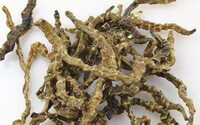
Characteristics of the Herb: Roots are cylindrical—sometimes branched—with variable lengths and diameters of 1–4 cm. The surface is taupe (dust-colored or grayish-brown) to tan (chocolate brown); the root head bears stem remnants and branch scars. The cortex is slightly coarse and rough, marked by fine longitudinal wrinkles and transverse lenticels. The texture is solid and firm, not easily fractured; the cortical layer at the fracture surface is thin; the xylem is well-developed, khaki to ash-gray (grayish-white), with dense radial striations and concentric ring patterns. The herb has a slight odor and tastes initially bitter and astringent, followed by a mild sweetness. Commercial material is commonly irregularly lumpy or flaky, varying in size, and 0.5–1 cm thick.
Pharmacological Actions: (1) Effects on the cardiovascular system; (2) Antimicrobial effect: bacteriostatic tests showed that Staphylococcus aureus is extremely sensitive to Radix Ilicis Pubescentis. Bacillus proteus, Shigella flexneri, and Pseudomonas aeruginosa are also sensitive; (3) Antitussive and expectorant effects.
Medicinal Efficacy: Clearing heat, detoxifying, promoting blood circulation, and unblocking collaterals. It is indicated for wind-heat common cold, lung-heat asthma and cough, sore throat, tonsillitis (“nippled moth”), gingival swelling and pain, chest pain and epigastric discomfort, apoplexy with hemiplegia, thromboangiitis obliterans (Buerger’s disease), erysipelas, burns (scalds or thermal burns), ulcers, central retinitis, etc.
Administration of Radix Ilicis Pubescentis (Máo Dōnɡ Qīnɡ):
Reference:
Administration Guide for Radix Ilicis Pubescentis (Máo Dōnɡ Qīnɡ)
TCM Books:
(1) Internally: 3–9 grams; (2) Internally: water decoction, 1–3 liang (approximately 30–90 grams); external use: apply topically with water decoction or soak; (3) Internally: water decoction, 10–30 grams; external use: appropriate amount, apply topically with water decoction or soak.
Contraindications, Precautions, and Adverse Reactions: Radix Ilicis Pubescentis is slightly toxic; long-term or excessive dosing should be avoided.
References:
1.Introduction of Máo Dōnɡ Qīnɡ: Pubescent Holly Root

 ✵This article documents the herb Pubescent Holly Root—including its English name, Latin name, Pinyin name, properties and flavor, botanical source (a single plant species: Ilex pubescens Hook. et Arn.), and provides a detailed description of the plant’s botanical features, growth characteristics, ecological environment, macroscopic characteristics of the dried root, pharmacological actions, medicinal efficacy, and administration guidelines.
 Pinyin Name: Máo Dōnɡ Qīnɡ
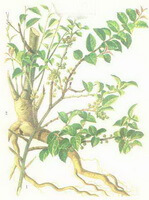 Botanical Description: Ilex pubescens Hook. et Arn. is also known as Ilex trichoclada Hayata, commonly called Máo Dōnɡ Qīnɡ. It is an evergreen shrub or small tree, reaching up to 3–4 meters in height. Branchlets are slender and nearly prismatic, taupe (dust-colored or grayish-brown), densely hirsute, with longitudinal ridges, lacking lenticels, and bearing slightly raised, nearly crescent-shaped leaf scars. Terminal buds are usually stunted or absent; current-year or one- to two-year-old branches bear leaves. Leaf blades are chartaceous (papery) or membranous, oval (egg-shaped), elliptic, or long-ovate, 2–6 cm long and 1–2.7 cm wide; the apex is short-acuminate or acute; the base is broadly cuneate or rounded; the margin is finely serrated with thin, sharp teeth—or nearly entire; the midvein is concave on the upper surface; there are 4–5 pairs of lateral veins; both surfaces bear sparse coarse hairs, while dense short coarse hairs occur along the veins. Petioles are 2.5–5 mm long and densely hirsute.
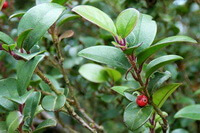 Inflorescences are axillary, grow on one- to two-year-old branches, and densely hirsute. Male inflorescences: each bears one flower (rarely three); flowers are tetramerous or pentamerous; pedicels are 1–2 mm long, with two bracteoles at the base; in three-flowered inflorescences, pedicels measure 1–1.5 mm. The calyx is ~2 mm in diameter, with ovate-triangular, pubescent lobes. The corolla is 4–5 mm in diameter, obovate-oblong, and shorter than the stamens. Female inflorescences: each bears 1–3 flowers; flowers are hexamerous or octomerous; the calyx is ~2.5 mm in diameter, with broadly ovate, hirsute lobes; petals are oblong-ovate, ~2 mm long; the ovary is ovoid, ~1.5 mm long and ~1.3 mm in diameter, glabrous; the style is conspicuous; the stigma is capitate or thickly discoid.
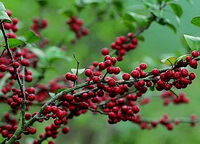 Ecological Environment: This species commonly grows in thickets and sparse grasslands on hillsides or mountain slopes, at elevations of 180–500 m above sea level, within evergreen broad-leaved forests or at forest margins, and along streams and roadsides.
 Characteristics of the Herb: Roots are cylindrical—sometimes branched—with variable lengths and diameters of 1–4 cm. The surface is taupe (dust-colored or grayish-brown) to tan (chocolate brown); the root head bears stem remnants and branch scars. The cortex is slightly coarse and rough, marked by fine longitudinal wrinkles and transverse lenticels. The texture is solid and firm, not easily fractured; the cortical layer at the fracture surface is thin; the xylem is well-developed, khaki to ash-gray (grayish-white), with dense radial striations and concentric ring patterns. The herb has a slight odor and tastes initially bitter and astringent, followed by a mild sweetness. Commercial material is commonly irregularly lumpy or flaky, varying in size, and 0.5–1 cm thick.
