✵The article records the herb Sappan Wood, including its English name, Latin name, Pinyin name, properties and flavors, and its botanical source—namely, the plant species Caesalpinia sappan L. It provides a detailed introduction to the botanical features, growth characteristics, and ecological environment of this species, as well as the macroscopic and microscopic characteristics of the herb Sappan Wood, its pharmacological actions, medicinal efficacy, and administration guidelines.
Lignum Sappan (Sappan Wood)
Pinyin Name: Sū Mù
English Name: Sappan Wood
Latin Name:Lignum Sappan Properties and Flavors: Neutral in nature; sweet and salty
Brief Introduction:Lignum Sappan is the dried heartwood of Caesalpinia sappan L., used to invigorate blood and dispel stasis. It is primarily indicated for contused wounds, dysmenorrhea, and amenorrhea. Commonly known as Sappan Wood, Logwood, or Sū Mù.
Botanical Source: Classical herbal works define Lignum Sappan (Sappan Wood) as the dried heartwood of Caesalpinia sappan L., a species belonging to the genus Caesalpinia, family Fabaceae (Leguminosae, the legume or pea family), order Rosales. The following describes this commonly used species:
(1) Caesalpinia sappan L.
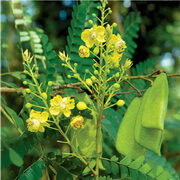
Botanical Description:Caesalpinia sappan L. is commonly known as Sū Mù. It is a shrub or small tree, growing up to 5–10 meters tall. The trunk bears spines; branchlets are celadon (grayish-green), bearing round, protruding lenticels; young branchlets are puberulent but become glabrous with age. Leaves are bipinnately compound, 30–40 cm long; pinnae occur in 7–13 opposite pairs; rachis is pubescent; leaflets (foliolules) occur in 9–17 opposite pairs, oblong to oblong-rhombic, ~14 mm long and ~6 mm wide; apex is blunt and emarginate (slightly concave); base is oblique; margins are entire; upper surface is green and glabrous; lower surface bearing glandular dots; midvein is oblique.
Inflorescences are terminal or axillary panicles, approximately equal in length to the leaves, and pubescent. Floral bracts are large, lanceolate, and caducous. Pedicels are ~15 mm long and finely pilose. The receptacle is shallowly campanulate (bell-shaped). There are five sepals, slightly unequal in size; the lower sepal is larger and pouch-shaped. Petals are yellow, broadly obovate, ~9 mm long; the upper sepal is pink at the base and stipitate. There are ten free stamens arranged in two whorls, slightly exserted; filaments are slender—the upper portion is twisted, the lower portion is densely pubescent. The pistil consists of a single carpel; the style is slender and elongated; the ovary is covered with grayish pubescence; the style is pilose; the stigma is truncate.
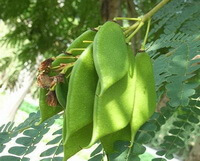
Fruits are woody, slightly flattened, nearly oblong to oblong-obovate, ~7 cm long and 3.5–4 cm wide; base is slightly narrowed; apex is obliquely truncate and promuscoid (beak-like); reddish-brown; indehiscent. Seeds number 3–4, oblong, slightly flattened, ~2 cm long, brownish-yellow. Flowering occurs from May to October; fruiting extends from July to March of the following year.
Ecological Environment: This small tree grows naturally in valleys and jungles or is cultivated. It is mainly distributed in China and also occurs in several regions of Southeast Asia.
Growth Characteristics:Caesalpinia sappan prefers full sun, avoids shade and waterlogging, and is drought-tolerant. Soil requirements are not strict.
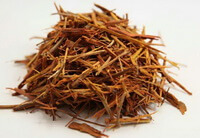
Characteristics of the Herb: The dried heartwood is cylindrical or semi-cylindrical, 10–100 cm long and 3–12 cm in diameter. The surface is yellowish-red to reddish-brown, marked by knife cuts and branch scars; longitudinal cracks are common. The transverse section is slightly lustrous, with conspicuous growth rings (annual rings); the pith is dark brown, loose, and interspersed with bright spots. The texture is firm and hard. The herb has a faint odor and a slightly astringent taste.
Pharmacological Actions: (1) Cardiovascular effects; (2) Anticancer activity; (3) Aldose reductase inhibition; (4) Antibacterial activity against various bacteria, including Staphylococcus aureus, Streptococcus pyogenes, Streptococcus pneumoniae, Corynebacterium diphtheriae, Haemophilus influenzae, Shigella flexneri, Salmonella paratyphi, Bordetella pertussis, Salmonella typhi, Paratyphoid A and B strains, Klebsiella pneumoniae, and Clostridium tetani.
Medicinal efficacy: Invigorates blood circulation, dispels blood stasis, reduces swelling, and alleviates pain. It is indicated for traumatic injuries (e.g., contusions, tendon/muscle injuries, and fractures), blood stasis syndrome (manifesting as swelling and pain), abdominal and chest pain in women due to Qi and blood stagnation, dysmenorrhea, amenorrhea caused by blood stasis, postpartum blood stasis, postpartum abdominal or epigastric pain due to stasis obstruction, postpartum swelling and pain with dyspnea and tachypnea, stabbing pain in the chest or abdomen, postpartum syncope or coma attributable to blood stasis, dysentery, carbuncles, ulcers, swellings, tetanus, and traumatic pain associated with blood stasis.
Administration of Lignum Sappan (Sū Mù):
Reference:
Administration Guide of Lignum Sappan (Sū Mù)
TCM Books:
(1) Internally: 3–9 grams in decoction; (2) Internally: water decoction, 1–3 qian (≈3–9 grams); alternatively, prepare as a finely powdered herb or as a paste. For external use: apply the finely powdered herb topically. (3) Internally: water decoction, 3–9 grams; or prepare as a finely powdered herb. For external use: apply an appropriate amount of the finely powdered herb topically.
Contraindications, Precautions, and Adverse Reactions: Lignum Sappan should be used with caution during pregnancy and in cases of menorrhagia; it is contraindicated in pregnancy. It should not be prepared or stored in iron utensils.

 ✵The article records the herb Sappan Wood, including its English name, Latin name, Pinyin name, properties and flavors, and its botanical source—namely, the plant species Caesalpinia sappan L. It provides a detailed introduction to the botanical features, growth characteristics, and ecological environment of this species, as well as the macroscopic and microscopic characteristics of the herb Sappan Wood, its pharmacological actions, medicinal efficacy, and administration guidelines.
 Pinyin Name: Sū Mù
 Botanical Source: Classical herbal works define Lignum Sappan (Sappan Wood) as the dried heartwood of Caesalpinia sappan L., a species belonging to the genus Caesalpinia, family Fabaceae (Leguminosae, the legume or pea family), order Rosales. The following describes this commonly used species:
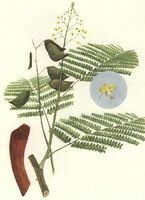 Botanical Description: Caesalpinia sappan L. is commonly known as Sū Mù. It is a shrub or small tree, growing up to 5–10 meters tall. The trunk bears spines; branchlets are celadon (grayish-green), bearing round, protruding lenticels; young branchlets are puberulent but become glabrous with age. Leaves are bipinnately compound, 30–40 cm long; pinnae occur in 7–13 opposite pairs; rachis is pubescent; leaflets (foliolules) occur in 9–17 opposite pairs, oblong to oblong-rhombic, ~14 mm long and ~6 mm wide; apex is blunt and emarginate (slightly concave); base is oblique; margins are entire; upper surface is green and glabrous; lower surface bearing glandular dots; midvein is oblique.
 Ecological Environment: This small tree grows naturally in valleys and jungles or is cultivated. It is mainly distributed in China and also occurs in several regions of Southeast Asia.
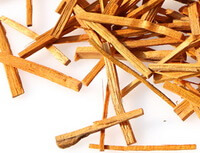 Characteristics of the Herb: The dried heartwood is cylindrical or semi-cylindrical, 10–100 cm long and 3–12 cm in diameter. The surface is yellowish-red to reddish-brown, marked by knife cuts and branch scars; longitudinal cracks are common. The transverse section is slightly lustrous, with conspicuous growth rings (annual rings); the pith is dark brown, loose, and interspersed with bright spots. The texture is firm and hard. The herb has a faint odor and a slightly astringent taste.
