✵The article records the herb Motherwort, including its English name, Latin name, Pinyin name, properties and flavors, and its botanical sources as defined in classical herbal works. These include (1) Leonurus artemisia (Lour.) S. Y. Hu, and other two usable plant species, (2) Leonurus sibiricus L., and (3) Leonurus cardiaca L.—The article provides a detailed introduction to the botanical features, growth characteristics, and ecological environments of these three species; the macroscopic and microscopic characteristics of the dried herb; its pharmacological actions, medicinal efficacy, and administration guidelines.
Herba Leonuri (Motherwort Herb)
Pinyin Name: Yì Mǔ Cǎo
English Name: Motherwort Herb
Latin Name:Herba Leonuri Properties and Flavor: Slightly cold; pungent and bitter
Brief Introduction:Herba Leonuri consists of the dried aerial parts of Leonurus heterophyllus Sweet. It is used (1) to invigorate blood circulation and regulate menstruation in cases of menstrual disorders, and (2) as a diuretic for nephritic edema. Common names include Motherwort, Herba Leonuri, and Yì Mǔ Cǎo.
Botanical Source: Classical herbal works define Motherwort as the whole herb of Lamiaceae species, primarily (1) Leonurus artemisia (Lour.) S. Y. Hu. Other authoritative works also accept (2) Leonurus sibiricus L. and (3) Leonurus cardiaca L. as legitimate sources. All three belong to the genus Leonurus, family Lamiaceae (Labiatae, mint family), order Lamiales. Descriptions of these three commonly used species follow:
(1) Leonurus artemisia (Lour.) S.Y. Hu
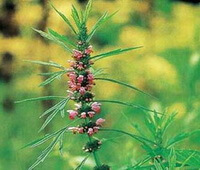
Botanical Description:Leonurus artemisia (Lour.) S. Y. Hu is a member of the Lamiaceae family (Labiatae, mint family) and the genus Leonurus. Synonyms include Leonurus heterophyllus Sweet, Leonurus sibiricus auct. non L., and Leonurus japonicus Houtt. Common names are Oriental motherwort, Chinese motherwort, and Yì Mǔ Cǎo. It is an annual or biennial herb, growing 60–100 cm tall. The stem is erect, quadrangular, and mucilaginous. Leaves are opposite; leaf shapes are highly variable. Petioles measure 0.5–8 cm in length. Basal leaves of annual plants have long petioles and are nearly circular (4–8 cm in diameter), with 5–9 shallow lobes; each lobe bears 2–3 blunt teeth, and the base is cordate. Middle-stem leaves are short-petiolate, trisected; lateral lobes are lanceolate, and the central lobe is often further 3-lobed; lateral lobes may be simple or 2-lobed; terminal lobules are usually >3 mm wide, acuminate at the apex, and sparsely serrate or subentire at the margin. Uppermost leaves are undivided, linear, and subsessile; the upper surface is green and strigose; the lower surface is pale green, sparsely pilose and glandular.
Inflorescences are axillary verticillasters, each bearing 8–15 flowers. Bracteoles are spinose and sessile. The calyx is campanulate, puberulent on the adaxial surface, 5-dentate with spiny tips; the lower two teeth are longer than the upper three and persistent. The corolla is labiate, faintly red or violet-red (prunus), 9–12 mm long, externally pilose; the upper and lower lips are nearly equal in length—the upper lip is oblong and entire, with ciliate margins; the lower lip is 3-lobed, with the central lobe largest and obcordate. There are four didynamous stamens inserted near the middle of the inner corolla surface; filaments are sparsely scaly-hairy; anthers are bilocular. The pistil is single; the ovary is 4-lobed; the style is filiform and slightly longer than the stamens; the stigma is bifid.
Nutlets are brown and prismatic, truncate at the apex and cuneate at the base, measuring 2–2.5 mm in length and ~1.5 mm in diameter. Flowering occurs from June to September; fruiting occurs from July to October.
Ecological Environment:Leonurus artemisia (Lour.) S. Y. Hu grows on field ridges, roadsides, stream banks, and hillside grasslands—especially in sunny locations—at elevations up to 3,000 meters above sea level. This species is primarily distributed in China and southern Asia, and has also been introduced to North America, South America, and Europe.
Growth Characteristics:Leonurus artemisia (Lour.) S. Y. Hu prefers a warm, humid climate and is typically cultivated at elevations below 1,000 meters above sea level. Soil requirements are not strict.
Characteristics of the Herb: Fresh motherwort: In the seedling stage, the plant lacks an aerial stem; basal leaves are rounded and cordate, 5–9-lobed, with each lobe bearing 2–3 blunt teeth. During early flowering, the stem is quadrangular, highly branched in the upper portion, and longitudinally grooved along all four sides; it measures 30–60 cm in length and 0.2–0.5 cm in diameter. The surface is turquoise-green; the herb is fresh and tender, with a prominent pith visible in the cross-section. Leaves are opposite and petiolate; they are turquoise-green, succulent, and exude juice when crushed. Lower stem leaves are palmately 3-lobed; upper leaves are pinnately or shallowly 3-parted, with entire or sparsely serrated margins. The herb has a faint odor and a slightly bitter taste.
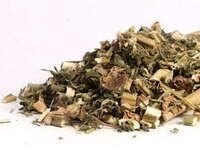
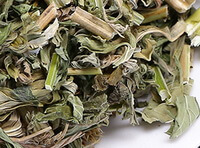
Dry motherwort: The stem is quadrangular, with concave longitudinal grooves along the four sides; it measures 30–60 cm in length and approximately 5 mm in diameter. The stem surface is celadon (grayish-green) or yellowish-green and densely strigose. The herb is lightweight and brittle, with a central pith evident in the cross-section. Leaves are decussate, celadon-colored, and mostly abscised—often wrinkled and fragmented. Intact lower leaves are palmately 3-lobed; middle-stem leaves are divided into several oblong-linear lobes; upper leaves are pinnately parted or shallowly 3-lobed. Axillary verticillasters bear violet (purple) flowers, most of which have fallen. Phyllaries of the inflorescence are entire or sparsely dentate; the calyx is persistent, tubular, and yellowish-green; it encloses three nutlets, and the corolla is bilabiate. The floral segment (i.e., corolla tube + limb) is approximately 2 cm long. The herb has a faint odor and a mild taste.
Pharmacological Actions: (1) Uterotonic effect in various animal species; (2) increased coronary blood flow; (3) improvement of microcirculatory disorders; (4) enhancement of renal function; (5) inhibition of dermatophytes, among others.
Medicinal Efficacy: Promotes blood circulation and regulates menstruation; resolves blood stasis; alleviates edema; induces diuresis and reduces swelling; clears heat and detoxifies. It is indicated for: menoxenia (irregular menstruation), dysmenorrhea (painful menstruation), amenorrhea, threatened abortion, dystocia (difficult labor), postpartum lochiorrhagia, retained placenta, postpartum syncope due to blood deficiency or vertigo, abdominal pain caused by blood stasis, metrorrhagia and uterine bleeding, hematuria, epistaxis, diarrhea, dysuria, edema and oliguria, carbuncles and furuncles, toxic swellings and sores, and traumatic injuries.
Administration of Herba Leonuri (Yì Mǔ Cǎo):
Reference:
Administration Guide for Herba Leonuri (Yì Mǔ Cǎo)
TCM Books:
(1) Internally: 9–30 grams dried herb; 12–40 g fresh herb; (2) Internally: water decoction, 3–6 qián (≈9–18 grams); also prepared as paste, pills, or powder. External use: wash affected area with decoction, or apply mashed herb topically. (3) Internally: water decoction, 10–15 grams; also prepared as paste or pills/powder. External use: appropriate amount—wash with decoction or apply mashed herb topically.
Contraindications, Precautions, and Adverse Reactions: Herba Leonuri is contraindicated during pregnancy. It should not be prepared or stored in iron utensils.
(2) Leonurus sibiricus L.
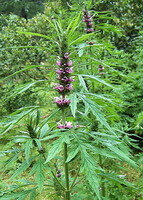
Botanical Description:Leonurus sibiricus L. is a member of the Lamiaceae family (Labiatae, mint family) and the genus Leonurus. It is commonly known as Xì Yè Yì Mǔ Cǎo, Thin-leaf Motherwort, or Siberian Motherwort. An annual or biennial herb, it grows up to 80 cm tall. Stems are erect, quadrangular, and strigose. Leaves are opposite. Petioles measure 0.5–5 cm in length. Basal leaves are caducous; middle-stem leaves are oval (egg-shaped), palmately 3-cleft, approximately 5 cm long and 4 cm wide; lobes are oblong-rhombic and further pinnately divided into linear lobules 1–3 mm wide. Terminal leaves are distinctly 3-lobed, with linear, subsessile lobules. The upper leaf surface is green and sparsely strigose; the lower surface is pale green, sparsely strigose and covered with glandular points; leaf veins are conspicuously convex.
Verticillasters are axillary and pluriflorous; bracteoles are needle-like, shorter than the hypanthium (calyx tube), and strigose. The calyx is campanulate (bell-shaped), pubescent externally, 5-dentate at the apex with spinose tips; the upper three teeth are shorter than the lower two, and the calyx is persistent. The corolla is labiate, faintly red or violet-red, 15–20 mm long, densely pilose externally. The upper lip is approximately one-quarter longer than the lower lip; it is oblong and entire. The lower lip is 3-lobed, with the central lobe obovate. There are four didynamous stamens inserted near the middle of the inner corolla surface; filaments are sparsely scaly-hairy; anthers are bilocular. A single pistil is present; the ovary is 4-lobed; the style is filiform and slightly longer than the stamens; the stigma is bifid.
Nutlets are brown and prismatic, truncate at the apex and cuneate at the base, approximately 2.5 mm long. Flowering occurs from June to September; fruiting occurs from July to October.
Ecological Environment:Leonurus sibiricus L. grows on stony hillsides, sandy grasslands, and open pine forests at elevations up to 1,500 meters above sea level. This species is primarily distributed in China and extends across temperate Asia—including Siberia—and has been introduced to North America, Central America, and South America.
Characteristics of the Herb: Middle-stem leaves are oval (egg-shaped), broadly cuneate at the base, and palmatisect; lobes are pinnately divided into linear lobules. Bracteoles of the inflorescence are conspicuously 3-parted, with linear lobules.
(3) Leonurus cardiaca L.
Botanical Description:Leonurus cardiaca L. is a member of the Lamiaceae family (Labiatae, mint family) and the genus Leonurus. Common names include Grayish-white Motherwort, throw-wort, lion’s ear, and lion’s tail. It has a square stem clad in short hairs and often tinged purplish—especially near the nodes. Opposite leaves have serrated margins and are palmately lobed with long petioles. Basal leaves are cuneate (wedge-shaped) with three lobes, whereas upper leaves typically have five. The upper surface is sparsely pilose; the lower surface is grayish-tomentose.
Flowers arise from leaf axils in the upper portion of the plant and bear 3-lobed bracteoles. Each flower has a campanulate, 5-lobed calyx. The corolla is irregular, 8–12 mm (0.3–0.5 in) long, tubular-fused, and bilabiate. The upper lip is convex and white-pilose; the lower lip is 3-lobed, deflexed, and red-spotted. Flowers range from pink to lilac, often with hairy (pubescent) lower lips. There are four stamens—two shorter and two longer—and the fruit is a 4-loculed schizocarp. The plant grows to 60–100 cm (24–39 in) tall and blooms from July to August.
Ecological Environment:Leonurus cardiaca grows along roadsides, vacant fields, waste grounds, and other disturbed habitats. Native to southeastern Europe and Central Asia—where it has been cultivated since antiquity—it is now naturalized worldwide, largely due to its historical use as a medicinal herb.
It is distinguished from other British Lamiaceae by its deeply palmately 5-lobed (or 3-lobed) leaves and the spinose calyx teeth. When not in flower, it resembles Artemisia vulgaris (mugwort) in general habit.
From the perennial rootstock rise the square, stout stems, 2 to 3 feet (60.9–91.4 cm) high, upright and branched, principally below; the angles are prominent. The leaves are very closely set: the radical ones on slender, long petioles, ovate, lobed, and toothed; those on the stem are 2 to 3 inches (5.1–7.6 cm) long, petioled, cuneate (wedge-shaped); the lower ones are roundish, palmately five-lobed, with lobes trifid at the apex; the upper ones are three-lobed, coarsely serrate, reticulately veined, the veinlets are prominent beneath, and covered with slender, curved hairs. The uppermost leaves and bracts are very narrow and entire, or bearing only a single tooth on each side, and bear in their axils numerous whorls of pinkish or nearly white, sessile flowers—six to fifteen in a whorl. The corollas, though whitish on the outside, are stained with paler or darker purple within. They have rather short tubes and nearly flat upper lips, very pilose on the upper part, with long, woolly hairs. The two anterior stamens are the longest, and the anthers are sprinkled with hard, shining dots.
The plant blossoms in August. It has a rather pungent odor and a very bitter taste. It is dull green; the leaves are paler beneath, pubescent—especially on the stem angles and leaf undersides—the hairs varying considerably in length and abundance.
The genus name Leonurus, from Greek, signifies “lion’s tail”, alluding to a fancied resemblance in the plant’s inflorescence or foliage. Motherwort is also known as lion’s ear. It originated in Central Asia but has now spread to all temperate regions of the world, primarily as a garden plant but also as an escaped weed. The leaves and flowers of this mint-family plant are used medicinally; in Chinese herbal medicine, the seeds are also employed. The use of motherwort is largely consistent between traditional Chinese herbal medicine and European folk medicine—to regulate menstruation and treat associated conditions. The genus name Leonurus is derived from the Greek words leōn (“lion”) and oura (“tail”), not Latin “Leo”; the species epithet cardiaca comes from the Greek kardia (“heart”). The Chinese name for this plant is “Yi Mu Cao”, meaning “benefit-mother herb”.

 ✵The article records the herb Motherwort, including its English name, Latin name, Pinyin name, properties and flavors, and its botanical sources as defined in classical herbal works. These include (1) Leonurus artemisia (Lour.) S. Y. Hu, and other two usable plant species, (2) Leonurus sibiricus L., and (3) Leonurus cardiaca L.—The article provides a detailed introduction to the botanical features, growth characteristics, and ecological environments of these three species; the macroscopic and microscopic characteristics of the dried herb; its pharmacological actions, medicinal efficacy, and administration guidelines.
 Pinyin Name: Yì Mǔ Cǎo
 Botanical Description: Leonurus artemisia (Lour.) S. Y. Hu is a member of the Lamiaceae family (Labiatae, mint family) and the genus Leonurus. Synonyms include Leonurus heterophyllus Sweet, Leonurus sibiricus auct. non L., and Leonurus japonicus Houtt. Common names are Oriental motherwort, Chinese motherwort, and Yì Mǔ Cǎo. It is an annual or biennial herb, growing 60–100 cm tall. The stem is erect, quadrangular, and mucilaginous. Leaves are opposite; leaf shapes are highly variable. Petioles measure 0.5–8 cm in length. Basal leaves of annual plants have long petioles and are nearly circular (4–8 cm in diameter), with 5–9 shallow lobes; each lobe bears 2–3 blunt teeth, and the base is cordate. Middle-stem leaves are short-petiolate, trisected; lateral lobes are lanceolate, and the central lobe is often further 3-lobed; lateral lobes may be simple or 2-lobed; terminal lobules are usually >3 mm wide, acuminate at the apex, and sparsely serrate or subentire at the margin. Uppermost leaves are undivided, linear, and subsessile; the upper surface is green and strigose; the lower surface is pale green, sparsely pilose and glandular.
 Characteristics of the Herb: Fresh motherwort: In the seedling stage, the plant lacks an aerial stem; basal leaves are rounded and cordate, 5–9-lobed, with each lobe bearing 2–3 blunt teeth. During early flowering, the stem is quadrangular, highly branched in the upper portion, and longitudinally grooved along all four sides; it measures 30–60 cm in length and 0.2–0.5 cm in diameter. The surface is turquoise-green; the herb is fresh and tender, with a prominent pith visible in the cross-section. Leaves are opposite and petiolate; they are turquoise-green, succulent, and exude juice when crushed. Lower stem leaves are palmately 3-lobed; upper leaves are pinnately or shallowly 3-parted, with entire or sparsely serrated margins. The herb has a faint odor and a slightly bitter taste.
 Botanical Description: Leonurus sibiricus L. is a member of the Lamiaceae family (Labiatae, mint family) and the genus Leonurus. It is commonly known as Xì Yè Yì Mǔ Cǎo, Thin-leaf Motherwort, or Siberian Motherwort. An annual or biennial herb, it grows up to 80 cm tall. Stems are erect, quadrangular, and strigose. Leaves are opposite. Petioles measure 0.5–5 cm in length. Basal leaves are caducous; middle-stem leaves are oval (egg-shaped), palmately 3-cleft, approximately 5 cm long and 4 cm wide; lobes are oblong-rhombic and further pinnately divided into linear lobules 1–3 mm wide. Terminal leaves are distinctly 3-lobed, with linear, subsessile lobules. The upper leaf surface is green and sparsely strigose; the lower surface is pale green, sparsely strigose and covered with glandular points; leaf veins are conspicuously convex.
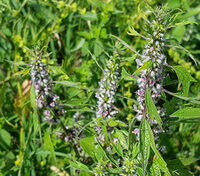 Botanical Description: Leonurus cardiaca L. is a member of the Lamiaceae family (Labiatae, mint family) and the genus Leonurus. Common names include Grayish-white Motherwort, throw-wort, lion’s ear, and lion’s tail. It has a square stem clad in short hairs and often tinged purplish—especially near the nodes. Opposite leaves have serrated margins and are palmately lobed with long petioles. Basal leaves are cuneate (wedge-shaped) with three lobes, whereas upper leaves typically have five. The upper surface is sparsely pilose; the lower surface is grayish-tomentose.
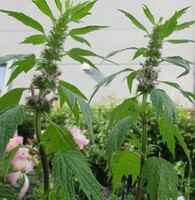 Ecological Environment: Leonurus cardiaca grows along roadsides, vacant fields, waste grounds, and other disturbed habitats. Native to southeastern Europe and Central Asia—where it has been cultivated since antiquity—it is now naturalized worldwide, largely due to its historical use as a medicinal herb.
