✵The article documents the herb Spine Date Seed, including its English name, Latin name, Pinyin name, properties and flavor, botanical source—namely, one plant species: (1) Ziziphus jujuba Mill. var. spinosa (Bunge) Hu ex H. F. Chow—and provides a detailed introduction to the botanical characteristics, growth habits, and ecological environment of this species; the macroscopic and microscopic features of the herb Spine Date Seed; its pharmacological actions, medicinal efficacy, and administration guidelines.
Semen Ziziphi Spinosae (Spine Date Seed)
Pinyin Name: Suān Zǎo Rén
English Name: Spine Date Seed
Latin Name:Semen Ziziphi Spinosae Properties and Flavor: Neutral; sweet and sour.
Brief Introduction:Semen Ziziphi Spinosae is the dried, ripe seed of Ziziphus jujuba Mill. var. spinosa (Bunge) Hu ex H. F. Chow. It is used (1) as a sedative to treat restlessness, insomnia, and palpitations, and (2) to arrest spontaneous and nocturnal sweating. Common names include Semen Ziziphi Spinosae, Spine Date Seed, and Suān Zǎo Rén.
Botanical Source: Classical herbal works define Spine Date Seed (also recorded as “Zizyphus Seed”) as the seed of (1) Ziziphus jujuba Mill. var. spinosa (Bunge) Hu ex H. F. Chow. It is a species of the genus Ziziphus Mill., family Rhamnaceae (buckthorn family), order Rosales. (formerly placed in order Rhamnales) This species is described below:
(1) Ziziphus jujuba Mill. var. spinosa (Bunge) Hu ex H. F. Chow
Botanical Description:Ziziphus jujuba Mill. var. spinosa (Bunge) Hu ex H. F. Chow is also known as Ziziphus vulgaris Lam. var. spinosa Bunge. It is commonly called the jujube tree, sour jujube, wild jujube, or Suān Zǎo (“sour jujube”). The plant is a deciduous shrub, occasionally a small tree, reaching 1–3 meters in height. Older branches are taupe; young branches are green. At the base of each branch, a pair of thorns is present: one is acicular (needle-shaped), erect, up to 3 cm long; the other is recurved, approximately 0.7 cm long. Leaves are simple and alternate; stipules are acicular; leaf blades are oblong-ovate to ovate-lanceolate, with an obtuse apex, a rounded (slightly oblique) base, and a serrulate margin.
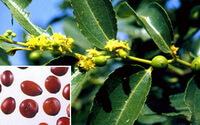
Flowers are small, grow in clusters of two to three in the leaf axils; the calyx is 5-lobed, with ovate-triangular lobes; there are five yellowish-green petals, alternating with the sepals; five stamens, opposite the petals; the floral disc is prominent and shallowly 10-lobed; the ovary is elliptic and embedded in the floral disc; the style is bifid.
Drupes are fleshy, subsphaeroidal (nearly spherical), turning fusco-testaceous (dark reddish-brown) at maturity; the pericarp is thin, and the fruit tastes sour. Flowering occurs from June to July; fruiting from September to October.
Ecological Environment:Ziziphus jujuba var. spinosa grows on sunny, dry hillsides and mountain slopes, in valleys, on plains, along roadsides, and in wastelands and open fields, at elevations below 1,700 meters. It is widely cultivated and highly drought-tolerant, often forming dense thickets.
Distribution: Native to China, this species is also introduced and cultivated across Asia, Europe, and the Americas.
Growth Characteristics:Ziziphus jujuba var. spinosa prefers a warm, arid climate and exhibits tolerance to drought, cold, and alkaline soils. It thrives in sandy loam on sunny, well-drained sites such as hillsides, valleys, plains, and roadsides. Low-lying or waterlogged fields are unsuitable for cultivation.
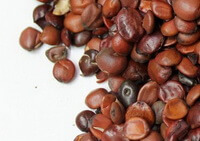
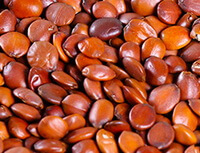
Characteristics of the Herb: The seeds of Ziziphus jujuba are oblate or oblate-elliptic, 5–9 mm long, 5–7 mm wide, and 3 mm thick. The surface is prune-colored (violet-red) or puce (purplish-brown), smooth and glossy; some exhibit longitudinal cracks. Some have rounded protrusions on both sides, while others are flattened on one side, with raised longitudinal lines in the center; the opposite side is slightly convex. One end is concave, bearing a linear hilum; the other end bears a fine, small, elevated chalaza. The spermoderm (seed coat) is brittle, the endosperm is white, and there are two cotyledons—light yellow and oil-rich. The herb has a faint odor and a mild taste.
Pharmacological Actions: (1) sedative and hypnotic effects; (2) analgesic, anticonvulsant, and antipyretic effects; (3) effects on the cardiovascular system.
Properties: The herb is sweet and sour in flavor, neutral in nature, and enters the Heart, Liver, and Gallbladder meridians. It is sweet in flavor and moistening in nature. Its sweetness and sourness nourish Yin, tonify the Liver and Gallbladder, nourish the Heart, and calm the mind. It is commonly used for insomnia and dream-disturbed sleep due to deficiency of both Qi and Blood, to nourish the Heart and calm the spirit. Being sour in taste, it also restrains sweating and is indicated for spontaneous sweating due to general deficiency.
Medicinal Efficacy: Nourishes the Heart and replenishes the Liver; calms the Heart and soothes the nerves (relieves mental and physical restlessness and promotes tranquility); arrests sweating; promotes secretion of saliva and body fluids. It is indicated for irritability and insomnia (i.e., emotional depression and dissatisfaction accompanied by sleep disturbance), palpitations with anxiety, dream-disturbed sleep, severe palpitations, physical debility with excessive sweating, fluid depletion with thirst, spontaneous sweating due to deficiency, night sweats, and abnormal sweating resulting from general debility.
Administration of Semen Ziziphi Spinosae (Suān Zǎo Rén):
Reference:
Administration Guide for Semen Ziziphi Spinosae (Suān Zǎo Rén)
TCM Books:
(1) Internally: 10–15 grams (2) Internally:decoction in water, 2–5 qian (≈6–15 grams), or prepared as pills or powder; (3) Internally: water decoction, 6–15 grams; or finely powdered herb, 3–5 grams per dose; or prepared as pills or powder.
Contraindications, Precautions, and Adverse Reactions: Semen Ziziphi Spinosae should not be combined with Radix Stephaniae Tetrandrae.

 ✵The article documents the herb Spine Date Seed, including its English name, Latin name, Pinyin name, properties and flavor, botanical source—namely, one plant species: (1) Ziziphus jujuba Mill. var. spinosa (Bunge) Hu ex H. F. Chow—and provides a detailed introduction to the botanical characteristics, growth habits, and ecological environment of this species; the macroscopic and microscopic features of the herb Spine Date Seed; its pharmacological actions, medicinal efficacy, and administration guidelines.
 Pinyin Name: Suān Zǎo Rén
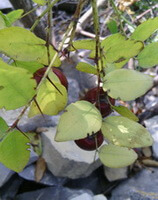 Botanical Description: Ziziphus jujuba Mill. var. spinosa (Bunge) Hu ex H. F. Chow is also known as Ziziphus vulgaris Lam. var. spinosa Bunge. It is commonly called the jujube tree, sour jujube, wild jujube, or Suān Zǎo (“sour jujube”). The plant is a deciduous shrub, occasionally a small tree, reaching 1–3 meters in height. Older branches are taupe; young branches are green. At the base of each branch, a pair of thorns is present: one is acicular (needle-shaped), erect, up to 3 cm long; the other is recurved, approximately 0.7 cm long. Leaves are simple and alternate; stipules are acicular; leaf blades are oblong-ovate to ovate-lanceolate, with an obtuse apex, a rounded (slightly oblique) base, and a serrulate margin.
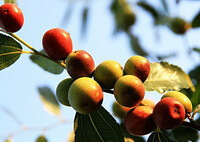 Drupes are fleshy, subsphaeroidal (nearly spherical), turning fusco-testaceous (dark reddish-brown) at maturity; the pericarp is thin, and the fruit tastes sour. Flowering occurs from June to July; fruiting from September to October.
 Distribution: Native to China, this species is also introduced and cultivated across Asia, Europe, and the Americas.
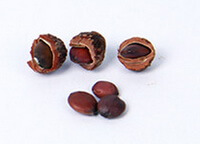 Characteristics of the Herb: The seeds of Ziziphus jujuba are oblate or oblate-elliptic, 5–9 mm long, 5–7 mm wide, and 3 mm thick. The surface is prune-colored (violet-red) or puce (purplish-brown), smooth and glossy; some exhibit longitudinal cracks. Some have rounded protrusions on both sides, while others are flattened on one side, with raised longitudinal lines in the center; the opposite side is slightly convex. One end is concave, bearing a linear hilum; the other end bears a fine, small, elevated chalaza. The spermoderm (seed coat) is brittle, the endosperm is white, and there are two cotyledons—light yellow and oil-rich. The herb has a faint odor and a mild taste.
 Pharmacological Actions: (1) sedative and hypnotic effects; (2) analgesic, anticonvulsant, and antipyretic effects; (3) effects on the cardiovascular system.
