✵This article documents the herb Thin-leaf Milkwort Root—including its English name, Latin name, Pinyin name, properties and flavor—as well as the botanical sources defined in classical Chinese herbal works: (1) Polygala tenuifolia Willd., (2) Polygala sibirica L., and one commonly used species in North America and Europe, (3) Polygala senega L. It provides a detailed description of the botanical features, growth characteristics, and ecological environments of these three species; the macroscopic and microscopic characteristics of the dried root (Radix Polygalae); its pharmacological actions; medicinal efficacy; and administration guidelines.
Radix Polygalae (Thin-leaf Milkwort Root)
Pinyin Name: Yuǎn Zhì
English Name: Thin-leaf Milkwort Root
Latin Name:Radix Polygalae Properties and Flavor: Warm, pungent, and bitter
Brief Introduction:Radix Polygalae is the dried root of Polygala tenuifolia Willd. or Polygala sibirica L. It is clinically employed: (1) as a sedative for palpitations and insomnia due to Heart–Kidney disharmony; (2) as an expectorant for acute or chronic cough with profuse sputum; (3) to resolve phlegm and open the orifices in epilepsy and mania caused by phlegm obstruction of the Heart orifice; and (4) to reduce swelling in boils and sores. Common vernacular names include Thin-leaf Milkwort Root, Thin-leaf Milkwort Root-bark, Siberian Milkwort Root, and Yuǎn Zhì.
Botanical Source: Classical Chinese herbal works define Radix Polygalae (Yuǎn Zhì) as the dried root of (1) Polygala tenuifolia Willd. or (2) Polygala sibirica L. In contrast, North American and European herbal traditions designate the dried root of (3) Polygala senega L. as Senega Root. All three species belong to the genus Polygala L., family Polygalaceae (Polygalaceae Hoffmanns. et Link), order Fabales (formerly in order Rutales). The following describes each of these three pharmacopeially relevant species:
(1) Polygala tenuifolia Willd.
Botanical Description:Polygala tenuifolia Willd. is a perennial herb of the family Polygalaceae and genus Polygala. It is commonly known as Thin-leaf Milkwort, Xì Yè Yuǎn Zhì (meaning “thin-leaf polygala”), or Chinese Senega. Plants reach 25–40 cm in height. The root is cylindrical, elongated, and slightly curved. Stems are erect or ascending, numerous, tufted, and arise from the base; they are slender, cylindrical, firm and hard in texture, greenish, and highly branched in the upper portion. Leaves are simple and alternate; petioles are short or nearly sessile; leaf blades are linear (filiform), 1–3 cm long and 1.5–3 mm wide; the apex is acute; the base is attenuate; margins are entire; the midvein is sunken on the adaxial surface and prominent on the abaxial surface; surfaces are glabrous or sparsely pubescent.
In spring, terminal racemes emerge from stem tips, measuring 5–12 cm in length; flowers are small and sparsely arranged. Each flower has five sepals, two of which are petaloid and greenish-white; three petals, mauve (lilac), with the keel petal enlarged and trochiscoid (spoon-shaped), bearing penicillate (fringelike) appendages at the apex; eight stamens with filaments fused at the base; and one pistil with an obovate, flattened, bilocular ovary; the style is curved, and the stigma is bifid.
The fruit is a capsule—flat, circular-obcordate, 4–5 mm in both length and width, green and smooth; the margin is narrowly winged (pterygoid), lacking cilia; persistent bracts remain at the base and dehisce along the margins at maturity. Seeds are ovoid (egg-shaped), slightly compressed, brownish-black, and densely covered with white pubescence. Flowering occurs from May to July; fruiting from June to August.
Ecological Environment:Polygala tenuifolia Willd. grows on sunny hillsides, mountain slopes, roadsides, grasslands, shrublands, and mixed forests, at elevations of 200–2,300 m above sea level. It is predominantly distributed across China.
Growth Characteristics:Polygala tenuifolia Willd. prefers a cool, temperate climate and is intolerant of high temperatures; it exhibits moderate drought resistance. Optimal cultivation sites are sunny, well-drained sandy soils; secondarily, loamy clay or calcareous soils are suitable. Heavy clay soils and waterlogged lowlands are unsuitable for cultivation.
Characteristics of the Herb: The root is cylindrical and slightly curved, 3–15 cm long (occasionally up to 30 cm), and 2–8 mm (or 0.2–1 cm) in diameter. The surface is sallow (grayish-yellow) to light brown, coarse and uneven, bearing rootlet scars and deeply sunken transverse grooves, longitudinal wrinkles, and fissures. In older roots, the transverse grooves are dense and deep, imparting a slightly nodular appearance. The texture is hard and brittle, fracturing readily; the cortex of the fracture surface is brownish-yellow, the xylem (wood) is yellowish-white, and the cortex peels easily from the xylem. Roots from which the woody central core has been removed are hollow. The herb has a faint odor and a bitter, slightly pungent taste, producing a tingling sensation in the throat upon chewing.
(2) Polygala sibirica L.
Botanical Description:Polygala sibirica L. is a perennial herb of the family Polygalaceae and genus Polygala. It is commonly known as Siberian Milkwort, Eggleaf Milkwort, Kuān Yè Yuǎn Zhì (“broad-leaf polygala”), or Luǎn Yè Yuǎn Zhì (“egg-leaf polygala”). Plants reach 10–30 cm in height. Roots are cylindrical and obliquely ascending, with a woody texture. Stems are multi-branched, usually erect, and pubescent. Leaves are simple and alternate, shortly stipitate; those on the lower stem are small, ovate (egg-shaped), ~6 mm long × ~4 mm wide, with an obtuse apex terminating in a short mucro; those on the upper stem are larger, lanceolate or elliptic-lanceolate, 1–2 cm long × 3–6 mm wide, green and pubescent, with a blunt apex bearing a rigid, short mucro, a cuneate base, entire and slightly revolute margins, a sunken midvein on the adaxial surface, and a prominent midvein on the abaxial surface; lateral veins are inconspicuous.
Racemes are extra-axillary or pseudo-terminal, typically exceeding the stem tips, pubescent, and bearing few flowers. Flowers are ~6–10 mm long and subtended by three bracteoles (bractlets), subulate-lanceolate, ~2 mm long, and pubescent. There are five sepals: the outer three are small, lanceolate, ~3 mm long, and persistent; the inner two are larger, petaloid, ~7–7.5 mm long × ~3 mm wide. There are three petals—royal purple (bluish-violet) in color: the two lateral petals are obovate, 5–6 mm long, fused at the base to the keel (tropis); the keel is longer than the lateral petals, pubescent on the dorsal surface, and bears fimbriate, comb-like appendages at the apex. There are eight stamens; filaments are 5–6 mm long, fused for the lower two-thirds to form a sheath bearing marginal setae (trichomes); anthers are ovoid and dehisce via apical pores. The ovary is obovate, ~2 mm in diameter, with marginal setae at the apex; styles are thickened and robust, curved at the apex (~5 mm long), each bearing two stigmas spaced apart on the apical surface.
The fruit is a capsule—nearly obcordate, ~5 mm in diameter, with an emarginate apex, narrowly winged margins, and sparse pubescence. Seeds are oblong, flattened, ~1.5 mm long, black, and densely covered with white pilose hairs except at the strophiole, which bears white, pod-like outgrowths. Flowering occurs from April to July; fruiting from May to August.
The root of this species contains chemical constituents largely identical to those of Polygala tenuifolia Willd. and may serve as a substitute for it in practice.
Ecological Environment:Polygala sibirica L. grows in hillside meadows at elevations of 1,100–2,800 m; it also occurs in sandy soils, gravelly substrates, limestone mountain shrublands, forest margins, and meadows at elevations of 1,100–3,300 m (locally up to ~4,300 m). It is predominantly distributed across China and also found in Eastern Europe, Siberia, Nepal, and Kashmir.
Growth Characteristics:Polygala sibirica prefers cool, temperate climates and is intolerant of high temperatures; it exhibits moderate drought resistance. Optimal cultivation sites are sunny, well-drained sandy soils; loamy clay or calcareous soils are acceptable alternatives. Heavy clay soils and waterlogged lowlands are unsuitable for cultivation.
Characteristics of the Herb: Roots are 4–18 cm long and 2–8 mm in diameter, with 2–5 stem bases visible at the root head. The surface is coarse, taupe-brown to grayish-black; a few specimens are sallow (grayish-yellow). Longitudinal grooves are numerous; transverse grooves are sparse; rootlets are abundant, 2–5 cm long. The texture is firm and not easily fractured; the cortical layer is thin; the woody central core (duramen) is relatively large; the taste is slightly bitter. Compared with Polygala tenuifolia, the root of Polygala sibirica is thinner and considered inferior in quality.
Medicinal Efficacy: Calms the nerves (relieves mental and physical uneasiness, promotes tranquility), benefits intelligence, restores normal coordination between the heart and kidney, resolves phlegm, revives consciousness, alleviates melancholy, detoxifies, and reduces swelling. It is indicated for insomnia and vivid dreaming due to disharmony between the heart and kidney; restlessness (mental unease); palpitations with fear; amnesia (poor memory); fright-induced epilepsy; nocturnal emission; mental distraction; expectoration (coughing up phlegm accompanied by discomfort); cough with excessive phlegm; sores and ulcers; pyogenic infections; carbuncles and abscesses on the back; breast distension and pain; etc.
Administration of Radix Polygalae (Yuǎn Zhì):
Reference:
Administration Guide for Radix Polygalae (Yuǎn Zhì)
TCM Books:
(1) Internally: 3–10 grams; (2) Internally: water decoction, 1–3 qian (≈3–9 grams), infusion in wine; or prepared as pills or powder; (3) Internally: water decoction, 3–10 grams; infusion in wine; or prepared as pills or powder.
Contraindications, Precautions, and Adverse Reactions: Radix Polygalae is best combined with Poria cocos, Malva fruit (Fructus Malvae), and Os Draconis; it should not be combined with Pearl, Black False Hellebore (Veratrum nigrum), Blattaria (cockroach), or Grubs (larvae of beetles).
(3) Polygala senega L.
Botanical Description:Polygala senega L. is a perennial herb of the family Polygalaceae and genus Polygala, commonly known as Seneca snakeroot, rattlesnake root, mountain flax, or Mei Yuan Zhi. It has multiple unbranched stems (though older plants may exhibit branching) and grows up to 50 cm tall. A mature plant arises from a hard, woody, horizontally spreading rootstock and may produce up to 70 stems. Its lanceolate leaves are alternately arranged; the lower leaves are reduced and scale-like. The inflorescence is a spike bearing rounded, white or greenish flowers. The fruit is a capsule containing two pilose, black seeds. The root is twisted and conical, with a wintergreen-like aroma and an intensely pungent taste. Two root morphotypes exist: a northern morph—found in Canada and extending into Minnesota—produces larger roots (up to 15 cm long and 1.2 cm wide), dark brown to purplish at the apex; and a southern morph—native to the southeastern USA—has smaller, yellow-brown roots.
Ecological Environment:Polygala senega L. grows on prairies, in woodlands, and along wet shorelines and riverbanks. It prefers thin, rocky, usually calcareous soils. It also occurs in disturbed habitats such as roadsides. This species is native to North America and is distributed across central and eastern regions of the USA, southern Canada, and adjacent areas.
References:
1.Introduction of Yuan Zhi: Thin-leaf Milkwort Root

 ✵This article documents the herb Thin-leaf Milkwort Root—including its English name, Latin name, Pinyin name, properties and flavor—as well as the botanical sources defined in classical Chinese herbal works: (1) Polygala tenuifolia Willd., (2) Polygala sibirica L., and one commonly used species in North America and Europe, (3) Polygala senega L. It provides a detailed description of the botanical features, growth characteristics, and ecological environments of these three species; the macroscopic and microscopic characteristics of the dried root (Radix Polygalae); its pharmacological actions; medicinal efficacy; and administration guidelines.
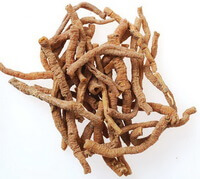 Pinyin Name: Yuǎn Zhì
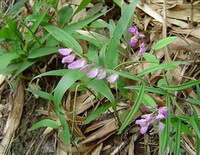 Botanical Description: Polygala tenuifolia Willd. is a perennial herb of the family Polygalaceae and genus Polygala. It is commonly known as Thin-leaf Milkwort, Xì Yè Yuǎn Zhì (meaning “thin-leaf polygala”), or Chinese Senega. Plants reach 25–40 cm in height. The root is cylindrical, elongated, and slightly curved. Stems are erect or ascending, numerous, tufted, and arise from the base; they are slender, cylindrical, firm and hard in texture, greenish, and highly branched in the upper portion. Leaves are simple and alternate; petioles are short or nearly sessile; leaf blades are linear (filiform), 1–3 cm long and 1.5–3 mm wide; the apex is acute; the base is attenuate; margins are entire; the midvein is sunken on the adaxial surface and prominent on the abaxial surface; surfaces are glabrous or sparsely pubescent.
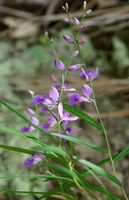 Ecological Environment: Polygala tenuifolia Willd. grows on sunny hillsides, mountain slopes, roadsides, grasslands, shrublands, and mixed forests, at elevations of 200–2,300 m above sea level. It is predominantly distributed across China.
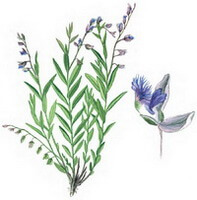 Racemes are extra-axillary or pseudo-terminal, typically exceeding the stem tips, pubescent, and bearing few flowers. Flowers are ~6–10 mm long and subtended by three bracteoles (bractlets), subulate-lanceolate, ~2 mm long, and pubescent. There are five sepals: the outer three are small, lanceolate, ~3 mm long, and persistent; the inner two are larger, petaloid, ~7–7.5 mm long × ~3 mm wide. There are three petals—royal purple (bluish-violet) in color: the two lateral petals are obovate, 5–6 mm long, fused at the base to the keel (tropis); the keel is longer than the lateral petals, pubescent on the dorsal surface, and bears fimbriate, comb-like appendages at the apex. There are eight stamens; filaments are 5–6 mm long, fused for the lower two-thirds to form a sheath bearing marginal setae (trichomes); anthers are ovoid and dehisce via apical pores. The ovary is obovate, ~2 mm in diameter, with marginal setae at the apex; styles are thickened and robust, curved at the apex (~5 mm long), each bearing two stigmas spaced apart on the apical surface.
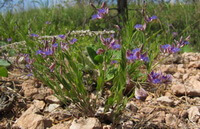 The fruit is a capsule—nearly obcordate, ~5 mm in diameter, with an emarginate apex, narrowly winged margins, and sparse pubescence. Seeds are oblong, flattened, ~1.5 mm long, black, and densely covered with white pilose hairs except at the strophiole, which bears white, pod-like outgrowths. Flowering occurs from April to July; fruiting from May to August.
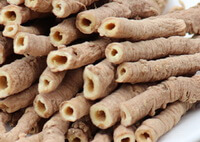 Characteristics of the Herb: Roots are 4–18 cm long and 2–8 mm in diameter, with 2–5 stem bases visible at the root head. The surface is coarse, taupe-brown to grayish-black; a few specimens are sallow (grayish-yellow). Longitudinal grooves are numerous; transverse grooves are sparse; rootlets are abundant, 2–5 cm long. The texture is firm and not easily fractured; the cortical layer is thin; the woody central core (duramen) is relatively large; the taste is slightly bitter. Compared with Polygala tenuifolia, the root of Polygala sibirica is thinner and considered inferior in quality.
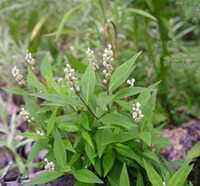 Botanical Description: Polygala senega L. is a perennial herb of the family Polygalaceae and genus Polygala, commonly known as Seneca snakeroot, rattlesnake root, mountain flax, or Mei Yuan Zhi. It has multiple unbranched stems (though older plants may exhibit branching) and grows up to 50 cm tall. A mature plant arises from a hard, woody, horizontally spreading rootstock and may produce up to 70 stems. Its lanceolate leaves are alternately arranged; the lower leaves are reduced and scale-like. The inflorescence is a spike bearing rounded, white or greenish flowers. The fruit is a capsule containing two pilose, black seeds. The root is twisted and conical, with a wintergreen-like aroma and an intensely pungent taste. Two root morphotypes exist: a northern morph—found in Canada and extending into Minnesota—produces larger roots (up to 15 cm long and 1.2 cm wide), dark brown to purplish at the apex; and a southern morph—native to the southeastern USA—has smaller, yellow-brown roots.
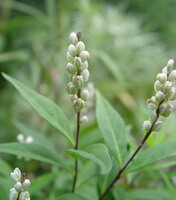 Ecological Environment: Polygala senega L. grows on prairies, in woodlands, and along wet shorelines and riverbanks. It prefers thin, rocky, usually calcareous soils. It also occurs in disturbed habitats such as roadsides. This species is native to North America and is distributed across central and eastern regions of the USA, southern Canada, and adjacent areas.
