Introduction of Bai Zi Ren: Chinese Arborvitae Seed
✵The article records the herb Chinese Arborvitae Seed—including its English name, Latin name, Pinyin name, properties and flavor, botanical source (one plant species: (1) Platycladus orientalis (L.) Franco), botanical features, growth characteristics, ecological environment, macroscopic and microscopic features of the herb, pharmacological actions, medicinal efficacy, and administration guidelines.
Semen Platycladi (Chinese Arborvitae Seed)
Pinyin Name: Bǎi Zǐ Rén
English Name: Chinese Arborvitae Seed
Latin Name:Semen Platycladi Properties and Flavor: Neutral; sweet
Brief Introduction:Semen Platycladi is the kernel of the dried, ripe seed of Platycladus orientalis (L.) Franco. It is used (1) to nourish the heart and calm the spirit for treating palpitations and insomnia due to Heart-Blood deficiency, and (2) as a moistening laxative for constipation in debilitated or elderly patients. Common names include Semen Platycladi, Chinese Arborvitae Seed, and Bǎi Zǐ Rén.
Botanical Source: Classical herbal works define Semen Platycladi (Bai Zi Ren) as the kernel of the dried, ripe seed of (1) Platycladus orientalis (L.) Franco. It is a species of the genus Platycladus Spach, family Cupressaceae (cypress family), order Cupressales. This widely used species is described below:
(1) Platycladus orientalis (L.) Franco
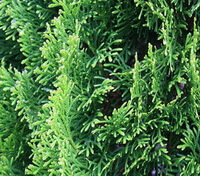
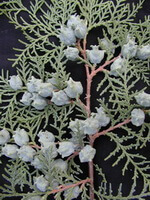
Botanical Description:Platycladus orientalis (L.) Franco is an evergreen tree of the Cupressaceae family (cypress family) and genus Platycladus. Synonyms include Thuja orientalis L., Biota orientalis (L.) Endl. Common names are Oriental Arborvitae, Chinese Arborvitae, Cè Bǎi, Xiang Bǎi (meaning “fragrant arborvitae”), Huáng Bǎi, Biàn Bǎi, Biàn Sōng, and Biàn Huì. Mature trees reach up to 20 m in height, with a diameter at breast height (DBH) of up to 1 m. The bark is thin, light grayish-brown, and longitudinally fissured into narrow strips. Branchlets are flattened, straight, and arranged in a single plane. Leaves are scale-like, decussate, 1–3 mm long, with a slightly obtuse apex. The exposed portions on the upper and lower surfaces of the branchlets are obovate-rhombic or rhombic; lateral leaves fold over the base between upper and lower leaves and are keeled (carinate). Glandular grooves occur along the midrib on the abaxial leaf surface.
The tree is monoecious. Cones (strobili) are solitary and grow terminally on short branchlets. Male cones are yellow, ovoid (egg-shaped), and ~2 mm long. Female cones mature in the same year; they are ovoid, 1.5–2 cm long, fleshy (succulent) and bluish-cyan (aquamarine) with a whitish bloom before maturity; at maturity, they become woody, dehiscent, and russet (reddish-brown). There are four pairs of peltate, flat seed-bearing scales (ovuliferous scales); the apical portion of the dorsal surface bears a reflexed tip; the central pair of scales each bears 1–2 seeds.
Seeds are ovoid to ovate-oblong, 4–6 mm long, taupe (dusty gray) or puce (purple-brown), wingless or with low longitudinal ridges; the hilum is large and conspicuous. Flowering occurs from March to April; cones mature from September to November.
Ecological Environment:Platycladus orientalis (L.) Franco grows in moist, fertile soils—including limestone mountains and well-drained, calcareous slopes. Native to northwestern China, it is widely cultivated and has become naturalized in other parts of Asia.
Growth Characteristics: The species prefers full sun, exhibits moderate shade tolerance when young, and is highly adaptable. It thrives in acidic, neutral, calcareous, and lightly saline soils. It is drought-tolerant but poorly tolerant of waterlogging. It exhibits strong sprouting capacity, moderate cold tolerance, heat tolerance, and weak wind resistance. It is restricted to elevations below 900 m, growing optimally below 400 m.
It grows both wild and in cultivation, favoring moist, fertile, well-drained calcareous soils. It tolerates cold and drought, and exhibits moderate tolerance to saline-alkali conditions. It grows on plains and cliffs, but growth is slow and stunted on dry, infertile mountains. Its root system is shallow, with well-developed lateral roots; it sprouts vigorously, withstands pruning, has a long lifespan, resists smoke, and absorbs and detoxifies pollutants such as sulfur dioxide and hydrogen chloride.
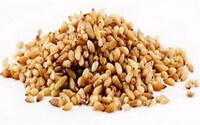
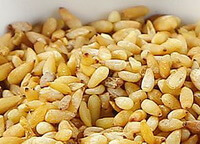
Characteristics of the Herb: The kernel of Platycladus orientalis is oval (egg-shaped) to oblong-oval, 3–7 mm long and 1.5–3 mm in diameter. The fresh kernel is primrose yellow (pale yellow) or yellowish-white. If stored for a long time, its color darkens to yellowish-brown and becomes oily. The kernel is enveloped externally by a membranous endotesta; the apex is slightly smooth and round-trigonous, bearing dark brown spots, while the base is blunt and light-colored. The fracture surface is cream-white (milky white) to yellowish-white; the endosperm is well developed, and there are two or more cotyledons, which are rich in oil. The herb has a mild fragrance, a bland taste, and a greasy texture.
Pharmacological Actions: (1) moistening the intestines and promoting bowel motility; (2) sedative effect.
Medicinal efficacy: Nourishing the heart and calming the mind (to relieve mental and physical restlessness and promote tranquility), moistening the intestines and promoting bowel motility. It is indicated for blood and body fluid deficiency, irritability and insomnia, forgetfulness with insomnia, palpitations and severe palpitations, palpitations accompanied by fear, spermatorrhea (nocturnal emission), intestinal dryness, constipation, yin deficiency with night sweats, etc.
Administration of Semen Platycladi (Bǎi Zǐ Rén):
Reference:
Administration Guide for Semen Platycladi (Bǎi Zǐ Rén)
TCM Books:
(1) Internally: 3–10 grams; (2) Internally: water decoction, 1–3 qian (≈3–9 grams), or prepared as pills or powder; external use: fry and extract oil for topical application; (3) Internally: water decoction, 10–15 grams, or prepared as pills or powder; external use: appropriate amount, finely powdered herb applied topically, or fresh herb mashed and applied topically.
Contraindications, Precautions, and Adverse Reactions: Semen Platycladi should not be combined with Flos Chrysanthemi, Rumex root, mineral-based herbs (e.g., stone herbs), or wheat flour. It is preferable to combine it with Concha Ostreae, Cortex Cinnamomi, or Semen Trichosanthis (Melon Seeds), among others.
References:
1.Introduction of Bai Zi Ren: Chinese Arborvitae Seed

 ✵The article records the herb Chinese Arborvitae Seed—including its English name, Latin name, Pinyin name, properties and flavor, botanical source (one plant species: (1) Platycladus orientalis (L.) Franco), botanical features, growth characteristics, ecological environment, macroscopic and microscopic features of the herb, pharmacological actions, medicinal efficacy, and administration guidelines.
 Pinyin Name: Bǎi Zǐ Rén
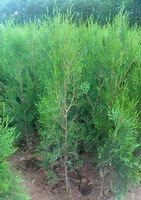 Botanical Description: Platycladus orientalis (L.) Franco is an evergreen tree of the Cupressaceae family (cypress family) and genus Platycladus. Synonyms include Thuja orientalis L., Biota orientalis (L.) Endl. Common names are Oriental Arborvitae, Chinese Arborvitae, Cè Bǎi, Xiang Bǎi (meaning “fragrant arborvitae”), Huáng Bǎi, Biàn Bǎi, Biàn Sōng, and Biàn Huì. Mature trees reach up to 20 m in height, with a diameter at breast height (DBH) of up to 1 m. The bark is thin, light grayish-brown, and longitudinally fissured into narrow strips. Branchlets are flattened, straight, and arranged in a single plane. Leaves are scale-like, decussate, 1–3 mm long, with a slightly obtuse apex. The exposed portions on the upper and lower surfaces of the branchlets are obovate-rhombic or rhombic; lateral leaves fold over the base between upper and lower leaves and are keeled (carinate). Glandular grooves occur along the midrib on the abaxial leaf surface.
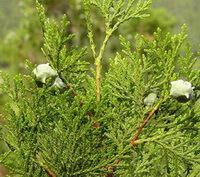 The tree is monoecious. Cones (strobili) are solitary and grow terminally on short branchlets. Male cones are yellow, ovoid (egg-shaped), and ~2 mm long. Female cones mature in the same year; they are ovoid, 1.5–2 cm long, fleshy (succulent) and bluish-cyan (aquamarine) with a whitish bloom before maturity; at maturity, they become woody, dehiscent, and russet (reddish-brown). There are four pairs of peltate, flat seed-bearing scales (ovuliferous scales); the apical portion of the dorsal surface bears a reflexed tip; the central pair of scales each bears 1–2 seeds.
 Ecological Environment: Platycladus orientalis (L.) Franco grows in moist, fertile soils—including limestone mountains and well-drained, calcareous slopes. Native to northwestern China, it is widely cultivated and has become naturalized in other parts of Asia.
 Growth Characteristics: The species prefers full sun, exhibits moderate shade tolerance when young, and is highly adaptable. It thrives in acidic, neutral, calcareous, and lightly saline soils. It is drought-tolerant but poorly tolerant of waterlogging. It exhibits strong sprouting capacity, moderate cold tolerance, heat tolerance, and weak wind resistance. It is restricted to elevations below 900 m, growing optimally below 400 m.
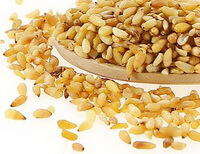 Characteristics of the Herb: The kernel of Platycladus orientalis is oval (egg-shaped) to oblong-oval, 3–7 mm long and 1.5–3 mm in diameter. The fresh kernel is primrose yellow (pale yellow) or yellowish-white. If stored for a long time, its color darkens to yellowish-brown and becomes oily. The kernel is enveloped externally by a membranous endotesta; the apex is slightly smooth and round-trigonous, bearing dark brown spots, while the base is blunt and light-colored. The fracture surface is cream-white (milky white) to yellowish-white; the endosperm is well developed, and there are two or more cotyledons, which are rich in oil. The herb has a mild fragrance, a bland taste, and a greasy texture.
 Pharmacological Actions: (1) moistening the intestines and promoting bowel motility; (2) sedative effect.
