✵This article documents the herb Silktree Albizia Bark and Albizia Flower, including their English names, Latin names, Pinyin names, properties and flavors, botanical source—namely, the plant species Albizia julibrissin Durazz.—and provides a detailed description of the plant’s botanical features, growth characteristics, ecological environment, as well as the morphological characteristics, pharmacological actions, medicinal efficacy, and administration guidelines for both Silktree Albizia Bark and Albizia Flower.
Cortex Albiziae (Silktree Albizia Bark)
Pinyin Name: Hé Huān Pí
English Name: Silktree Albizia Bark
Latin Name:Cortex Albiziae Property and Flavor: Neutral; sweet
Brief Introduction:Cortex Albiziae is the dried stem bark of Albizia julibrissin Durazz. It is used (1) as a sedative to alleviate palpitations and insomnia caused by anxiety, and (2) to invigorate blood circulation and relieve pain in the treatment of traumatic swellings, boils, and sores. Commonly known names include Cortex Albiziae, silktree albizia bark, bark of silktree albizia, and Hé Huān Pí.
Botanical Source: Classical herbal works define Cortex Albiziae as the dried stem bark of Albizia julibrissin Durazz., a deciduous tree belonging to the genus Albizia, family Fabaceae (Leguminosae, or legume/pea family), order Rosales. The following describes this commonly used species:
(1) Albizia julibrissin Durazz.
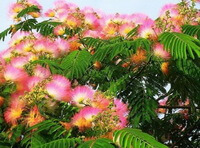
Botanical Description:Albizia julibrissin Durazz. is a deciduous tree of the Fabaceae family and genus Albizia, commonly known as Hé Huān. It grows up to 16 meters tall, with a broadly spreading crown; trunks are grayish-black; young shoots, inflorescences, and rachises are densely tomentose or pubescent.
Stipules (peraphylla) are linear-lanceolate, smaller than the leaflets, and caducous. Leaves are bipinnately compound and alternate; primary petioles measure 3–5 cm in length, with a gland at the base and another near the apex where one pair of pinnae is inserted. Pinnae occur in 4–12 pairs (cultivated varieties may have up to 20 pairs); each pinna bears 10–30 leaflets, which are linear to oblong, 6–12 mm long and 1–4 mm wide, ascending, with an acute or mucronate apex, ciliate margins (trichomes along the edge), and sometimes pubescent on the abaxial surface—or pubescence restricted to the midrib (midvein); the midrib is adpressed against the upper surface.
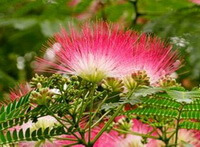
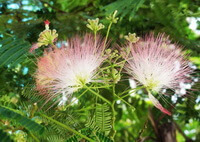
Inflorescences are paniculate, grow terminally on branches; flowers are pink; the calyx is tubular (fistuliform), ~3 mm long; the corolla is ~8 mm long, with triangular lobes ~1.5 mm long; both calyx and corolla are pubescent externally. Stamens are numerous, with connate bases and slender, elongated filaments. The ovary is superior; the style is nearly as long as the filaments; the stigma is cylindrical.
Fruits are linear-lanceolate legumes (pods), 9–15 cm long and 1.5–2.5 cm wide; young pods are pilose, maturing to glabrous. Flowering occurs from June to July; fruiting from August to October.
Ecological Environment:Albizia julibrissin Durazz. grows naturally on hillsides and roadsides and is widely cultivated in gardens. Native to the Yellow River Basin of China and the southern United States, it is now predominantly distributed across China and also found in other parts of East Asia and Central Asia; it has been introduced and cultivated in the Americas.
Growth Characteristics:Albizia julibrissin Durazz. prefers warm, sunny conditions and exhibits tolerance to cold and drought. It thrives in infertile soils and arid climates but is intolerant of waterlogging. The species grows rapidly and demonstrates strong resistance to atmospheric pollutants such as sulfur dioxide and hydrogen chloride.
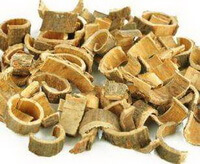
Characteristics of the Herb: The herb is shallowly grooved or curled into a monocylindrical shape, 40–80 cm long and 1–3 mm thick. The outer surface is taupe (dusty grayish-brown), slightly coarse, with reddish-brown elliptic lenticels. The inner surface is smooth, yellowish-white, bearing longitudinal fine veins, occasional shallow cracks, dense oval transverse lenticels (brown or brownish-red), occasionally protruding transverse ridges or larger circular branch scars, and often accompanied by lichen spots. The herb is hard and brittle, fractures easily, and the fracture surface is lobed, yellowish-brown or yellowish-white. It has a mild fragrance, a bland taste, slight astringency, and a faint tingling sensation on the tongue, followed by mild pharyngeal discomfort.
Medicinal Efficacy: Relieving depression and calming the mind (to alleviate mental restlessness and promote tranquility), harmonizing the blood, invigorating blood circulation, reducing swelling. It is indicated for restlessness (mental unease), depression, insomnia, pulmonary abscess, carbuncles, furuncles, sores, scrofula (cervical lymphadenitis), fractures and muscle injuries, traumatic injury—including falls.
Administration of Cortex Albiziae (Hé Huān Pí):
Reference:
Administration Guide for Cortex Albiziae (Hé Huān Pí)
TCM Books:
(1) Internally: 6–12 grams; external use: appropriate amount, applied topically as a finely powdered herb; (2) Internally: water decoction, 1.5–3 qian (≈4.5–9 grams), or prepared as powder; external use: appropriate amount, applied topically as a finely powdered herb; (3) Internally: water decoction, 10–15 grams, or prepared as pills or powder; external use: appropriate amount, applied topically as a finely powdered herb.
Flos Albiziae (Albizia Flower)
Pinyin Name: English Name: Albizia Flower
Latin Name:Flos Albiziae Property and Flavor: Neutral; sweet
Brief Introduction:Flos Albiziae is the dried inflorescence of Albizia julibrissin Durazz., used as a sedative to treat restlessness and insomnia. Commonly known names include Flos Albiziae, Albizia Flower, and Hé Huān Huā.
Classical herbal works define Flos Albiziae (Albizia Flower) as the dried inflorescence (capitulum), flowers, or flower buds of Albizia julibrissin Durazz., a deciduous tree of the genus Albizia, family Fabaceae (Leguminosae, or legume family), order Rosales. This species is described in the entry “Cortex Albiziae (Silktree Albizia Bark).”
Characteristics of the Herb: Albizia Flower: The capitula shrivel into globular masses. Individual flowers are slender, curved, and 0.7–1 cm long, fawn-colored (pale yellowish-brown) with short pedicels. The calyx is terete (tubular), apically 5-denticulate, and sparsely pubescent; the corolla tube is approximately twice the length of the calyx tube, apically 5-lobed, with lanceolate lobes that are sparsely pubescent; stamens are numerous, filaments are slender and yellowish-brown or tawny, partially connate at the base and free distally, extending beyond the corolla tube. The herb is lightweight and brittle. It has a faint fragrance and a bland taste.
Albizia Flower Bud: Commonly known as Hé Huān Mǐ (“Albizia Rice”), the buds resemble rice grains, turquoise or yellowish-green, and are pilose. The lower one-third is enclosed by the calyx tube.
Pharmacological Actions: (1) central nervous system depressant effect.
Medicinal Efficacy: Relieving depression, calming the mind (to alleviate mental restlessness and promote tranquility), regulating Qi, stimulating appetite, unblocking the collaterals, dispelling wind, improving vision, invigorating blood circulation, and relieving pain. It is indicated for restlessness and mental unease, depression and insomnia, Qi stagnation with chest oppression, chest tightness and anorexia, insomnia, forgetfulness, acute conjunctivitis due to wind-fire invasion, blurred vision, pharyngalgia, carbuncles, lumbago, and traumatic injury—including falls.
Administration of Flos Albiziae (Hé Huān Huā):
Reference:
Administration Guide of Flos Albiziae (Hé Huān Huā)
TCM Books:
(1) Internally: 5–10 grams; (2) Internally: water decoction, 1–3 qian (≈3–9 grams), or prepared as pills or powder; (3) Internally: water decoction, 3–9 grams, or prepared as pills or powder.
References:
1.Introduction of He Huan Pi: Silktree Albizia Bark

 ✵This article documents the herb Silktree Albizia Bark and Albizia Flower, including their English names, Latin names, Pinyin names, properties and flavors, botanical source—namely, the plant species Albizia julibrissin Durazz.—and provides a detailed description of the plant’s botanical features, growth characteristics, ecological environment, as well as the morphological characteristics, pharmacological actions, medicinal efficacy, and administration guidelines for both Silktree Albizia Bark and Albizia Flower.
 Pinyin Name: Hé Huān Pí
 Botanical Description: Albizia julibrissin Durazz. is a deciduous tree of the Fabaceae family and genus Albizia, commonly known as Hé Huān. It grows up to 16 meters tall, with a broadly spreading crown; trunks are grayish-black; young shoots, inflorescences, and rachises are densely tomentose or pubescent.
 Inflorescences are paniculate, grow terminally on branches; flowers are pink; the calyx is tubular (fistuliform), ~3 mm long; the corolla is ~8 mm long, with triangular lobes ~1.5 mm long; both calyx and corolla are pubescent externally. Stamens are numerous, with connate bases and slender, elongated filaments. The ovary is superior; the style is nearly as long as the filaments; the stigma is cylindrical.
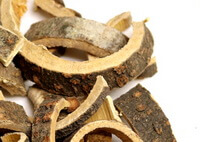 Characteristics of the Herb: The herb is shallowly grooved or curled into a monocylindrical shape, 40–80 cm long and 1–3 mm thick. The outer surface is taupe (dusty grayish-brown), slightly coarse, with reddish-brown elliptic lenticels. The inner surface is smooth, yellowish-white, bearing longitudinal fine veins, occasional shallow cracks, dense oval transverse lenticels (brown or brownish-red), occasionally protruding transverse ridges or larger circular branch scars, and often accompanied by lichen spots. The herb is hard and brittle, fractures easily, and the fracture surface is lobed, yellowish-brown or yellowish-white. It has a mild fragrance, a bland taste, slight astringency, and a faint tingling sensation on the tongue, followed by mild pharyngeal discomfort.
 Pinyin Name:
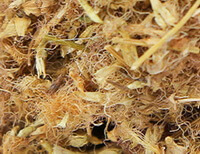 Characteristics of the Herb: Albizia Flower: The capitula shrivel into globular masses. Individual flowers are slender, curved, and 0.7–1 cm long, fawn-colored (pale yellowish-brown) with short pedicels. The calyx is terete (tubular), apically 5-denticulate, and sparsely pubescent; the corolla tube is approximately twice the length of the calyx tube, apically 5-lobed, with lanceolate lobes that are sparsely pubescent; stamens are numerous, filaments are slender and yellowish-brown or tawny, partially connate at the base and free distally, extending beyond the corolla tube. The herb is lightweight and brittle. It has a faint fragrance and a bland taste.
