✵The article records the herb Magnetite, including its English name, Latin name, Pinyin name, properties and flavor, and its source mineral—(1) magnetic iron ore—with a detailed introduction to the mineral’s characteristics, geographical distribution, features of the herb Magnetite, its pharmacological actions, medicinal efficacy, and administration guidelines.
Magnetitum (Magnetite)
Pinyin Name: Cí Shí
English Name: Magnetite
Latin Name:Magnetitum Properties and Flavor: Cold, salty
Brief Introduction: The herb Magnetitum is magnetic iron ore composed mainly of ferroferric oxide (Fe3O4). It is used as a sedative–tranquilizing and antiasthmatic agent for treating tinnitus, palpitations, insomnia, epilepsy, and mania, and also for relieving asthma. The herb is commonly known as Magnetitum, Magnetite, or Cí Shí.
Mineral Source: Classical herbal works—including major authoritative materia medica works—define Magnetitum (Magnetite) as magnetic iron ore primarily composed of ferroferric oxide (Fe3O4). This widely used mineral is described below:
Magnetite
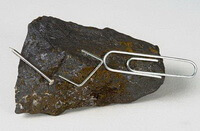
Mineral Description: Magnetite crystallizes in the isometric (cubic) crystal system. Crystals commonly occur as octahedra, garnetohedra (rhombic dodecahedra), or coarse-to-fine granular to massive aggregates; crystal faces often exhibit parallel striations. Color is iron-black; surfaces may oxidize or hydrate to reddish-black or brown-black; severely wind-abraded specimens may be coated with velvety layers of hydrohematite and ferrohydrite. Streak is black; opaque; luster is submetallic. No cleavage; fracture is uneven, conchoidal, or jagged. Hardness is 5.5–6.5 on the Mohs scale. Texture is brittle; relative density (specific gravity) ranges from 4.9 to 5.2. It exhibits strong ferromagnetism. It occurs in many igneous and metamorphic rocks; also common in beach sands.
Magnetite forms through various endogenic geological processes and commonly coexists with iron–magnesium silicate minerals and quartz-rich rocks. The weathering resistance of these associated silicates is lower than that of magnetite, making them more susceptible to wind abrasion and the formation of small pores.
Mineral Distribution: Magnetite is predominantly produced in China, but also occurs in North America, Brazil, and Australia.
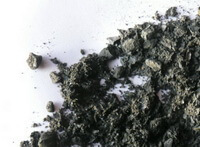
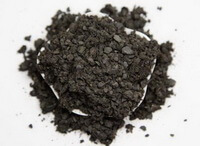
Characteristics of the Herb: The mineral occurs as irregularly massive or slightly cuboidal aggregates, typically angular and non-uniform in size. Surface color is iron-black, gray-black, or brown, often marked by black streak-like flaws. It is opaque, with a submetallic luster. The surface is rough and uneven. It is heavy, hard, and firm—difficult to crush—and its fractured surface is irregular and uneven. It exhibits magnetic properties, has an earthy odor, and a mild taste.
Pharmacological Actions: (1) Sedative and anticonvulsant effects; (2) Hematopoietic (iron-replenishing) effect in iron-deficiency anemia; (3) Anti-inflammatory activity; (4) Analgesic effect; (5) Procoagulant activity, among others.
Medicinal efficacy: Relieving convulsions; calming the mind and spirit (alleviating mental restlessness and promoting tranquility); pacifying the Liver and subduing Yang (suppressing hyperactive Liver-Yang); subduing Yang to improve respiration; enhancing hearing and vision (improving auditory and visual acuity); promoting inspiration and relieving asthma. Indications include palpitations, insomnia (agrypnia, sleeplessness), dizziness, vertigo, blurred vision (diminished visual acuity), tinnitus and deafness (ringing in the ears, hearing loss), Kidney-Deficiency-type asthma, deficiency-induced asthma, convulsive epilepsy, and palpitations.
Administration of Magnetitum (Cí Shí):
Reference:
Administration Guide for Magnetitum (Cí Shí)
TCM Books:
(1) Internally: 9–30 grams per dose; preferably added early in decoction. (2) Internally: water decoction, 0.3–1 liang (≈9–30 grams); alternatively, prepared as pills or powders. External use: appropriate amount, ground into fine powder, mixed with a suitable medium and applied topically. (3) Internally: water decoction, 10–30 grams per dose; preferably crushed and added early in decoction, or formulated into pills or powders. External use: appropriate amount, ground into fine powder and applied topically.
Contraindications, Precautions, and Adverse Reactions: Magnetitum should not be combined with Paeonia suffruticosa (Tree Peony), Aconitum carmichaelii (Sikimi), or petroleum jelly (Vaseline). Its nature is heavy and sedating; it may be used short-term but is unsuitable for prolonged administration.

 ✵The article records the herb Magnetite, including its English name, Latin name, Pinyin name, properties and flavor, and its source mineral—(1) magnetic iron ore—with a detailed introduction to the mineral’s characteristics, geographical distribution, features of the herb Magnetite, its pharmacological actions, medicinal efficacy, and administration guidelines.
 Pinyin Name: Cí Shí
 Mineral Description: Magnetite crystallizes in the isometric (cubic) crystal system. Crystals commonly occur as octahedra, garnetohedra (rhombic dodecahedra), or coarse-to-fine granular to massive aggregates; crystal faces often exhibit parallel striations. Color is iron-black; surfaces may oxidize or hydrate to reddish-black or brown-black; severely wind-abraded specimens may be coated with velvety layers of hydrohematite and ferrohydrite. Streak is black; opaque; luster is submetallic. No cleavage; fracture is uneven, conchoidal, or jagged. Hardness is 5.5–6.5 on the Mohs scale. Texture is brittle; relative density (specific gravity) ranges from 4.9 to 5.2. It exhibits strong ferromagnetism. It occurs in many igneous and metamorphic rocks; also common in beach sands.
 Characteristics of the Herb: The mineral occurs as irregularly massive or slightly cuboidal aggregates, typically angular and non-uniform in size. Surface color is iron-black, gray-black, or brown, often marked by black streak-like flaws. It is opaque, with a submetallic luster. The surface is rough and uneven. It is heavy, hard, and firm—difficult to crush—and its fractured surface is irregular and uneven. It exhibits magnetic properties, has an earthy odor, and a mild taste.
