✵The article records the herb Amber—its English name, Latin name, Pinyin name, properties and flavor, and its source mineral, succinum—with a detailed introduction to the characteristics of this mineral, its ecological environment, the features of the herb Amber, its pharmacological actions, medicinal efficacy, and administration guidelines.
Succinum (Amber)
Pinyin Name: Hǔ Pò
English Name: Amber
Latin Name:Succinum Properties and Flavor: Neutral in nature, sweet
Brief Introduction: The herb Succinum is a yellowish or brownish fossilized resin, used (1) as a sedative for the treatment of insomnia, dream-disturbed sleep, palpitations, and convulsions, and (2) as a diuretic and hemostatic agent for urodynia and hematuria caused by acute urinary tract infection and urinary calculi. The herb is commonly known as Amber, Succinum, or Hǔ Pò.
Source: Common herbal classics and other renowned materia medica texts define the herb Succinum (Amber) as hydrocarbons formed from ancient pine resin buried underground and subjected to long-term condensation and geological transformation. This commonly used herb is introduced below:
Succinum (Amber)
Description: Amber is also known as Succinum and commonly referred to as Hǔ Pò. In ancient China, amber was formerly called Hǔ Pò (meaning “the soul of a tiger”), Shòu Pò (meaning “the soul of a beast”), Jiāng Zhū (meaning “pearl in a river”), and Wèi Yù (meaning “lost jade”). According to ancient legends, when a tiger died, its soul descended into the earth and transformed into stone; alternatively, amber was believed to be the tears shed by a tiger. These legends reflect ancient Chinese speculation and inquiry into amber’s origin and suggest that it was traditionally thought to possess functions such as attracting good fortune, warding off evil, calming the household, and soothing the spirit. To ancient emperors, amber held special significance: according to historical records, “the emperor used lapis lazuli for ornaments at the Heaven Altar, amber at the Earth Altar, coral at the Sun Altar, and turquoise at the Moon Altar.”
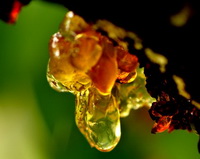
Amber is fossilized resin derived from coniferous trees (e.g., pines and cypresses) dating from the Mesozoic Cretaceous to the Cenozoic Tertiary periods, formed through geological processes and organic alteration. Amber formation generally occurs in three stages: (1) secretion of resin from pine and cypress trees; (2) deep burial of the resin, followed by polymerization and petrification—during which its composition, structure, and physical characteristics undergo significant changes; and (3) erosion, transportation, deposition, and diagenesis of the polymerized resin, ultimately yielding amber.
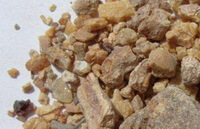
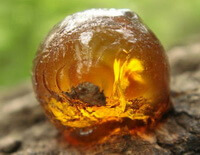
Morphological Characteristics: Amber is amorphous and commonly occurs as massive blocks, loose granules, stalactitic forms, small droplet-shaped pieces, or irregular granules and chunks. Some specimens exhibit radial textures resembling tree rings. Amber may contain inclusions such as animal remains and plant fragments, and it is typically found in coal seams and sandy clay loam layers. Amber recovered from coal seams—characterized by firm, hard texture—is known as Méi Pò (“coal amber”); amber recovered from clay layers—characterized by loose texture and light weight—is known as Hǔ Pò. Amber exhibits a wide range of colors, including yellow, brown, pale brown, orange-yellow, and occasionally reddish, brownish, or greenish hues. It ranges from transparent to opaque and displays the luster typical of pine resins. Amber has low hardness (2–2.5 on the Mohs scale), a relative density (specific gravity) of 1.05–1.09, a light texture, a gem-like luster, and crystalline appearance. Another distinctive feature is its rich inclusions—such as insects, plant matter, and minerals.
Amber melts easily and emits a characteristic crackling sound when heated. When heated to 150 °C, it begins to soften; it fully melts at 250–400 °C. It is soluble in concentrated sulfuric acid and hot nitric acid, partially soluble in ethanol and turpentine oil.
Ecological Environment: Amber is primarily distributed in conglomeratic rocks and coal seam sediments of the Cretaceous and Tertiary periods.
Harvest and Storage: After excavation from strata or coal seams, sand, stones, soil, and other impurities are removed. Due to its light weight, amber is easy to store; high-quality, intact specimens are highly collectible.
Natural amber is mainly found and produced in the Baltic States, Myanmar (Burma), China, the Dominican Republic, and other regions
Characteristics of the Herb Amber: It occurs as irregular blocks, stalactitic masses, coarse granules, or polygonal fragments. Blocks vary in size; lump-shaped amber may reach up to 6 cm in length, while stalactitic specimens measure 1–4.5 cm in diameter and up to 7 cm in length. The surface is smooth or uneven, ranging in color from sanguine (reddish-brown) and primrose yellow (pale yellow) to pale brown or dark brown—often arranged in alternating bands. The streak is white; the material is transparent to translucent and exhibits a resinous luster. It is lightweight, with a crisp and brittle texture, and fractures easily under torsion. The fracture surface is smooth and displays a vitreous luster. When rubbed, it develops static electricity and can attract small pieces of paper or fine grass blades. It has a faint odor of turpentine or rosin and a mild taste; it is brittle when chewed and imparts no gritty sensation. It melts readily upon heating, emits a crackling sound, and produces white smoke.
High-grade amber is bright red, with well-ordered blocky morphology, crisp and brittle texture, and a brilliant (splendent) fracture surface. Low-grade amber is smaller in size, harder in texture, and dark brown in color. It is insoluble in dilute acids and only slightly soluble in warm ethanol and other organic solvents.
Coal Amber: Also known as black amber, it occurs as irregular polygonal blocks or granules; a few specimens are stalactitic and vary in size. Colors range from pale yellow and light brown to dark brown (“black-brown”). It is glossy, with a firm, hard texture that resists fracturing under torsion. When the dark outer layer is removed, the underlying material becomes transparent or translucent and exhibits a vitreous appearance. The fracture surface shows a vitreous luster. It has a kerosene-like (coal oil) odor and a mild taste. No gritty sensation is perceived when chewed. High-grade coal amber is yellowish-brown, with a vitreous luster on the fracture surface.
Medicinal Efficacy: Relieving convulsions; calming the mind (to alleviate mental restlessness and promote tranquility); invigorating blood circulation and dispelling stasis; arresting bleeding; promoting diuresis for stranguria; clearing corneal opacities (nebulae) and improving visual acuity. It is indicated for infantile convulsions and epilepsy; palpitations with anxiety; insomnia (agrypnia); hematuric stranguria (stranguria accompanied by hematuria); isolated hematuria; urinary retention; blood stasis-induced amenorrhea; menostasis; postpartum abdominal pain due to stasis; abdominal masses and accumulations; nebula (mild corneal opacity); ulcers and sores; and traumatic injuries.
Administration of Succinum (Hǔ Pò):
Reference:
Administration Guide for Succinum (Hǔ Pò)
TCM Books:
(1) Internally: Administered as pills or powders, 3–6 fen (approximately 0.9–1.8 grams). External use: Apply finely powdered herb topically—either as a point application or by sprinkling onto affected areas. (2) Internally: Administered as pills or powders, 3–6 fen (approximately 0.9–1.8 grams). External use: Apply finely powdered herb topically—either as a point application or by sprinkling onto affected areas.

 ✵The article records the herb Amber—its English name, Latin name, Pinyin name, properties and flavor, and its source mineral, succinum—with a detailed introduction to the characteristics of this mineral, its ecological environment, the features of the herb Amber, its pharmacological actions, medicinal efficacy, and administration guidelines.
 Pinyin Name: Hǔ Pò
 Description: Amber is also known as Succinum and commonly referred to as Hǔ Pò. In ancient China, amber was formerly called Hǔ Pò (meaning “the soul of a tiger”), Shòu Pò (meaning “the soul of a beast”), Jiāng Zhū (meaning “pearl in a river”), and Wèi Yù (meaning “lost jade”). According to ancient legends, when a tiger died, its soul descended into the earth and transformed into stone; alternatively, amber was believed to be the tears shed by a tiger. These legends reflect ancient Chinese speculation and inquiry into amber’s origin and suggest that it was traditionally thought to possess functions such as attracting good fortune, warding off evil, calming the household, and soothing the spirit. To ancient emperors, amber held special significance: according to historical records, “the emperor used lapis lazuli for ornaments at the Heaven Altar, amber at the Earth Altar, coral at the Sun Altar, and turquoise at the Moon Altar.”
 Amber is fossilized resin derived from coniferous trees (e.g., pines and cypresses) dating from the Mesozoic Cretaceous to the Cenozoic Tertiary periods, formed through geological processes and organic alteration. Amber formation generally occurs in three stages: (1) secretion of resin from pine and cypress trees; (2) deep burial of the resin, followed by polymerization and petrification—during which its composition, structure, and physical characteristics undergo significant changes; and (3) erosion, transportation, deposition, and diagenesis of the polymerized resin, ultimately yielding amber.
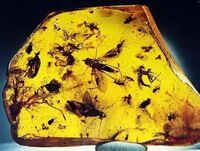 Morphological Characteristics: Amber is amorphous and commonly occurs as massive blocks, loose granules, stalactitic forms, small droplet-shaped pieces, or irregular granules and chunks. Some specimens exhibit radial textures resembling tree rings. Amber may contain inclusions such as animal remains and plant fragments, and it is typically found in coal seams and sandy clay loam layers. Amber recovered from coal seams—characterized by firm, hard texture—is known as Méi Pò (“coal amber”); amber recovered from clay layers—characterized by loose texture and light weight—is known as Hǔ Pò. Amber exhibits a wide range of colors, including yellow, brown, pale brown, orange-yellow, and occasionally reddish, brownish, or greenish hues. It ranges from transparent to opaque and displays the luster typical of pine resins. Amber has low hardness (2–2.5 on the Mohs scale), a relative density (specific gravity) of 1.05–1.09, a light texture, a gem-like luster, and crystalline appearance. Another distinctive feature is its rich inclusions—such as insects, plant matter, and minerals.
