✵This article documents the herb Valerian Rhizome, including its English name, Latin name, Pinyin name, properties and flavor, botanical sources as defined in classical herbal works—namely, two primary species: (1) Valeriana officinalis L. and (2) Valeriana amurensis Smir. ex Kom.—as well as other acceptable species, including (3) Valeriana officinalis L. var. latifolia Miq. It provides a detailed description of the botanical features, growth characteristics, and ecological environments of these three species; the macroscopic and microscopic features of the herb Valerian Rhizome; its pharmacological actions; medicinal efficacy; and administration guidelines.
Rhizoma Valerianae (Valerian Rhizome)
Pinyin Name: Xié Cǎo
English Name: Valerian Rhizome
Latin Name:Rhizoma Valerianae Properties and Flavor: Warm, pungent, bitter
Brief Introduction:Rhizoma Valerianae is the dried rhizome of Valeriana officinalis L., used (1) as a sedative to treat insomnia and (2) to regulate Qi flow to relieve abdominal distension and pain. Commonly known names include Rhizoma Valerianae, Valerian Rhizome, Valerian Root, and Xié Cǎo.
Botanical Source: Classical herbal works define Rhizoma Valerianae (Valerian Rhizome) as the dried rhizome—not dry root—of (1) Valeriana officinalis L. or (2) Valeriana amurensis Smir. ex Kom. Other authoritative herbal classics further include (3) Valeriana officinalis L. var. latifolia Miq. These species belong to the genus Valeriana L., family Valerianaceae (formerly classified under Caprifoliaceae, subfamily Valerianoideae), order Dipsacales. Descriptions of these three commonly used species follow.
(1) Valeriana officinalis L.
Botanical Description:Valeriana officinalis L. is commonly known as Xié Cǎo. It is a perennial herb of the family Valerianaceae (formerly placed in Caprifoliaceae, subfamily Valerianoideae) and genus Valeriana. (Some taxonomic systems historically classified it under Caprifoliaceae, but current consensus places it firmly in Valerianaceae). It grows up to 1–1.5 m tall. The rhizome is stout and short, capitate, with tufted, aromatic, fibrous roots. The stem is hollow, bearing a coarse vertical ridge and covered with long, coarse hairs. Procumbent branches and basal leaves—especially those at the base—often wither during flowering. Cauline leaves are opposite, oval to broadly ovate, arranged in 2–9 pairs, and pinnately divided; central and lateral lobes are similar in shape and size, but the central lobe is frequently fused with the first pair of lateral lobes, resulting in a 3-lobed appearance. Lobes are lanceolate or linear, with attenuated apices, decurrent bases, and margins that are entire or sparsely serrate. Both leaf surfaces and petioles are more or less pilose.
Inflorescences are terminal, forming corymbose, ternate, racemose cymes. Flower bracts are pinnately divided and 1–2 cm long; bracteoles are linear, ~1 cm long; calyx is involute; corolla is lavender-tinged or white, ~5 mm long, slightly widened apically, and 5-lobed; stamens (3) exserted beyond the corolla; ovary is inferior.
Achenes are ovate-oblong, ~4 mm long, with a nearly truncate base and an apex bearing numerous persistent, plumose (feathery) calyx teeth. Flowering occurs from May to July; fruiting from June to October.
Ecological Environment:Valeriana officinalis L. grows at elevations up to 2,500 m, commonly found in grasslands on hillsides or mountain slopes, forest margins, and along ditches. Though native to Europe and temperate Asia, it is now widely distributed—including in China—and has been naturalized in parts of North America.
Growth Characteristics:Valeriana officinalis prefers moist, well-drained soils. Cultivation sites should have a high groundwater table or be low-lying, with reliable irrigation, good waterlogging tolerance, and moderate drought resistance. Neutral or slightly alkaline sandy loam is optimal for planting.
Characteristics of the Herb: The rhizome is cylindrical to subglobose, stout and short, 0.5–2 cm long and 0.4–1.5 cm in diameter. Its surface is yellowish-brown to brown, coarse and rough, bearing remnants of petioles and a residual stem base at the upper end; the stem base is hollow. Some rhizomes exhibit transverse branches, with stem base remnants persisting at distal nodes; internode length is 1–2 cm. Numerous fine, clustered roots arise around and from the lower end of the rhizome; root tips are slender, surface is yellowish-brown to brown, with longitudinal wrinkles. The texture is slightly tough. On fracture, the outer layer is yellowish-brown or brown, and the center is yellowish-white. It emits a distinctive, strong odor—more pronounced in the dried material. Taste is initially slightly pungent, then mildly bitter, followed by a cooling sensation.
(2) Valeriana amurensis Smir. ex Kom.
Botanical Description:Valeriana amurensis Smir. ex Kom. is commonly known as Hēi Shuǐ Xié Cǎo (“Black Water Valeriana”). It is a perennial herb of the family Valerianaceae and genus Valeriana. It is also referred to as Black Water Valeriana. Plants reach up to 1.5 m in height. The rhizome is thin, elongated, aromatic, and irregularly clumped. The upper part of the stem bears petiolate glandular hairs. Leaves are opposite and imparipinnate, 15–20 cm long; basal petioles are ~20 cm long, while cauline petioles gradually shorten upward, becoming sessile and bearing rough hairs. The first 1–2 pairs of basal leaflets are smaller; the terminal (central) lobe is the largest, broadly ovate, often fused with—or closely appressed to—the first pair of upper leaflets; apex is obtuse, base is cuneate or broadly cuneate; margin is coarsely serrate.
Inflorescences are terminal, multipartite cymes. Pedicels are covered with petiolate glandular hairs and coarse hairs. Bracts are pinnately divided and ~2 cm long; bracteoles are pinnatisect to linear, ~1 cm long, all bearing glandular hairs. Calyx is involute. Corolla is pale red, funnelform, 3–5 mm long, and 5-lobed. Stamens (3) are included or slightly exserted. Ovary is inferior.
Achenes are narrowly triangular-ovate, ~3 mm long, with a pilose, persistent calyx at the apex. Flowering occurs from June to July; fruiting from July to August.
Ecological Environment:Valeriana amurensis Smir. ex Kom. grows in meadows on hillsides or mountain slopes, as well as in larch and birch forests. It is primarily distributed in China and also occurs in other areas.
Characteristics of the Herb: The rhizomes are capitate, 0.3–1.4 cm long and 0.3–1 cm in diameter. The surface is brownish-yellow, bearing remnants of brownish-yellow aerial stems and petioles at the apex; numerous radicels surround the rhizome. The texture is solid and firm—resistant to fracture—with a central cavity visible on the transverse section. The herb emits a distinctive, pungent odor and has a slightly bitter taste.
Pharmacological Actions: (1) Sedative effect; (2) Effects on the cardiovascular and respiratory systems; (3) Antimicrobial activity; (4) Antidiuretic effect.
Medicinal Efficacy: Calms the heart and tranquilizes the mind. It is indicated for restlessness, palpitations, insomnia, mania, hysteria, rheumatic arthralgia, gastric asthenia, lumbago, irregular menstruation, dysmenorrhea, amenorrhea, and traumatic injury.
Administration of Rhizoma Valerianae (Xié Cǎo):
Reference:
Administration Guide for Rhizoma Valerianae (Xié Cǎo)
TCM Books:
(1) Internally:water decoction, 1–1.5 qian (≈3–4.5 grams); or prepared as a fine powder, or infused in wine; (2) Internally: water decoction, 3–9 grams; or prepared as a fine powder; or infused in wine. Externally: appropriate amount, prepare as a fine powder and apply topically as a paste.
Contraindications, Precautions, and Adverse Reactions: Rhizoma Valerianae should be used with caution in individuals with yin deficiency or constitutional debility.
(3) Valeriana officinalis L. var. latifolia Miq.
Botanical Description:Valeriana officinalis L. var. latifolia Miq. is a variety of Valeriana officinalis L., belonging to the family Valerianaceae and genus Valeriana. It is commonly known as Kuān Yè Xié Cǎo (“Broad-leaf Valeriana”). Key morphological distinctions from the typical variety include broader leaf lobes, larger terminal lobes, broadly ovate serrated lobes, and fewer lobes overall—typically 5–7. Its flowering and fruiting periods coincide with those of Valeriana officinalis L.
Ecological Environment:Valeriana officinalis L. var. latifolia Miq. grows in forests or along ditches, at elevations below 1,500 m. It is distributed in regions overlapping with Valeriana officinalis L., primarily in northeastern and southwestern China.
Characteristics of the Herb: The rhizomes closely resemble those of Valeriana officinalis L.

 ✵This article documents the herb Valerian Rhizome, including its English name, Latin name, Pinyin name, properties and flavor, botanical sources as defined in classical herbal works—namely, two primary species: (1) Valeriana officinalis L. and (2) Valeriana amurensis Smir. ex Kom.—as well as other acceptable species, including (3) Valeriana officinalis L. var. latifolia Miq. It provides a detailed description of the botanical features, growth characteristics, and ecological environments of these three species; the macroscopic and microscopic features of the herb Valerian Rhizome; its pharmacological actions; medicinal efficacy; and administration guidelines.
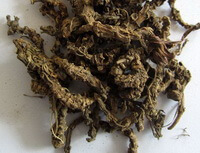 Pinyin Name: Xié Cǎo
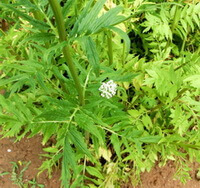 Botanical Description: Valeriana officinalis L. is commonly known as Xié Cǎo. It is a perennial herb of the family Valerianaceae (formerly placed in Caprifoliaceae, subfamily Valerianoideae) and genus Valeriana. (Some taxonomic systems historically classified it under Caprifoliaceae, but current consensus places it firmly in Valerianaceae). It grows up to 1–1.5 m tall. The rhizome is stout and short, capitate, with tufted, aromatic, fibrous roots. The stem is hollow, bearing a coarse vertical ridge and covered with long, coarse hairs. Procumbent branches and basal leaves—especially those at the base—often wither during flowering. Cauline leaves are opposite, oval to broadly ovate, arranged in 2–9 pairs, and pinnately divided; central and lateral lobes are similar in shape and size, but the central lobe is frequently fused with the first pair of lateral lobes, resulting in a 3-lobed appearance. Lobes are lanceolate or linear, with attenuated apices, decurrent bases, and margins that are entire or sparsely serrate. Both leaf surfaces and petioles are more or less pilose.
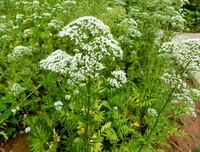 Ecological Environment: Valeriana officinalis L. grows at elevations up to 2,500 m, commonly found in grasslands on hillsides or mountain slopes, forest margins, and along ditches. Though native to Europe and temperate Asia, it is now widely distributed—including in China—and has been naturalized in parts of North America.
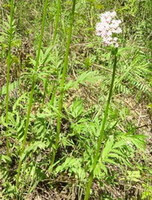 Botanical Description: Valeriana amurensis Smir. ex Kom. is commonly known as Hēi Shuǐ Xié Cǎo (“Black Water Valeriana”). It is a perennial herb of the family Valerianaceae and genus Valeriana. It is also referred to as Black Water Valeriana. Plants reach up to 1.5 m in height. The rhizome is thin, elongated, aromatic, and irregularly clumped. The upper part of the stem bears petiolate glandular hairs. Leaves are opposite and imparipinnate, 15–20 cm long; basal petioles are ~20 cm long, while cauline petioles gradually shorten upward, becoming sessile and bearing rough hairs. The first 1–2 pairs of basal leaflets are smaller; the terminal (central) lobe is the largest, broadly ovate, often fused with—or closely appressed to—the first pair of upper leaflets; apex is obtuse, base is cuneate or broadly cuneate; margin is coarsely serrate.
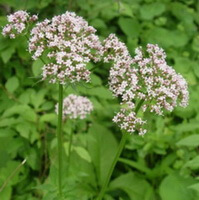 Botanical Description: Valeriana officinalis L. var. latifolia Miq. is a variety of Valeriana officinalis L., belonging to the family Valerianaceae and genus Valeriana. It is commonly known as Kuān Yè Xié Cǎo (“Broad-leaf Valeriana”). Key morphological distinctions from the typical variety include broader leaf lobes, larger terminal lobes, broadly ovate serrated lobes, and fewer lobes overall—typically 5–7. Its flowering and fruiting periods coincide with those of Valeriana officinalis L.
