✵The article records the herb Fu Shen, including its English name, Latin name, Pinyin name, properties and flavor, and botanical source—the fungus species Poria cocos (Schw.) Wolf.—and provides a detailed introduction to the morphological characteristics, growth requirements, and ecological environment of this fungus, as well as the macroscopic features of the herb, its pharmacological actions, medicinal efficacy, and administration guidelines.
Poria cum Radice Pini (Fu-shen)
Pinyin Name: Fú Shén
English Name: Fu Shen (Tuckahoe with Pine Root)
Latin Name:Poria cum Radice Pini Properties and Flavor: Neutral in nature; sweet and bland
Brief Introduction:Poria cum Radice Pini is a fungal sclerotium of Poria cocos that naturally incorporates a fragment of pine root (Pinus massoniana or related species). It is used as a tranquilizing herb for palpitations and insomnia. The herb is commonly known as Poria cum Radice Pini, Fu Shen, or Tuckahoe with Pine Root.
Botanical Source: Classical herbal works define Poria cum Radice Pini (Fu Shen) as the sclerotium of Poria cocos containing an embedded segment of pine root or fine pine wood core. The fungal species Poria cocos (Schw.) Wolf. belongs to the genus Wolfiporia, family Polyporaceae (poroid fungi family), order Polyporales. This widely used species is described below:
(1) Poria cocos (Schw.) Wolf.
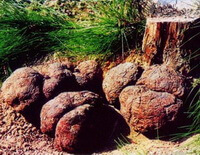
Botanical Description:Poria cocos (Schw.) Wolf. is a fungus of the family Polyporaceae (bracket fungus family) and the genus Wolfiporia. It is also known as Pachyma cocos Fr., Wolfiporia extensa, and Wolfiporia extensa (Peck) Ginns (syn. Poria cocos F.A. Wolf). Common names include hoelen, poria, tuckahoe, China root, and Fu Ling. In some modern classification systems, it is placed in the family Fomitopsidaceae. The sclerotium is spherical, ovoid, ellipsoid, or irregularly shaped, measuring 10–30 cm in length—or longer—and varying widely in weight, typically 500–5,000 g. Its outer surface bears a thick, deeply wrinkled rind, bistre (dark brown) in color; it is soft when fresh and hardens upon drying. The interior is white or rose-pink and has a powdery, granular texture. The fruiting body (encarpium) emerges on the sclerotium surface, is resupinate (flat-lying), 3–8 cm thick, white and succulent when young, and turns sandy beige (pale brown) with age or drying. The pore layer (hymenophore) is dense, with tubes 2–3 mm long and thin walls; the pores are circular, polygonal, or irregular, 0.5–1.5 mm in diameter, and bear a toothed peristome. Spores are rectangular to subcylindrical, smooth, with a slightly curved apex, measuring (7.5–9) μm × (3–3.5) μm.
Poria cocos exhibits three distinct morphological stages during its life cycle: mycelium, sclerotium, and fruiting body.
(1) Mycelium: Comprises both monokaryotic and dikaryotic hyphae. The monokaryotic (primary) mycelium arises from spore germination and exists only transiently in early development. The dikaryotic (secondary) mycelium is the dominant vegetative form. It appears as white, fluffy mycelial mats and forms colonies with distinctive concentric rings.
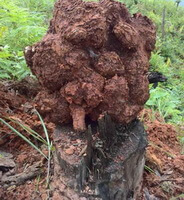
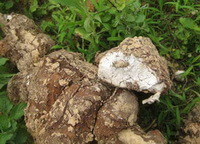
(2) Sclerotium: A compact, dormant structure formed by aggregated hyphae and stored nutrients. Also known as “tuckahoe” or “Fu Ling”, it occurs as spherical, ellipsoidal, oblate, or irregular masses—ranging from small nodules to specimens weighing several kilograms. Fresh sclerotia are soft and easily cut; dried ones become hard and brittle. The outer rind is shell-like and rough, with nodular shrinkage; color ranges from light brown or tan (chocolate brown) when fresh to dark brown when dried. The inner tissue is white or pale brown.
(3) Fruiting body: Typically develops on the surface of mature sclerotia, occasionally on aged mycelial mats. It is resupinate (sessile and flat-lying), honeycombed in appearance, variable in size, and ~0.3–1 cm thick. Initially white, the fertile layer (hymenium) turns pale yellow with maturity. Spores are ash-gray (greyish-white), oblong to nearly cylindrical, with a slightly curved apex, measuring 6–11 μm × 2.5–3.5 μm.
Ecological Environment:Poria cocos is a facultative saprophyte and weak parasite, primarily associated with the roots of pine species—including Pinus massoniana, Pinus tabuliformis, and Pinus densiflora—at depths of 20–30 cm in well-drained, sandy soils. It is native to and widely distributed across China.
Growth Characteristics:Poria cocos thrives in mountainous regions at altitudes of 600–1,000 m, particularly on dry, sunny slopes. Optimal growth conditions include: spore germination at 22–28 °C (71.6–82.4 °F); mycelial growth at 18–35 °C (64.4–95 °F), most vigorous at 25–30 °C (77–86 °F); and fruiting body differentiation and sporulation at 18–26 °C (64.4–78.8 °F). It grows best on wooden substrates with 50–60% moisture content and in soils with ~20% moisture, pH 3–7, and on slopes of 10°–35°. A large diurnal temperature range favors sclerotium formation.
Poria cocos is not taxonomically related to the North American “Indian bread”, which refers to Peltandra virginica—a flowering, tuberous plant in the Araceae family.
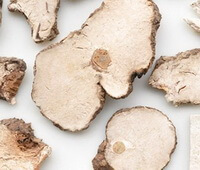
Characteristics of the Herb:Poria cum Radice Pini (Fu Shen) resembles ordinary Poria cocos in gross morphology but contains an embedded, slender, lignified pine root (Pinus massoniana or related species) running through its center. Commercial specimens are commonly cut into square slices. The texture is solid, firm, and slightly powdery. The embedded pine root appears brownish-yellow in cross-section, with visible annual growth rings. The herb is odorless or faintly aromatic and tasteless or mildly bland. High-grade Fu Shen features thick, compact slices with a fine, centrally located pine root.
Pharmacological Actions: (1) Sedative effect.
Medicinal Efficacy: Calms the heart and spirit, alleviates restlessness, and promotes urination. It is indicated for palpitations and insomnia due to heart deficiency, forgetfulness, fright-induced epilepsy, dysuria, and edema.
Administration of Poria cum Radice Pini (Fú Shén):
Reference:
Administration Guide for Poria cum Radice Pini (Fú Shén)
TCM Books:
(1) Internally:water decoction, 3–5 qian (approximately 9–15 grams), or prepared as pills or powder; (2) Internally: water decoction, 9–15 grams, or prepared as pills or powder.
References:
1.Introduction of Fú Shén: Tuckahoe with Pine Root

 ✵The article records the herb Fu Shen, including its English name, Latin name, Pinyin name, properties and flavor, and botanical source—the fungus species Poria cocos (Schw.) Wolf.—and provides a detailed introduction to the morphological characteristics, growth requirements, and ecological environment of this fungus, as well as the macroscopic features of the herb, its pharmacological actions, medicinal efficacy, and administration guidelines.
 Pinyin Name: Fú Shén
 Botanical Description: Poria cocos (Schw.) Wolf. is a fungus of the family Polyporaceae (bracket fungus family) and the genus Wolfiporia. It is also known as Pachyma cocos Fr., Wolfiporia extensa, and Wolfiporia extensa (Peck) Ginns (syn. Poria cocos F.A. Wolf). Common names include hoelen, poria, tuckahoe, China root, and Fu Ling. In some modern classification systems, it is placed in the family Fomitopsidaceae. The sclerotium is spherical, ovoid, ellipsoid, or irregularly shaped, measuring 10–30 cm in length—or longer—and varying widely in weight, typically 500–5,000 g. Its outer surface bears a thick, deeply wrinkled rind, bistre (dark brown) in color; it is soft when fresh and hardens upon drying. The interior is white or rose-pink and has a powdery, granular texture. The fruiting body (encarpium) emerges on the sclerotium surface, is resupinate (flat-lying), 3–8 cm thick, white and succulent when young, and turns sandy beige (pale brown) with age or drying. The pore layer (hymenophore) is dense, with tubes 2–3 mm long and thin walls; the pores are circular, polygonal, or irregular, 0.5–1.5 mm in diameter, and bear a toothed peristome. Spores are rectangular to subcylindrical, smooth, with a slightly curved apex, measuring (7.5–9) μm × (3–3.5) μm.
 (1) Mycelium: Comprises both monokaryotic and dikaryotic hyphae. The monokaryotic (primary) mycelium arises from spore germination and exists only transiently in early development. The dikaryotic (secondary) mycelium is the dominant vegetative form. It appears as white, fluffy mycelial mats and forms colonies with distinctive concentric rings.
 Ecological Environment: Poria cocos is a facultative saprophyte and weak parasite, primarily associated with the roots of pine species—including Pinus massoniana, Pinus tabuliformis, and Pinus densiflora—at depths of 20–30 cm in well-drained, sandy soils. It is native to and widely distributed across China.
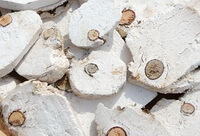 Characteristics of the Herb: Poria cum Radice Pini (Fu Shen) resembles ordinary Poria cocos in gross morphology but contains an embedded, slender, lignified pine root (Pinus massoniana or related species) running through its center. Commercial specimens are commonly cut into square slices. The texture is solid, firm, and slightly powdery. The embedded pine root appears brownish-yellow in cross-section, with visible annual growth rings. The herb is odorless or faintly aromatic and tasteless or mildly bland. High-grade Fu Shen features thick, compact slices with a fine, centrally located pine root.
