✵The article records the herb Fleece-flower Stem, including its English name, Latin name, Pinyin name, properties and flavor, botanical source—namely, the plant species Polygonum multiflorum Thunb.—and provides a detailed introduction to the botanical features, growth characteristics, and ecological environment of this species, as well as the macroscopic characteristics of the herb, its pharmacological actions, medicinal efficacy, and administration guidelines.
Caulis Polygoni Multiflori (Fleece-flower Stem)
Pinyin Name: Shǒu Wū Ténɡ
English Name: Fleece-flower Stem
Latin Name:Caulis Polygoni Multiflori Properties and Flavor: Neutral in nature; sweet and slightly bitter
Brief Introduction:Caulis Polygoni Multiflori is the dried twining stem of Polygonum multiflorum Thunb. It is used (1) as a heart-nourishing tranquilizer for treating insomnia and dream-disturbed sleep, and (2) to activate blood circulation in the collaterals for treating aching limbs. The herb is commonly known as Caulis Polygoni Multiflori, fleece-flower stem, or Shǒu Wū Téng.
Botanical Source: Classical herbal works define Caulis Polygoni Multiflori (Fleece-flower Stem) as the dried stem and vine of Polygonum multiflorum Thunb., a plant of the genus Fallopia, family Polygonaceae (smartweed or buckwheat family), order Caryophyllales. This widely used species is described below:
(1) Polygonum multiflorum Thunb.
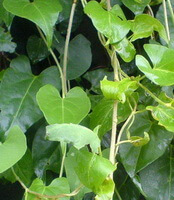
Botanical Description:Polygonum multiflorum Thunb. is a member of the Polygonaceae family and the genus Fallopia, also known as Fallopia multiflora (Thunb.) Haraldson. It is commonly referred to as Fo-Ti, Fleeceflower Root, Maltiflower Knotweed, Tuber Fleeceflower, Climbing Knotweed, Chinese Knotweed, Flowery Knotweed, He-Shou-Wu, Shǒu Wū, Hé Shǒu Wū, or Jiāo Téng. The plant is a perennial twining liana. Its roots are slender and elongated, with the root tip developing into a hypertrophied tuberous root; the tuber’s surface is russet (brunneus or reddish-brown) to dark brown. The basal portion of the stem is slightly lignified and hollow. Leaves are alternate, with long petioles; the ochrea (stipular sheath) is membranous and brown; leaf blades are narrowly ovate or cordate, 4–8 cm long and 2.5–5 cm wide; the apex is acuminate; the base is cordate or sagittate; margins are entire or slightly undulate; the upper surface is dark green (bottle-green), while the lower surface is pale green (aqua-green); both surfaces are smooth and glabrous.
Inflorescences are panicles. Flowers are pedicellate; each small pedicel bears nodes, and the base bears membranous bracts. Flowers are small; the perianth is greenish-white, 5-lobed, unequal in size; the outer three tepals bear conspicuous wings. There are eight stamens of unequal length, all shorter than the perianth; one pistil, with a 3-lobed, capitate stigma.
Achenes are elliptic, 3-ridged, black, shiny, and enclosed by the persistent perianth, which bears three prominent wings. The flowering period extends from August to October; the fruiting period is from September to November.
Ecological Environment:Polygonum multiflorum Thunb. grows in valley thickets, grassy slopes, along roadsides, and in rock crevices, at elevations of 200–3,000 meters above sea level. It is predominantly distributed in China.
Growth Characteristics:Polygonum multiflorum prefers warm, moist climates and is intolerant of drought and waterlogging. Cultivation is best carried out in fields with deep, loose, fertile, well-drained, humus-rich sandy loam soil. Heavy clay soils are unsuitable for cultivation.
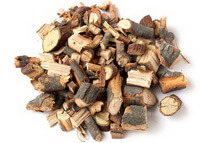
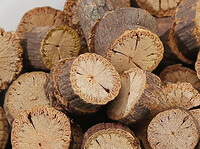
Characteristics of the Herb: The stems are long, cylindrical, slightly twisted, and branched, varying in length and measuring 3–7 mm in diameter. The surface is reddish-brown or tan (chocolate brown), coarse and rough, with prominent spirally twisted longitudinal wrinkles and fine, round lenticels. Nodes are slightly enlarged and bear branch scars. The cortex is thin and readily peelable. The herb is brittle and easily fractured; the fracture surface shows a reddish-brown cortex, a primrose-yellow (pale yellow) xylem with conspicuous vessel pores, and a white, spongy pith at the center. The cross-section is cylindrical. The herb is odorless and tastes slightly bitter and astringent.
Medicinal efficacy: Nourishes blood, calms the mind (relieving mental and physical restlessness), nourishes the heart, dispels wind, and unblocks the collaterals. It is indicated for insomnia and disturbed sleep (characterized by difficulty falling asleep, frequent dreaming), blood deficiency with body pain, rheumatic arthralgia, numbness of skin and muscle, pruritus, internal injury due to overexertion, spontaneous sweating and night sweats (hyperhidrosis), ulcers and sores, scrofula (cervical tuberculous lymphadenitis), urticaria (including pruritic urticarial papules), scabies, etc.
Administration of Caulis Polygoni Multiflori (Shǒu Wū Téng):
Reference:
Administration Guide for Caulis Polygoni Multiflori (Shǒu Wū Téng)
TCM Books:
(1) Internally: 9–15 grams; external use: appropriate amount, as a decoction for washing. (2) Internally: water decoction, 2–4 qián (≈6–12 grams); external use: decoction for washing, or mashed herb applied topically. (3) Internally: water decoction, 10–20 grams; external use: decoction for washing, or mashed herb applied topically.
References:
1.Introduction of Shou Wu Teng: Fleece-flower Stem

 ✵The article records the herb Fleece-flower Stem, including its English name, Latin name, Pinyin name, properties and flavor, botanical source—namely, the plant species Polygonum multiflorum Thunb.—and provides a detailed introduction to the botanical features, growth characteristics, and ecological environment of this species, as well as the macroscopic characteristics of the herb, its pharmacological actions, medicinal efficacy, and administration guidelines.
 Pinyin Name: Shǒu Wū Ténɡ
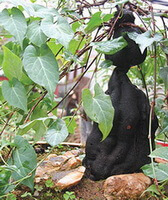 Botanical Description: Polygonum multiflorum Thunb. is a member of the Polygonaceae family and the genus Fallopia, also known as Fallopia multiflora (Thunb.) Haraldson. It is commonly referred to as Fo-Ti, Fleeceflower Root, Maltiflower Knotweed, Tuber Fleeceflower, Climbing Knotweed, Chinese Knotweed, Flowery Knotweed, He-Shou-Wu, Shǒu Wū, Hé Shǒu Wū, or Jiāo Téng. The plant is a perennial twining liana. Its roots are slender and elongated, with the root tip developing into a hypertrophied tuberous root; the tuber’s surface is russet (brunneus or reddish-brown) to dark brown. The basal portion of the stem is slightly lignified and hollow. Leaves are alternate, with long petioles; the ochrea (stipular sheath) is membranous and brown; leaf blades are narrowly ovate or cordate, 4–8 cm long and 2.5–5 cm wide; the apex is acuminate; the base is cordate or sagittate; margins are entire or slightly undulate; the upper surface is dark green (bottle-green), while the lower surface is pale green (aqua-green); both surfaces are smooth and glabrous.
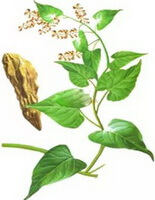 Inflorescences are panicles. Flowers are pedicellate; each small pedicel bears nodes, and the base bears membranous bracts. Flowers are small; the perianth is greenish-white, 5-lobed, unequal in size; the outer three tepals bear conspicuous wings. There are eight stamens of unequal length, all shorter than the perianth; one pistil, with a 3-lobed, capitate stigma.
 Achenes are elliptic, 3-ridged, black, shiny, and enclosed by the persistent perianth, which bears three prominent wings. The flowering period extends from August to October; the fruiting period is from September to November.
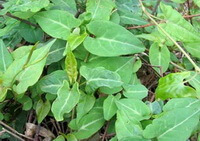 Ecological Environment: Polygonum multiflorum Thunb. grows in valley thickets, grassy slopes, along roadsides, and in rock crevices, at elevations of 200–3,000 meters above sea level. It is predominantly distributed in China.
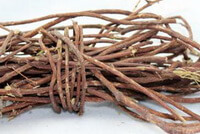 Characteristics of the Herb: The stems are long, cylindrical, slightly twisted, and branched, varying in length and measuring 3–7 mm in diameter. The surface is reddish-brown or tan (chocolate brown), coarse and rough, with prominent spirally twisted longitudinal wrinkles and fine, round lenticels. Nodes are slightly enlarged and bear branch scars. The cortex is thin and readily peelable. The herb is brittle and easily fractured; the fracture surface shows a reddish-brown cortex, a primrose-yellow (pale yellow) xylem with conspicuous vessel pores, and a white, spongy pith at the center. The cross-section is cylindrical. The herb is odorless and tastes slightly bitter and astringent.
 Pharmacological Actions: (1) Sedative effect; (2) Hypnotic action.
