Introduction of Jiang Huang, Pian Jiang Huang, and É Zhú: Turmeric
✵The article records the herb Turmeric—including its English name, Latin name, Pinyin name, properties and flavors, botanical sources—two primary plant species: (1) Curcuma longa L. and (2) Curcuma aromatica Salisb., and other usable plant species and varieties: (3) Curcuma wenyujin Y.H. Chen et C.Ling, (4) Curcuma kwangsiensis S.G. Lee et C.F. Liang, and (5) Curcuma aeruginosa Roxb.—with a detailed introduction to the botanical features, growth characteristics, and ecological environments of these five plant species; the macroscopic and microscopic characteristics of the herb Turmeric; its pharmacological actions, medicinal efficacy, and administration guidelines.
Rhizoma Curcumae Longae (Turmeric)
Pinyin Name: Jiānɡ Huánɡ
English Name: Turmeric
Latin Name:Rhizoma Curcumae Longae Properties and Flavor: Warm, pungent, bitter
Brief Introduction:Rhizoma Curcumae Longae is the steamed and dried rhizome of Curcuma longa L. It is used to activate blood circulation, promote Qi flow, unblock meridians, and relieve pain in conditions such as rheumatoid arthritis, dysmenorrhea, epigastric, abdominal, and costal pain, and traumatic injuries. It is commonly known as Rhizoma Curcumae Longae, Turmeric, or Jiānɡ Huánɡ.
Botanical Source: Herbal classical works define Rhizoma Curcumae Longae (Turmeric) as the dried rhizome of plants in the genus Curcuma (family Zingiberaceae, order Zingiberales), particularly (1) Curcuma longa L. Other classical works also include (2) Curcuma aromatica Salisb. as an acceptable source. However, according to official pharmacopoeial standards, the sole approved botanical source is the dried rhizome of Curcuma longa L. The following commonly used and related species are introduced:
(1) Curcuma longa L.
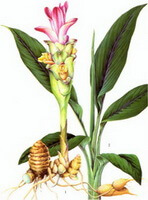
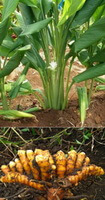
Botanical Description:Curcuma longa L. is a perennial herb of the Zingiberaceae family (ginger family) and the genus Curcuma. It is commonly known as turmeric or Jiānɡ Huánɡ. It grows up to 1–1.5 meters tall. Its rhizomes are well-developed and clustered; branch roots are elliptical or cylindrical, orange-yellow, and highly aromatic; roots are thick, with enlarged tuberous ends. Leaves are basal, 5–7 in number, arranged in two rows; petioles measure 20–45 cm; leaf blades are oblong or narrowly elliptic, 20–50 cm long and 5–15 cm wide; apex is acute to acuminate, base is cuneate and decurrent onto the petiole; upper surface is yellow-green, lower surface is pale green, both are glabrous.
Scapes emerge from the leaf sheaths; peduncles are 12–20 cm long; spikes are terete, 12–18 cm long; ananthous bracts on the upper part are pink or light reddish-purple, oblong-ovate, 4–6 cm long and 1–1.5 cm wide; floriferous bracts on the lower part are tender green or green-white, oval to orbicular, 3–4 cm long; calyx tube is green-white with three teeth; corolla tube is funnel-shaped, ~1.5 cm long, primrose yellow (pale yellow), densely pilose at the throat, with three lobes; one fertile stamen, filaments are short and flattened, anther is oblong with a basal calcar; ovary is inferior, externally villous; style is slender and elongated, with two bar-shaped glands at the base; stigma is slightly enlarged and somewhat labiate. Flowering occurs in August.
Ecological Environment:Curcuma longa L. grows wild or is cultivated in plains, meadows, or shrublands in mountainous regions.
Growth Characteristics:Curcuma longa prefers a warm, moist climate.
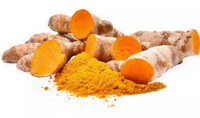
Characteristics of the Herb:Rhizoma Curcumae Longae is irregularly oval, cylindrical, or fusiform—often curved. Its surface is deep yellow and coarse, with wrinkled longitudinal veins and prominent nodes, circular branch scars, and fibrous root marks. The texture is firm and dense, not easily broken; the fracture surface is pale brown to golden-yellow, corneous, and exhibits a waxy luster. The endodermis displays conspicuous endodermal ring patterns, and vascular bundles are scattered as discrete dots. The herb has a distinctive fragrance and tastes bitter and pungent.
Pharmacological Actions: (1) lipid-lowering effects; (2) enhancement of fibrinolytic enzyme activity; (3) inhibition of platelet aggregation; (4) stimulation of bile secretion; (5) uterotonic effects.
Medicinal Efficacy: It breaks blood stasis, regulates Qi, promotes menstruation, and relieves pain. It is indicated for stabbing pain in the chest and hypochondrium, distension and pain in the epigastrium and abdomen, blood stasis with Qi stagnation, amenorrhea, dysmenorrhea, postpartum abdominal pain due to stasis, hypochondriac and abdominal pain, abdominal masses, arm pain, rheumatic arm pain, rheumatic arthralgia, carbuncles and swellings, traumatic injuries, and swelling and pain resulting from falls or trauma.
Administration of Rhizoma Curcumae Longae (Jiānɡ Huánɡ):
Reference:
Administration Guide for Rhizoma Curcumae Longae (Jiānɡ Huánɡ)
TCM Books:
(1) Internally: 3–9 grams; topical: appropriate amount. (2) Internally: water decoction, 1–3 qián (≈ 3–9 grams), or prepared into pills or powders; topical: finely ground herb powder, applied externally as a paste. (3) Internally: water decoction, 3–10 grams, or prepared into pills or powders; topical: appropriate amount, using finely ground herb powder applied externally as a paste.
Contraindications, Precautions, and Adverse Reactions: Rhizoma Curcumae Longae is contraindicated during pregnancy.
(2) Curcuma aromatica Salisb.
Botanical Description:Curcuma aromatica Salisb. is a perennial rhizomatous herb of the Zingiberaceae family (ginger family) and the genus Curcuma. It is commonly known as Curcuma aromatica or Yù Jīn. The plant grows up to approximately 1 meter tall. Its rhizome is succulent and hypertrophied, elliptic or oblong-ovate, yellow, and aromatic; root tips are enlarged into fusiform (spindle-shaped) tubers. Leaves are basal; leaf blades are oblong, 30–60 cm long and 10–20 cm wide; apex is finely caudate; base is attenuate; upper surface is glabrous; lower surface is pubescent; petioles are approximately equal in length to the leaf blades.
Scapes arise directly from the rhizome—either simultaneously with or prior to leaf emergence. Spikes are cylindrical, ~15 cm long and ~8 cm in diameter. Some floral bracts are pale green (pea-green), oval, 4–5 cm long. Ananthous bracts are narrow and oblong, white with a light red tinge, often bearing small apical points, and pilose; scales are sparsely pubescent, 0.8–1.5 cm long, with trilobed apices; corolla tube is funnel-shaped, 2.3–2.5 cm long, pilose at the throat; lobes are oblong (~1.5 cm long), white with pink hues—the posterior lobe is larger and bears a small apical point and pilosity; lateral staminodes are primrose yellow (pale yellow), obovate-oblong, ~1.5 cm long; labellum is yellow, obovate, 2.5 cm long, slightly bilobed at the apex; ovary is villous. Flowering occurs from April to June.
Ecological Environment:Curcuma aromatica Salisb. grows wild or is cultivated in forests or woodland areas.
Growth Characteristics:Curcuma aromatica Salisb. prefers a warm, humid climate with abundant sunshine and rainfall; it is sensitive to frost, cold, drought, and waterlogging.
Definitions and Differences: Official herbal classics define Curcuma aromatica as the dried tuberous roots of Curcuma wenyujin Y.H. Chen et C.L. Ling, Curcuma longa L., Curcuma kwangsiensis S.G. Lee et C.F. Liang, or Curcuma aeruginosa Roxb.
Another herb—Curcuma zedoaria (Zedoary or É Shū)—is defined in common herbal classics as the dried rhizomes of Curcuma wenyujin Y.H. Chen et C.L. Ling, Curcuma kwangsiensis S.G. Lee et C.F. Liang, or Curcuma aeruginosa Roxb.
Thus, Rhizoma Curcumae Longae is distinct from Curcuma aromatica, and Curcuma aromatica is also distinct from Curcuma zedoaria.
Main Varieties: Curcuma aromatica Salisb. has two main varieties recorded in China: (2.1) Curcuma wenyujin Y.H. Chen et C.L. Ling, (2.2) Curcuma kwangsiensis S.G. Lee et C.F. Liang, and (2.3) Curcuma aeruginosa Roxb.
(2.1) Curcuma wenyujin Y.H. Chen et C.L. Ling
Botanical Description:Curcuma wenyujin Y.H. Chen et C.L. Ling is a variety of Curcuma aromatica Salisb. It is commonly known as Wēn Yù Jīn. The tuberous root is long-oval, oval (egg-shaped), or spindle-shaped, 4–8 cm long and 2.5–4.5 cm in diameter. The apex is elongated; the base is acute or rounded. The surface is taupe-brown (grayish brown) to dark brown, rough, convex on the upper part, with sunken root scars at the base; bud scars and lateral root scars are inconspicuous. Knife marks are evident, and the tissue is heavily crushed. The transverse section is yellowish-brown or yellow-gray, corneous, spotted, or exhibits striped vascular bundles.
Ecological Environment:Curcuma wenyujin Y.H. Chen et C.L. Ling grows wild or is cultivated in sunny or moist fields and along ditch margins.
(2.2) Curcuma kwangsiensis S.G. Lee et C.F. Liang
Botanical Description:Curcuma kwangsiensis S.G. Lee et C.F. Liang is a variety of Curcuma aromatica Salisb. It is commonly known as Guǎng Xī É Shū. The rhizome is ovoid, 4–5 cm long and 2.5–3.5 cm in diameter, bearing more or less striated nodes covered with brownish, membranous leaf sheaths; fresh material is white or light yellow. Rootlets are slender and adventitious, often swelling near the tips into nearly fusiform (spindle-shaped) tubers; root diameter is 1.4–1.8 cm, with a creamy-white (milky-white) interior. Leaves emerge in spring; they are basal and 2–5-foliolate, erect; leaf blades are elliptic-lanceolate, 14–39 cm long and 4.5–9.5 cm wide; apex is shortly acuminate to acuminate; tip is pointed, directed ventrally; base is attenuate and decurrent; both surfaces are pubescent; ligule is ~1.5 mm high with a villous margin; petioles are 2–11 cm long and pubescent; leaf sheaths are 11–33 cm long and pubescent.
Inflorescences arise directly from the rhizomes, separate from the vegetative stems bearing leaves; peduncles are 7–14 cm long; spikes are ~15 cm long and ~7 cm in diameter. Bracts below the inflorescence are broadly ovate, ~4 cm long, with a flattened apex and pale-green coloration; upper bracts are oblong and oblique, pale red; calyx is white, ~1 cm long, split unilaterally to the middle, with three blunt apical teeth; corolla tube is ~2 cm long, tubular (trumpet-shaped), densely villous at the throat; three corolla lobes are ovate, ~1 cm long—the posterior lobe is broader (~9 mm), apically pointed and slightly saccate, with lateral margins slightly narrowed; lateral staminodes are oblong and nearly equal in length to the corolla lobes; labellum is suborbicular and yellowish, apically shallowly trilobed—the middle lobe is slightly longer and bilobed at the apex; filaments are broadly flattened; anthers are narrowly oblong, ~4 mm long, with closed thecae and a spaced base; style is filiform (thread-like) and glabrous; stigma is capitate and ciliate; ovary is villous. Flowering occurs from May to July.
Ecological Environment:Curcuma kwangsiensis S.G. Lee et C.F. Liang grows in sunny, moist habitats with deep, fertile soil—such as ditches, forest margins, hillsides, grasslands, and shrublands—at altitudes above 700 m.
Growth Characteristics:Curcuma kwangsiensis S.G. Lee et C.F. Liang prefers warm, humid environments and exhibits moderate drought tolerance. Leaves senesce in winter under low temperatures; new leaves emerge in spring.
Characteristics of the Herb: The tuberous root is oblong-conical or subglobose, 2–6.5 cm long and 1–1.8 cm in diameter. The surface is dark brown or khaki, bearing fine longitudinal striations and a rough reticulate texture. The texture is hard. The transverse section is cutinized, taupe-brown (grayish brown) to brown, with a conspicuous endodermal ring. The herb has a mild aroma and tastes slightly pungent and bitter.
(2.3) Curcuma aeruginosa Roxb.
Botanical Description:Curcuma aeruginosa Roxb. is a variety of Curcuma aromatica Salisb. It is commonly known as È Zhú. It is a perennial herb, glabrous throughout. Leaves are elliptic-oblong to oblong-lanceolate, 25–60 cm long and 10–15 cm wide, often purple in the central region; petioles exceed the leaf blade in length. Scapes arise directly from the rhizomes—leaves typically emerge before the inflorescence; spikes are ~15 cm long; bracts are numerous—green at the base, purple-tipped; calyx is white, apically trilobed; corolla is yellow, trilobed and unequal; lateral staminodes are small; yellow lobes arise apically. The inflorescence bears a triangular, wolf-shaped appearance. Flowering occurs from March to May.
The rhizome is conical, with a pointed upper end and a rounded base, 2–6 cm long and 2–3 cm in diameter. The surface is light yellow, slightly wrinkled, and bears distinct nodes. The cross-section shows scale-like petiole remnants and dot-like root scars. The texture is firm; the cross-section is yellowish green with a circular endodermal ring. The odor is slightly fragrant, and the taste is bitter and pungent. Dry rhizomes are oval (egg-shaped) or fusiform (spindle-shaped), solid and heavy, extremely difficult to break, with a brown-to-yellowish green, horny, lustrous fracture surface, a yellow-white ring, and white vascular bundles. They are slightly aromatic, with a mildly bitter and pungent taste. High-quality herb material is uniform, solid, and exhibits a taupe-brown cross-section.
Ecological Environment:Curcuma aeruginosa Roxb. grows in shaded habitats such as valleys, along streams, and in forests.
Characteristics of the Herb: Tubers are oblong and stout, 1.5–3.5 cm long and 1–1.2 cm in diameter, grayish in color and wrinkled. The herb is hard in texture, slightly grayish brown, with a conspicuous endodermis. It has a faint odor and a mild taste.
Pinyin Name: Piàn Jiāng Huáng
English Name: Wenyujin Concise Rhizome
Latin Name:Rhizoma Wenyujin concisa Property and Flavor: Warm, pungent, bitter
Brief Introduction:Rhizoma Wenyujin concisa is the dried rhizome of Curcuma wenyujin Y. H. Chen et C. L. Ling, used to resolve blood stasis and alleviate pain in conditions such as dysmenorrhea, rheumatoid arthralgia, shoulder pain, and traumatic injuries. It is commonly known as Rhizoma Wenyujin concisa, Wenyujin Concise Rhizome, or Piàn Jiāng Huáng.
Botanical Source: Official herbal classics define Rhizoma Wenyujin concisa (Wenyujin Concise Rhizome) as the dried rhizome of (1) Curcuma wenyujin Y. H. Chen et C. L. Ling—a plant of the genus Curcuma L., family Zingiberaceae (ginger family), order Zingiberales. This commonly used species is described in the entry “Radix Curcumae (Turmeric Root Tuber)”.
Characteristics of the Herb: The herb consists of oblong or irregularly shaped slices, varying in size: 3–6 cm long, 1–3 cm wide, and 0.1–0.4 cm thick. The cortex is grayish yellow, coarse, and shriveled; nodes and fibrous root scars are sometimes visible. The cross-section ranges from yellowish white to brownish yellow, featuring a circular vascular ring and numerous small vascular bundles. The texture is firm and crisp. The fracture surface is off-white (grayish white) to brownish yellow and slightly powdery. The herb possesses a distinctive fragrance and tastes slightly bitter, pungent, and cooling.
Medicinal Efficacy: Breaks blood stasis, promotes Qi circulation, regulates menstruation, and relieves pain. It is indicated for amenorrhea due to blood stasis, menstrual abdominal pain, stabbing pain in the chest and hypochondrium, rheumatic arthralgia, shoulder and arm pain, and trauma from falls.
Administration of Rhizoma Wenyujin concisa (Piàn Jiāng Huáng):
Reference:
Administration Guide for Rhizoma Wenyujin concisa (Piàn Jiāng Huáng)
TCM Books:
(1) Internally: 3–9 grams.
Contraindications, Precautions, and Adverse Reactions: Rhizoma Wenyujin concisa should be used with caution during pregnancy.
Rhizoma Curcumae (Zedoary Rhizome)
Pinyin Name: É Zhú
English Name: Zedoary Rhizome
Latin Name:Rhizoma Curcumae Property and Flavor: Warm, pungent, bitter
Brief Introduction:Rhizoma Curcumae is the steamed and dried rhizome of Curcuma zedoaria Roxb., Curcuma phaeocaulis Valeton, Curcuma kwangsiensis S. G. Lee et C. F. Liang, or Curcuma wenyujin Y. H. Chen et C. L. Ling. It is used to relieve pain caused by food retention, activate blood circulation, and resolve blood stasis—particularly for treating abdominal masses and amenorrhea—and has been employed as an anticancer agent, especially against cervical cancer of the uterus. The herb is commonly known as Rhizoma Curcumae, Zedoary Rhizome, or É Zhú.
Botanical Source: Official herbal classics define Rhizoma Curcumae (Zedoary Rhizome) as the dried rhizome of (1) Curcuma phaeocaulis Valeton, (2) Curcuma kwangsiensis S. G. Lee et C. F. Liang, or (3) Curcuma wenyujin Y. H. Chen et C. L. Ling. Other authoritative herbal classics also include (4) Curcuma aeruginosa Roxb. These are plants of the genus Curcuma L., family Zingiberaceae (ginger family), order Zingiberales. These commonly used species are described in the entries “Radix Curcumae (Turmeric Root Tuber)” and “Rhizoma Curcumae Longae (Turmeric)”.
Characteristics of the Herb: The rhizome is orbicular (nearly circular), oval, or oblong, with multiple blunt apices at the upper end and a rounded base; it measures 2–5 cm in length and 1.5–2.5 cm in diameter. The surface is khaki to sallow (grayish yellow); nodes on the upper portion are conspicuous, and there is a row of sunken bud scars and round lateral root scars on both sides. The rhizome is heavy, firm, and solid in texture; the fracture surface is dark greenish yellow to brown and often dusted with brown powder. The cortex separates readily from the stele. The herb has a slight fragrance and tastes slightly bitter and pungent.
Pharmacological Actions: (1) Antitumor effect; (2) Anti-early pregnancy effect; (3) Antibacterial effect; (4) Leukogenic effect; (5) Cardiovascular effect; (6) Relaxant or contractile effect on intestinal smooth muscle; (7) Hepatoprotective effect; (8) Effect on acute renal failure; (9) Inhibition of platelet aggregation and antithrombotic effect; (10) Anti-inflammatory effect, etc.
Medicinal Efficacy: Promotes Qi circulation and breaks blood stasis; alleviates Qi stagnation and relieves pain. It is indicated for abdominal masses, abdominal distension and palpable lumps, blood stasis-induced amenorrhea and dysmenorrhea, chest tightness and pain, chest pain, food retention (dietary stagnation), indigestion with distending pain, abdominal distension and pain, epigastric and abdominal distension-pain, chest pain due to Qi and blood stagnation, blood stasis with abdominal pain, hepatosplenomegaly (enlargement of liver and spleen), amenorrhea with blood stasis, dysmenorrhea (abdominal pain during menstruation), and traumatic injury pain.
Administration of Rhizoma Curcumae (É Zhú):
Reference:
Administration Guide for Rhizoma Curcumae (É Zhú)
TCM Books:
(1) Internally: 6–9 grams; (2) Internally: water decoction, 1.5–3 qian (≈ 4.5–9 grams), or prepared as pills or powders; (3) Internally: water decoction, 3–10 grams, or prepared as pills or powders. External use: appropriate amount—wash with decoction or apply finely powdered herb topically. Raw herb is preferred for promoting Qi circulation and relieving pain; vinegar-fried herb is preferred for breaking blood stasis and resolving stagnation.
Contraindications, Precautions, and Adverse Reactions: Rhizoma Curcumae is contraindicated during pregnancy and should be avoided in cases of menorrhagia, advanced menstruation, or blood-heat syndromes. Prolonged use is not recommended.
References:
1.Introduction of Jiang Huang, Pian Jiang Huang, and É Zhú: Turmeric

 ✵The article records the herb Turmeric—including its English name, Latin name, Pinyin name, properties and flavors, botanical sources—two primary plant species: (1) Curcuma longa L. and (2) Curcuma aromatica Salisb., and other usable plant species and varieties: (3) Curcuma wenyujin Y.H. Chen et C.Ling, (4) Curcuma kwangsiensis S.G. Lee et C.F. Liang, and (5) Curcuma aeruginosa Roxb.—with a detailed introduction to the botanical features, growth characteristics, and ecological environments of these five plant species; the macroscopic and microscopic characteristics of the herb Turmeric; its pharmacological actions, medicinal efficacy, and administration guidelines.
 Pinyin Name: Jiānɡ Huánɡ
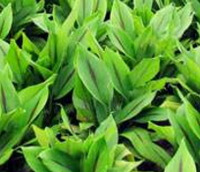
 Botanical Description: Curcuma longa L. is a perennial herb of the Zingiberaceae family (ginger family) and the genus Curcuma. It is commonly known as turmeric or Jiānɡ Huánɡ. It grows up to 1–1.5 meters tall. Its rhizomes are well-developed and clustered; branch roots are elliptical or cylindrical, orange-yellow, and highly aromatic; roots are thick, with enlarged tuberous ends. Leaves are basal, 5–7 in number, arranged in two rows; petioles measure 20–45 cm; leaf blades are oblong or narrowly elliptic, 20–50 cm long and 5–15 cm wide; apex is acute to acuminate, base is cuneate and decurrent onto the petiole; upper surface is yellow-green, lower surface is pale green, both are glabrous.
 Ecological Environment: Curcuma longa L. grows wild or is cultivated in plains, meadows, or shrublands in mountainous regions.
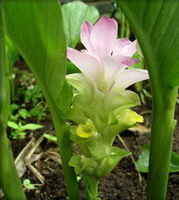 Botanical Description: Curcuma aromatica Salisb. is a perennial rhizomatous herb of the Zingiberaceae family (ginger family) and the genus Curcuma. It is commonly known as Curcuma aromatica or Yù Jīn. The plant grows up to approximately 1 meter tall. Its rhizome is succulent and hypertrophied, elliptic or oblong-ovate, yellow, and aromatic; root tips are enlarged into fusiform (spindle-shaped) tubers. Leaves are basal; leaf blades are oblong, 30–60 cm long and 10–20 cm wide; apex is finely caudate; base is attenuate; upper surface is glabrous; lower surface is pubescent; petioles are approximately equal in length to the leaf blades.
 Scapes arise directly from the rhizome—either simultaneously with or prior to leaf emergence. Spikes are cylindrical, ~15 cm long and ~8 cm in diameter. Some floral bracts are pale green (pea-green), oval, 4–5 cm long. Ananthous bracts are narrow and oblong, white with a light red tinge, often bearing small apical points, and pilose; scales are sparsely pubescent, 0.8–1.5 cm long, with trilobed apices; corolla tube is funnel-shaped, 2.3–2.5 cm long, pilose at the throat; lobes are oblong (~1.5 cm long), white with pink hues—the posterior lobe is larger and bears a small apical point and pilosity; lateral staminodes are primrose yellow (pale yellow), obovate-oblong, ~1.5 cm long; labellum is yellow, obovate, 2.5 cm long, slightly bilobed at the apex; ovary is villous. Flowering occurs from April to June.
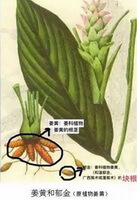 Definitions and Differences: Official herbal classics define Curcuma aromatica as the dried tuberous roots of Curcuma wenyujin Y.H. Chen et C.L. Ling, Curcuma longa L., Curcuma kwangsiensis S.G. Lee et C.F. Liang, or Curcuma aeruginosa Roxb.
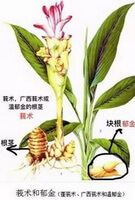 Main Varieties: Curcuma aromatica Salisb. has two main varieties recorded in China: (2.1) Curcuma wenyujin Y.H. Chen et C.L. Ling, (2.2) Curcuma kwangsiensis S.G. Lee et C.F. Liang, and (2.3) Curcuma aeruginosa Roxb.
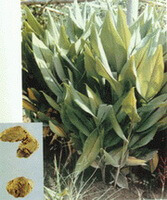 Botanical Description: Curcuma kwangsiensis S.G. Lee et C.F. Liang is a variety of Curcuma aromatica Salisb. It is commonly known as Guǎng Xī É Shū. The rhizome is ovoid, 4–5 cm long and 2.5–3.5 cm in diameter, bearing more or less striated nodes covered with brownish, membranous leaf sheaths; fresh material is white or light yellow. Rootlets are slender and adventitious, often swelling near the tips into nearly fusiform (spindle-shaped) tubers; root diameter is 1.4–1.8 cm, with a creamy-white (milky-white) interior. Leaves emerge in spring; they are basal and 2–5-foliolate, erect; leaf blades are elliptic-lanceolate, 14–39 cm long and 4.5–9.5 cm wide; apex is shortly acuminate to acuminate; tip is pointed, directed ventrally; base is attenuate and decurrent; both surfaces are pubescent; ligule is ~1.5 mm high with a villous margin; petioles are 2–11 cm long and pubescent; leaf sheaths are 11–33 cm long and pubescent.
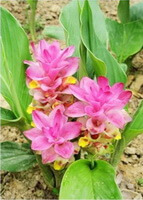 Ecological Environment: Curcuma kwangsiensis S.G. Lee et C.F. Liang grows in sunny, moist habitats with deep, fertile soil—such as ditches, forest margins, hillsides, grasslands, and shrublands—at altitudes above 700 m.
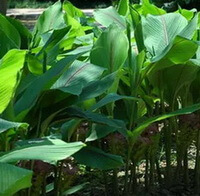 Botanical Description: Curcuma aeruginosa Roxb. is a variety of Curcuma aromatica Salisb. It is commonly known as È Zhú. It is a perennial herb, glabrous throughout. Leaves are elliptic-oblong to oblong-lanceolate, 25–60 cm long and 10–15 cm wide, often purple in the central region; petioles exceed the leaf blade in length. Scapes arise directly from the rhizomes—leaves typically emerge before the inflorescence; spikes are ~15 cm long; bracts are numerous—green at the base, purple-tipped; calyx is white, apically trilobed; corolla is yellow, trilobed and unequal; lateral staminodes are small; yellow lobes arise apically. The inflorescence bears a triangular, wolf-shaped appearance. Flowering occurs from March to May.
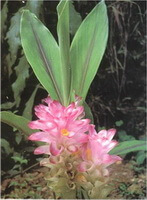 The rhizome is conical, with a pointed upper end and a rounded base, 2–6 cm long and 2–3 cm in diameter. The surface is light yellow, slightly wrinkled, and bears distinct nodes. The cross-section shows scale-like petiole remnants and dot-like root scars. The texture is firm; the cross-section is yellowish green with a circular endodermal ring. The odor is slightly fragrant, and the taste is bitter and pungent. Dry rhizomes are oval (egg-shaped) or fusiform (spindle-shaped), solid and heavy, extremely difficult to break, with a brown-to-yellowish green, horny, lustrous fracture surface, a yellow-white ring, and white vascular bundles. They are slightly aromatic, with a mildly bitter and pungent taste. High-quality herb material is uniform, solid, and exhibits a taupe-brown cross-section.
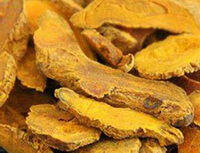 Pinyin Name: Piàn Jiāng Huáng
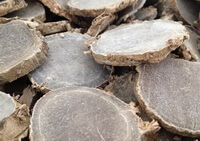 Pinyin Name: É Zhú
