✵This article records the herb Roof Stonecrop, including its English name, Latin name, Pinyin name, properties and flavor, and its botanical sources as defined in classical herbal texts. The primary species is (1) Orostachys fimbriatus (Turcz.) Berger.; three additional usable species are (2) Orostachys erubescens (Maxim.) Ohwi., (3) Orostachys malacophyllus (Pall.) Fisch., and (4) Orostachys spinosus (L.) C. A. Mey. Detailed descriptions are provided for the botanical features, growth characteristics, and ecological environments of these four species, as well as for the macroscopic features of the herb Roof Stonecrop, its pharmacological actions, medicinal efficacy, and administration guidelines.
Herba Orostachyos (Roof Stonecrop)
Pinyin Name: Wǎ Sōnɡ
English Name: Roof Stonecrop
Latin Name:Herba Orostachyos Properties and Flavor: Sour and bitter, cool, toxic
Brief Introduction:Herba Orostachyos is the dried aerial part of Orostachys fimbriatus (Turcz.) Berger., used primarily as a hemostatic agent for treating hematochezia and hematemesis, and externally for skin ulcers. It is commonly known as Herba Orostachyos, Roof Stonecrop, or Wǎ Sōnɡ.
Botanical source: Classical herbal works and other authoritative herbal compendia define Herba Orostachyos (Roof Stonecrop) as the dried aerial part of the following species: (1) Orostachys fimbriatus (Turcz.) Berger., (2) Orostachys erubescens (Maxim.) Ohwi., (3) Orostachys malacophyllus (Pall.) Fisch., and (4) Orostachys spinosus (L.) C. A. Mey. These belong to the genus Orostachys Fisch. in the family Crassulaceae (stonecrop family), order Rosales. All four commonly used species are described below.
(1) Orostachys fimbriatus (Turcz.) Berger.
Botanical Description:Orostachys fimbriatus (Turcz.) Berger is also known as Cotyledon fimbriata Turcz. and Sedum fimbriatum (Turcz.) Franch. var. genuinum Frod. It is commonly known as Wǎ Sōnɡ. A biennial or perennial herb, it grows up to 10–40 cm tall. The plant is pinkish-green, glabrous, with dense pruinose (violet-red) spots. Roots are fibrous and extensively branched. The stem is erect and unbranched. Basal leaves form a rosette; they are succulent, spatulate-linear to oblanceolate, 2–4 cm long and 4–5 mm wide, greenish-purple or pruinose (covered with a whitish bloom), with pinnatifid (fringelike or fimbriate) margins; the apex bears a semicircular cartilaginous appendage, and the center bears a single acicular spine. Cauline leaves are alternate, sessile, linear to lanceolate, 2–3 cm long and 2–5 mm wide; the apex is long-acuminate, and the margin is entire.
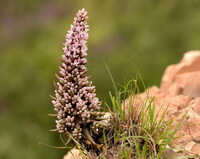
Inflorescence: Racemes are compact; lower branches form spicate clusters. Flowers are small and hermaphroditic. Bracts are linear-acuminate and leaf-like. There are 5 sepals, oblong, 1–3 mm long; 5 petals, faintly red, lanceolate-elliptic, 5–6 mm long, slightly connate at the base; 10 stamens in two whorls, equal in length to the petals or slightly shorter, with purple anthers; and 5 free carpels, each bearing a nearly quadrate (square) basal scale.
Fruit: Follicles are oblong, ~5 mm long, with a slender rostrum (beak) ~1 mm long. Seeds are numerous, minute, and ovoid (egg-shaped). Flowering occurs from August to September; fruiting occurs from September to November.
Ecological Environment: The plant grows on rocky substrates—such as stones and rock crevices on hillsides or mountain slopes—and occasionally on roof tiles.
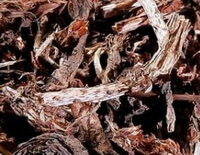
Characteristics of the Herb: The stem is thin and cylindrical, yellowish-brown or dark tan (chocolate brown), 12–20 cm long (occasionally 5–27 cm), and 2–6 mm in diameter. Leaf scars remain after most leaves abscise, forming interconnected, prismatic patterns. Leaves are celadon (sage green) or yellowish-brown; many have fallen off, leaving shriveled, curled remnants 12–15 mm long and ~3 mm wide. Flowerets (florets) arise from the axils of cauline leaves on the upper stem; they are reddish-brown (brunneus), grow on pedicels of variable length. The herb is light, crisp, and brittle. It has a slight odor and a sour taste.
Medicinal efficacy: Clears heat and detoxifies, cools the blood, stops bleeding (to arrest bleeding), resolves dampness via diuresis, reduces swelling, softens and disperses nodules, and promotes ulcer healing. It is indicated for hematemesis (spitting blood), epistaxis (nasal bleeding or bleeding from orifices/subcutaneous tissue), hematochezia (passing blood in stool), bloody stranguria (stranguria with hematuria), hepatitis, malaria, heat-induced stranguria, irregular menstruation, hemorrhoids, furuncles, carbuncles, eczema, ulcers, scalds and burns (from hot liquids or fire), pneumonia, cervical erosion, and chyluria.
Administration of Herba Orostachyos (Wǎ Sōnɡ):
Reference:
Administration Guide of Herba Orostachyos (Wǎ Sōnɡ)
TCM Books:
(1) Internally: 3–9 grams. External use: appropriate amount—powdered herb applied topically. (2) Internally: water decoction, 1–3 qian (~3–9 grams), fresh juice extraction, or prepared into pills. External use: mashed fresh herb applied topically; fumigation wash using water decoction; or charred herb (with properties preserved), finely powdered and applied topically. (2) Internally: water decoction, 5–15 grams, fresh juice extraction, or prepared into pills. External use: appropriate amount—mashed herb applied topically; fumigation wash using water decoction; or powdered herb applied topically.
(2) Orostachys erubescens (Maxim.) Ohwi.
Botanical Description:Orostachys erubescens (Maxim.) Ohwi is also known as Umbilicus erubescens Maxim. or Sedum erubescens (Maxim.) Ohwi. It is commonly known as Wǎn Hóng Wǎ Sōnɡ. A biennial herb. In the first year, only a rosette of leaves develops: succulent, narrowly spatulate or lanceolate, 1.5–3 cm long and 4–7 mm wide; the apex is long-acuminate and slightly curved, bearing cartilaginous spines; margins are entire or undulate. In the second year, scapes (flower stalks) emerge from the rosette, 10–40 cm tall and erect. The entire plant is covered with a whitish pruinosity and densely dotted with reddish-brown glandular points. Cauline leaves are linear to linear-lanceolate, 2–6 cm long and 3–7 mm wide; the apex is long-acuminate, and red spots appear upon drying.
Racemes are conical; flowers are dense; leafy bracts grow between inflorescence branches, ovate-lanceolate or falcate; 5 sepals (calyx lobes), ~4 mm long; 5 petals, white or faintly red, linear-lanceolate, 4–6 mm long and 1.8 mm wide; 10 stamens in two whorls, slightly shorter than the petals, with dark purple anthers; 5 scales, nearly quadrate, with emarginate (slightly concave) apices; 5 carpels, erect, free, with abruptly narrowed bases; styles are slender, ~2 mm long.
Follicles are ~5 mm long. Seeds are ~1 mm long and brown. Flowering occurs from August to September; fruiting occurs from September to November.
Ecological Environment: The plant grows on rocky substrates of low hills or along gullies.
(3) Orostachys malacophyllus (Pall.) Fisch.
Botanical Description:Orostachys malacophyllus (Pall.) Fisch. is also known as Cotyledon malacophylla Pall. or Sedum malacophyllum (Pall.) Stend. It is commonly known as Dùn Yè Wǎ Sōnɡ. A biennial herb. In the first year, the plant forms a rosette with densely arranged leaves that are oblong-lanceolate, obovate, or elliptic, 2–4 cm long and 1.5–2 cm wide; the apex is obtuse or shortly acuminate, non-spiny, and entire, densely covered with dark red spots. In the second year, scapes (flower stalks) emerge from the rosette—unbranched and 10–30 cm tall; cauline leaves are alternate and larger than the rosette leaves, up to 7 cm long.
The inflorescence is racemose, sometimes spicate (spiciform); flowers are dense. Bracts are spatulate-ovate. There are 5 sepals, oblong, 3–4 mm long and acutely pointed; 5 petals, white or greenish, ovate-oblong, 4–6 mm long; 10 stamens in two whorls, longer than the petals; 5 scales, linear-rectangular, ~0.3 mm long, with emarginate (slightly concave) apices; and 5 free carpels, ovoid (egg-shaped), with styles ~1 mm long.
Follicles are ellipsoidal. Seeds are numerous, minute, ovate-oblong, and longitudinally striated. Flowering occurs in July; fruiting occurs from August to September.
Ecological Environment: The plant grows in rock crevices at altitudes of 1,200–1,800 m above sea level.
(4) Orostachys spinosus (L.) C. A. Mey.
Botanical Description:Orostachys spinosus (L.) C. A. Mey. is also known as Cotyledon spinosa L. or Sedum spinosum (L.) Thunb. It is commonly known as Huáng Huā Wǎ Sōnɡ or Cì Yè Wǎ Sōnɡ. A biennial herb. In the first year, the plant forms a rosette with densely arranged oblong leaves bearing a semicircular white cartilaginous appendage at the apex and a central spine 2–4 mm long. In the second year, scapes (flower stalks) emerge from the rosette, reaching 10–30 cm in height. Cauline leaves are alternate, sessile, broadly linear to oblanceolate, 1–3 cm long and 2–5 mm wide; the apex is acuminate, spinose, and bears cartilaginous spines.
Inflorescences are spicate (spiciform) or racemose, terminal, 5–20 cm long; pedicels are ~1 mm long or absent (sessile); bracts are lanceolate to oblong, up to 4 mm long, with acuminate, spinose apices; 5 sepals, ovate-oblong, 2–3 mm long, with spinose apices and reddish spotting; 5 petals, yellowish-green, ovate-lanceolate, 5–7 mm long and 1.5 mm wide; 10 stamens, slightly longer than the petals; 5 scales, subquadrate (nearly square), ~0.7 mm long, with emarginate (slightly concave) apices; and 5 free carpels, lanceolate.
Follicles are elliptic-lanceolate, 5–6 mm long, with a marginal length of ~1.5 mm. Seeds are oblong-ovate. Flowering occurs from July to August; fruiting occurs in September.
Ecological Environment: The plant grows in rock crevices on dry hillsides, on stone cliffs along riverbanks, and in sandy grasslands.

 ✵This article records the herb Roof Stonecrop, including its English name, Latin name, Pinyin name, properties and flavor, and its botanical sources as defined in classical herbal texts. The primary species is (1) Orostachys fimbriatus (Turcz.) Berger.; three additional usable species are (2) Orostachys erubescens (Maxim.) Ohwi., (3) Orostachys malacophyllus (Pall.) Fisch., and (4) Orostachys spinosus (L.) C. A. Mey. Detailed descriptions are provided for the botanical features, growth characteristics, and ecological environments of these four species, as well as for the macroscopic features of the herb Roof Stonecrop, its pharmacological actions, medicinal efficacy, and administration guidelines.
 Pinyin Name: Wǎ Sōnɡ
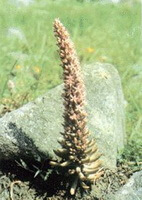 Botanical Description: Orostachys fimbriatus (Turcz.) Berger is also known as Cotyledon fimbriata Turcz. and Sedum fimbriatum (Turcz.) Franch. var. genuinum Frod. It is commonly known as Wǎ Sōnɡ. A biennial or perennial herb, it grows up to 10–40 cm tall. The plant is pinkish-green, glabrous, with dense pruinose (violet-red) spots. Roots are fibrous and extensively branched. The stem is erect and unbranched. Basal leaves form a rosette; they are succulent, spatulate-linear to oblanceolate, 2–4 cm long and 4–5 mm wide, greenish-purple or pruinose (covered with a whitish bloom), with pinnatifid (fringelike or fimbriate) margins; the apex bears a semicircular cartilaginous appendage, and the center bears a single acicular spine. Cauline leaves are alternate, sessile, linear to lanceolate, 2–3 cm long and 2–5 mm wide; the apex is long-acuminate, and the margin is entire.
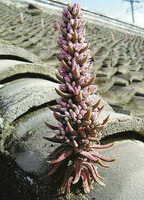 Inflorescence: Racemes are compact; lower branches form spicate clusters. Flowers are small and hermaphroditic. Bracts are linear-acuminate and leaf-like. There are 5 sepals, oblong, 1–3 mm long; 5 petals, faintly red, lanceolate-elliptic, 5–6 mm long, slightly connate at the base; 10 stamens in two whorls, equal in length to the petals or slightly shorter, with purple anthers; and 5 free carpels, each bearing a nearly quadrate (square) basal scale.
 Characteristics of the Herb: The stem is thin and cylindrical, yellowish-brown or dark tan (chocolate brown), 12–20 cm long (occasionally 5–27 cm), and 2–6 mm in diameter. Leaf scars remain after most leaves abscise, forming interconnected, prismatic patterns. Leaves are celadon (sage green) or yellowish-brown; many have fallen off, leaving shriveled, curled remnants 12–15 mm long and ~3 mm wide. Flowerets (florets) arise from the axils of cauline leaves on the upper stem; they are reddish-brown (brunneus), grow on pedicels of variable length. The herb is light, crisp, and brittle. It has a slight odor and a sour taste.
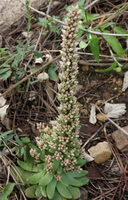 Botanical Description: Orostachys erubescens (Maxim.) Ohwi is also known as Umbilicus erubescens Maxim. or Sedum erubescens (Maxim.) Ohwi. It is commonly known as Wǎn Hóng Wǎ Sōnɡ. A biennial herb. In the first year, only a rosette of leaves develops: succulent, narrowly spatulate or lanceolate, 1.5–3 cm long and 4–7 mm wide; the apex is long-acuminate and slightly curved, bearing cartilaginous spines; margins are entire or undulate. In the second year, scapes (flower stalks) emerge from the rosette, 10–40 cm tall and erect. The entire plant is covered with a whitish pruinosity and densely dotted with reddish-brown glandular points. Cauline leaves are linear to linear-lanceolate, 2–6 cm long and 3–7 mm wide; the apex is long-acuminate, and red spots appear upon drying.
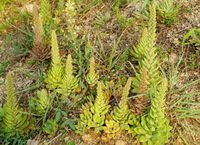 Follicles are ~5 mm long. Seeds are ~1 mm long and brown. Flowering occurs from August to September; fruiting occurs from September to November.
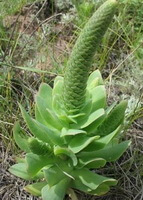 Botanical Description: Orostachys malacophyllus (Pall.) Fisch. is also known as Cotyledon malacophylla Pall. or Sedum malacophyllum (Pall.) Stend. It is commonly known as Dùn Yè Wǎ Sōnɡ. A biennial herb. In the first year, the plant forms a rosette with densely arranged leaves that are oblong-lanceolate, obovate, or elliptic, 2–4 cm long and 1.5–2 cm wide; the apex is obtuse or shortly acuminate, non-spiny, and entire, densely covered with dark red spots. In the second year, scapes (flower stalks) emerge from the rosette—unbranched and 10–30 cm tall; cauline leaves are alternate and larger than the rosette leaves, up to 7 cm long.
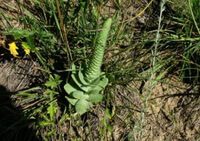 Follicles are ellipsoidal. Seeds are numerous, minute, ovate-oblong, and longitudinally striated. Flowering occurs in July; fruiting occurs from August to September.
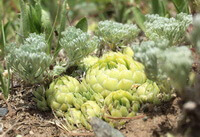 Botanical Description: Orostachys spinosus (L.) C. A. Mey. is also known as Cotyledon spinosa L. or Sedum spinosum (L.) Thunb. It is commonly known as Huáng Huā Wǎ Sōnɡ or Cì Yè Wǎ Sōnɡ. A biennial herb. In the first year, the plant forms a rosette with densely arranged oblong leaves bearing a semicircular white cartilaginous appendage at the apex and a central spine 2–4 mm long. In the second year, scapes (flower stalks) emerge from the rosette, reaching 10–30 cm in height. Cauline leaves are alternate, sessile, broadly linear to oblanceolate, 1–3 cm long and 2–5 mm wide; the apex is acuminate, spinose, and bears cartilaginous spines.
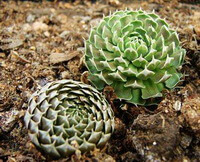 Follicles are elliptic-lanceolate, 5–6 mm long, with a marginal length of ~1.5 mm. Seeds are oblong-ovate. Flowering occurs from July to August; fruiting occurs in September.
